
www.aero-defence.tech
06
'26
Written on Modified on
Orbital Mechanics Simulation Using Standalone Virtual Reality
HOLOGATE developed an interactive virtual reality application enabling German Armed Forces personnel to simulate orbital mechanics and satellite paths.
hgxr.com
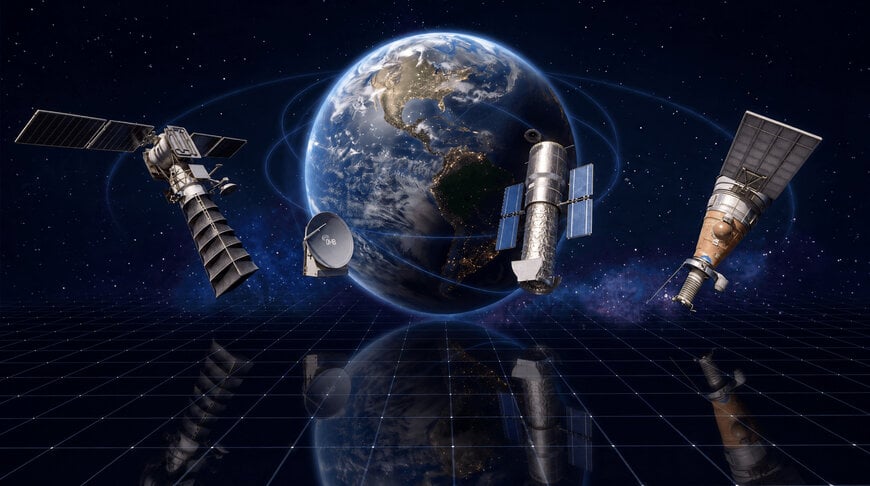
Complex three-dimensional astrodynamics and space situational awareness remain difficult to convey through conventional two-dimensional charts and static trajectory diagrams. To solve this operational visualization and training challenge for military aerospace operations, extended reality specialist HOLOGATE conducted a system study in collaboration with the German Armed Forces Space Command (Weltraumkommando der Bundeswehr) and the Bundeswehr Technical Center for Weapons and Ammunition (WTD 91), creating an interactive virtual reality application for orbital mechanics education.
Direct Manipulation of Orbital Trajectories and Ground Tracks
Traditional military and technical instruction in orbital mechanics relies on numerical software models or planar orbital projections. While these tools yield precise numerical ephemeris data, they offer limited spatial intuition regarding multi-body gravitational mechanics, orbital node drift, or real-time spatial orientation relative to Earth.
The application developed under the system study executes directly on a standalone virtual reality headset, removing the need for external processing clusters or tracking infrastructures. Within the immersive spatial environment, operators interact directly with three-dimensional terrestrial models and orbital tracks. Users can view satellites of diverse dimensional profiles, examine coordinate planes, and call up context-dependent operational metadata.
By manipulating core Keplerian orbital elements directly within the interface, personnel observe instantaneous variations in the satellite trajectory. The system calculates and plots associated ground tracks, showing the corresponding sub-satellite points across Earth's surface as orbital parameters change. This direct manipulation links abstract mathematical parameters to concrete planetary coverage corridors.
System Validation and Defense Technology Demonstration
HOLOGATE presented the initial operational system study to defense specialists at the Mission K space and defense industry conference held in Kalkar. Operational personnel and technical visitors evaluated the interface through hands-on headset trials, testing interactive orbital perturbations against live planetary projections.
Robert Fankhänel, Chief Operating Officer of HOLOGATE, noted that the study makes abstract orbital dynamics directly tangible by allowing users to modify an orbit and observe the operational outcome immediately, providing an empirical baseline for technical discussions with space domain personnel. The findings generated from the study inform ongoing joint research with the German Armed Forces Space Command and WTD 91 to determine how immersive spatial computing can integrate into future Bundeswehr aerospace training and mission rehearsal pipelines.
Additional Context:
This section details technical specifications and competitive benchmarking not included in the original product announcement.
Traditional space situational awareness (SSA) and orbital analysis in military and commercial domains rely heavily on two-dimensional desktop software suites such as Ansys Systems Tool Kit (STK) or NASA's General Mission Analysis Tool (GMAT). While STK provides three-dimensional viewport rendering on flat monitor displays using precise orbital propagators like SGP4 (Simplified General Perturbations-4) and numerical integration models, users experience geometric flattening and interface disconnect when managing complex satellite rendezvous and proximity operations (RPO) or multi-plane constellation coverage.
Immersive extended reality (XR) simulators bridge this gap by delivering full stereoscopic spatial perception and six degrees of freedom (6DoF) interaction. Comparable military simulation projects include the United States Space Force's collaboration with commercial spatial computing engines to develop Virtual Reality orbital analysis environments and digital mission rehearsal trainers. In benchmark comparisons between flat-panel desktop flight dynamics interfaces and stereoscopic head-mounted displays (HMDs), operators utilizing immersive VR environments consistently demonstrate reduced cognitive load during spatial orientation tasks and faster spatial recognition of orbital plane intersections, inclination adjustments, and line-of-sight tracking vectors.
Edited by Natania Lyngdoh, Induportals editor, with AI assistance.
www.hgxr.com
