
www.aero-defence.tech
30
'26
Written on Modified on
Sener Technology Powers BepiColombo Spacecraft Into Final Approach At Mercury
Advanced communications systems and precision scientific equipment developed for extreme space environments guide the landmark European and Japanese joint mission toward Mercury orbital insertion.
www.sener-group.com
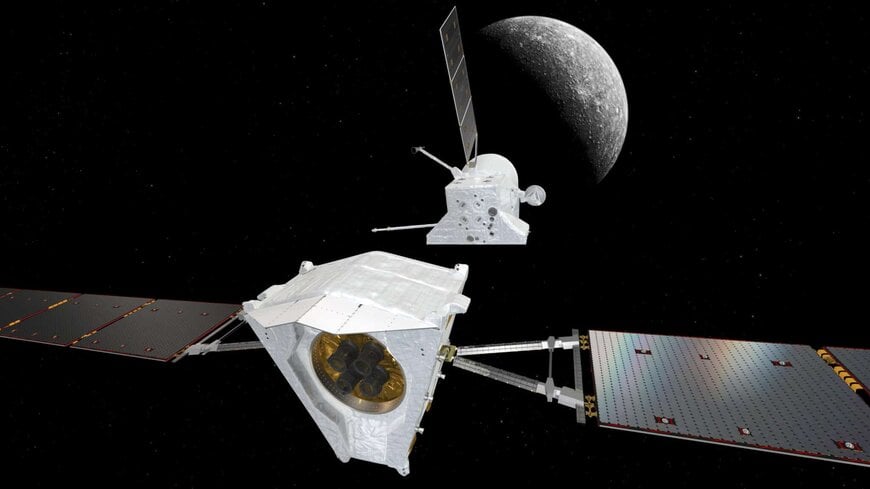
The European Space Agency and the Japan Aerospace Exploration Agency have integrated specialized pointing mechanisms and communication equipment developed by engineering group Sener for the BepiColombo mission. The engineering cooperation addresses deep space communication, orbital radio science, and magnetic field data acquisition in the high-radiation and extreme thermal environment of Mercury.
High-Gain Pointing Architecture and Extreme Thermal Engineering
The joint spacecraft stack combines ESA's Mercury Planetary Orbiter and JAXA's Mio orbiter, which separated from the Mercury Transfer Module on September 3, 2026. Deploying scientific orbiters around Mercury introduces extreme thermal gradients ranging from -130 °C to +400 °C. Standard spaceborne electronics and actuation systems degrade rapidly under solar radiation fluxes ten times higher than in Earth orbit, requiring qualified mechanical components and specialized surface coatings.
To resolve these environmental constraints, Sener engineered the high-gain antenna pointing mechanism, the medium-gain antenna assembly, and associated radio-frequency waveguides. The mechanical assembly utilizes silver plating applied to titanium structural elements alongside custom electric motors and position sensors qualified for high-temperature service. In addition to transmitting telemetry and relaying instrument datasets to Earth ground stations, the high-gain antenna pointing mechanism functions as a precision radio science payload. Its pointing stability allows ground-based tracking stations to calculate planetary orbital variations and measure solar gravitational perturbations with high positional accuracy.
Scientific Data Acquisition and Spacecraft Integration
Magnetic measurement precision represents a primary engineering objective for the orbital phase. Because operating electronics and onboard telemetry systems generate parasitic electromagnetic fields, sensitive magnetometers cannot function reliably directly adjacent to the main spacecraft body. Sener integrated a specialized deployable magnetometer boom to isolate the scientific sensors from internal spacecraft magnetic interference.
The mission trajectory encompassed 9.9 billion kilometers and nine planetary gravity-assist flybys following its October 2018 launch. The technical flight profile scheduled the orbital insertion maneuver to commence on November 21, 2026, followed by the separation of the Mercury Planetary Orbiter and Mio spacecraft on December 9 and 10, 2026. The communications architecture routes command telemetry, instrument status, and sensor data throughout these maneuvers ahead of planned scientific observations in April 2027.
Deep Space Communications Reliability Under Harsh Operating Parameters
Iñaki Pinto, Director of Space and Science at Sener, confirmed that the systems enable communications and scientific measurements under some of the most demanding operating conditions in our Solar System, following years of travel.
The deployment demonstrates operational qualification for high-temperature actuation mechanisms and deployable carbon-titanium structures in interplanetary space, providing verified design baselines for planetary exploration missions facing high thermal loading.
Edited by Evgeny Churilov, Induportals Media - Adapted by AI.
www.group.sener
