
www.aero-defence.tech
23
'26
Written on Modified on
HOLOGATE Deploys AI-Powered Virtual Action Trainer for Bundeswehr
VirtHT enables immersive multi-soldier exercises, digitally replicating mission equipment while recording tactical decisions, communication and movements for measurable training evaluation.
hgxr.com
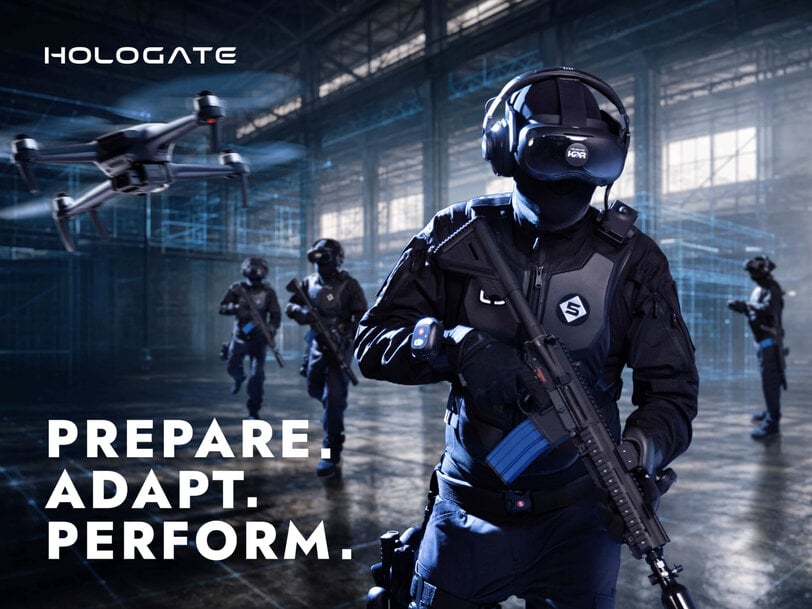
HOLOGATE has initiated the deployment of its Virtueller Handlungstrainer across the special and specialized operational units of the German armed forces under a procurement program commissioned by the Federal Office of Bundeswehr Equipment, Information Technology and In-Service Support. Developed in collaboration with the Technical Center for Weapons and Ammunition, the extended reality tactical simulation platform provides multi-user immersive operational environments for defense, law enforcement, and joint allied security forces.
Multi-Domain Operational Simulation and Collective Decision-Making
Modern combat requirements demand accelerated tactical adaptation due to the proliferation of unmanned aerial systems, sensor-dense operational environments, and automated threat vectors. The virtual action trainer system addresses these variables by placing multi-operator tactical elements inside synchronized digital environments where teams execute communications, spatial maneuvering, and compressed decision cycles under operational stress.
The platform architecture enables instructors to generate, parameterize, iterate, and evaluate mission profiles rapidly. Objective telemetry captures physical movement, spatial distribution, peer-to-peer communications, and weapon-handling sequences digitally. This automated data collection establishes verifiable performance metrics, enabling systematic validation of tactics, techniques, and procedures before live execution.
Hardware Replication and Subsystem Integration
Procured for active deployment starting in March 2026, the digital simulation environment pairs synthetic software rendering with physically replicated mission hardware. The integrated equipment matches the exact mass, ergonomics, and operational controls of standard-issue field materiel. Trainees interface with physical replicas including the Heckler and Koch G95 assault rifle, defensive equipment comprising batons, flashlights, conducted electrical weapons, irritant sprays, and restraints, as well as pyrotechnic markers, fragmentation grenades, and trauma treatment gear.
The technical scope extends beyond standard infantry loadouts. In collaboration with European missile manufacturer MBDA, HOLOGATE integrated the Enforcer shoulder-launched guided missile system. This integration allows operators to practice targeting sequences, lock-on acquisition, and firing protocols in simulated tactical engagements without expending live ordnance or incurring range-logistics overhead.
Decentralized Deployment Architecture and Modular Scalability
The physical architecture of the system relies on ruggedized mobile transit cases that allow operators to establish tactical training zones within non-dedicated infrastructure, such as vehicle maintenance depots and physical fitness halls. The untethered system supports free-roaming multi-user configurations, allowing dismounted squads to navigate identical virtual coordinates simultaneously.
The underlying HGXR operating platform uses a modular software architecture with standardized communication interfaces. This enables bidirectional data exchange between standalone free-roam training cells, dedicated hardware simulators, and broader military simulation networks across the Army, Navy, Air Force, Support Forces, and specialized detachments. The digital framework also incorporates procedural generation for unmanned aerial systems, supporting both counter-unmanned aerial vehicle defensive drills and pilot navigation protocols.
Evaluating the operational utility of the virtual system, retired Lieutenant General Joachim von Sandrart, former Commander of the Multinational Corps Northeast, noted: "The training and drilling of soldiers and conduction of exercises using virtual reality meets the need for a flexible, needs-based, and combat-realistic training landscape in a secure digital space. Special and specialized forces have the opportunity to develop their own application scenarios and raise their operational readiness, moving closer to the operational principle of training as you fight."
Leif Petersen, Chief Executive Officer of HOLOGATE, stated: "Virtual reality simulation centers on gaining quantifiable insights into decision-making, procedural behavior, squad dynamics, and cognitive performance under extreme stress conditions, providing operational data across military and police institutions."
Chief Operating Officer Robert Fankhänel highlighted the architectural flexibility of the framework: "The system models unmanned aerial systems across varied dimensions and classifications, supporting both operator training and dismounted defensive responses against aerial surveillance and munition drops."
The open software standards also support multinational networking, establishing technical interoperability for collective training exercises alongside NATO partners and regional allies.
Additional Context:
This section details technical specifications and competitive benchmarking not included in the original product announcement
The Virtueller Handlungstrainer operates via HOLOGATE’s HGXR enterprise software stack, which utilizes untethered head-mounted displays combined with inside-out tracking and complementary ultra-wideband spatial positioning anchors to support squad-level free roaming in operational footprints exceeding 200 square meters. System latency metrics are maintained below 20 milliseconds motion-to-photon, mitigating simulator-induced spatial disorientation during high-intensity tactical maneuvers. Weapon replicas communicate via low-latency wireless protocols to record trigger pull, selector switch status, round counts, and muzzle vectors at update rates exceeding 100 Hz, feeding directly into an automated after-action review database.
In the military and tactical law enforcement extended reality sector, the platform competes directly with systems developed by InVeris Training Solutions, Operator XR, and V-Armed.
InVeris Training Solutions fields the BlueFire and SURVIVR systems, which rely predominantly on proprietary simulated weapon conversions paired with commercial headsets or projection-based shoot-houses. While InVeris provides high-fidelity pneumatic recoil replicating real gas blowback impulse, its systems often demand larger fixed logistical footprints and specialized calibration compared to transportable field cases.
Operator XR offers a comparable roll-case form factor engineered for rapid deployment. The Operator XR software stack emphasizes low-footprint tactical decision-making and shoot-don't-shoot judgment drills, utilizing custom tracking modules mounted to decommissioned service weapons. However, the HOLOGATE system differentiates its hardware integration layer by directly embedding guided missile simulation profiles, such as the MBDA Enforcer, alongside full military police and medical loadout options within a single centralized sensor-fusion environment.
V-Armed provides large-scale multi-user tracking utilizing centralized optical motion-capture camera arrays and wide-area networking. While V-Armed achieves sub-millimeter tracking accuracy across complex physical structures, its reliance on fixed optical motion-capture masts requires substantial calibration time, contrasting with the self-contained inside-out tracking framework deployed by HOLOGATE for rapid field setup.
Edited by Natania Lyngdoh, Induportals editor, assisted by AI.
www.hgxr.com
