
www.aero-defence.tech
07
'26
Written on Modified on
Selective Catalytic Reduction System for Marine Propulsion Compliance
Rolls-Royce has introduced an integrated selective catalytic reduction system engineered to ensure compliance with IMO Tier III emission standards across maritime commercial applications.
www.rolls-royce.com
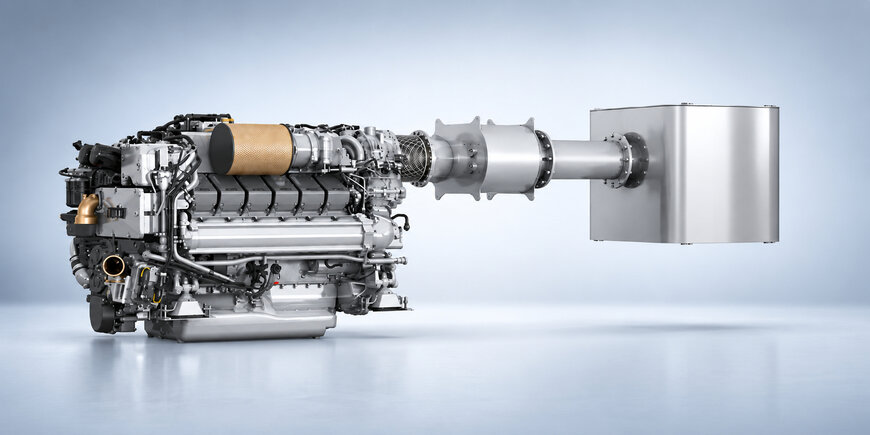
Developed in collaboration with Eminox for mtu Series 2000 marine engines, the technology targets offshore vessels, commercial passenger ferries, and governmental patrol craft operating within emission-regulated zones.
IMO Tier III Emissions Reduction
The implementation of selective catalytic reduction enables vessel operators to enter designated Emission Control Areas, notably the Baltic Sea and the North Sea, without operational restrictions. These regional jurisdictions enforce the IMO Tier III standard, which requires substantial decreases in nitrogen oxide discharge compared to previous MARPOL Annex VI regulations.
The system functions through the controlled injection of an aqueous urea reagent directly into the exhaust gas stream. As the fluid vaporizes and undergoes thermal decomposition, it generates ammonia, which reacts catalytically with nitrogen oxides to convert them into elemental nitrogen and water vapor. This chemical pathway yields a 75 percent reduction in total nitrogen oxide output compared to the IMO Tier II baseline, aligning mtu Series 2000 engines with international environmental thresholds.
Airless Dosing and Vessel Integration
Vessel architecture in crew transfer vessels, fast ferries, and offshore supply craft requires propulsion aftertreatment units with minimal installation volume and low auxiliary demand. The system utilizes an airless dosing design, eliminating the auxiliary compressed-air supply infrastructure typically needed for reagent atomization. Removing pneumatic supply lines reduces onboard parasitic electrical loads and lowers space claims in compact engine rooms.
Dr Lukas Köhler, Senior Vice President Global Marine and Mining at Rolls-Royce Power Systems, noted that all mtu Series 2000 engine configurations are now available with fully integrated SCR packages alongside existing systems for high-output Series 4000 platforms.
The physical components support modular integration configurations across varying hull profiles. Operational durability is rated up to 16,000 operating hours before major catalyst replacement or overhaul, contingent upon operational duty cycles and load profiles.
Additional Context:
This section details technical specifications and competitive benchmarking not included in the original product announcement
High-speed commercial marine vessels operating within 700 kW to 2,000 kW per powertrain require emission abatement strategies that do not impose significant thermal or space penalties. Within this power bracket, selective catalytic reduction is the established technical pathway to meet IMO Tier III nitrogen oxide thresholds (approximately 2.0 to 3.4 g/kWh depending on engine rated speed, down from roughly 7.7 to 9.8 g/kWh under IMO Tier II).
Conventional marine SCR systems typically employ air-assisted injection nozzles operating at approximately 4 bar pressure, requiring dedicated compressors, air driers, and continuous filtration modules. The airless mechanical atomization architecture utilized here operates at hydraulic pressures often between 7 bar and 10 bar, achieving fine aerosolization strictly via high-pressure pulsed liquid injectors. This approach directly competes against airless marine setups such as the Blunox Digital Airless Multipoint system and standard modular packages from manufacturers such as Hug Engineering and Danfoss.
Compared to competing airless packages, a rated service life of 16,000 hours matches established industrial benchmarks for vanadia-titania or base-metal zeolite catalytic substrates. Airless fluid delivery avoids the maintenance intervals associated with compressed air desiccant filters and eliminates compressor failures, but requires precision dosing pumps capable of handling crystalline urea deposits during engine shutdowns through automated line purging.
Edited by Sucithra Mani, Induportals editor – adapted by AI.
www.rolls-royce.com
