
www.aero-defence.tech
04
'26
Written on Modified on
Rolls-Royce Expands Variable-Speed mtu Series 2000 Generator Sets
Rolls-Royce has expanded its marine generator portfolio with standardized, variable-speed mtu Series 2000 gensets designed for optimized efficiency and power density.
www.rolls-royce.com
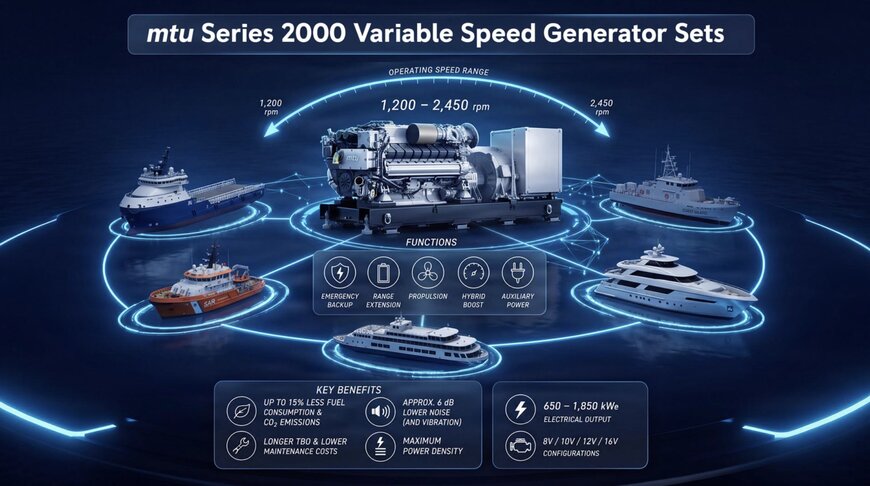
Rolls-Royce has introduced standardized variable-speed generator sets based on the mtu Series 2000 to serve maritime diesel-electric propulsion, hybrid configurations, and onboard electrical loads. The systems modulate engine speed in accordance with real-time electrical demand, lowering operational fuel consumption and CO2 emissions by up to 15 percent compared to conventional fixed-speed units while reducing operating sound levels by approximately 6 dB.
Operational Parameters and Marine Applications
The standardized generator package provides an electrical output ranging from 650 to 1,850 kWe, operating across an engine speed envelope of approximately 1,200 to 2,450 rpm depending on the specific engine variant. This variable-speed operational profile supports adaptation across changing load conditions, enabling deployment as range extenders or core charging units within battery-powered marine systems.
Due to their power density and reduced physical envelope, the units are targeted at vessels with weight and spatial limitations, including passenger ferries, offshore supply vessels, crew boats, patrol craft, and yachts. Extended times between overhaul (TBO) and lower maintenance demands are intended to reduce life-cycle operating costs.
Electrification and System Integration
The development draws on previous diesel-electric marine integrations, where variable-speed mtu Series 4000 platforms are used on commercial workboats and Series 2000 architectures are deployed in yacht propulsion systems. Within modern ship electrical systems, marine generator duties extend beyond dedicated propulsion or base auxiliary supply to incorporate emergency back-up power for fully electric craft and booster capability for hybrid arrangements.
Additional Context
This section details technical specifications not included in the original news release.
Variable-speed marine generator sets differ from standard synchronous gensets by eliminating the requirement to lock prime movers at fixed 1,500 rpm or 1,800 rpm speeds to maintain constant 50 Hz or 60 Hz grid frequencies. Instead, the combustion engine drives a permanent magnet or synchronous generator delivering variable-frequency AC, which is subsequently converted into direct current via an active front-end (AFE) rectifier feeding a common DC bus. This configuration permits the diesel engine to operate along its optimal brake specific fuel consumption (BSFC) curve, particularly during low-load intervals where fixed-speed engines experience severe thermal inefficiency, bore glazing, and elevated unburnt hydrocarbon emissions. High-speed marine diesel platforms in this output displacement typically utilize common-rail fuel injection systems operating above 2,000 bar with sequential turbocharging to ensure rapid transient load acceptance across the dynamic rpm band. Additionally, integrating variable-speed gensets into common DC-bus architectures removes bulky synchronizing switchgear and facilitates direct coupling with lithium-ion battery energy storage systems (BESS).
Edited by Romila DSilva, Induportals Editor, with AI assistance.
www.rolls-royce.com
