
www.aero-defence.tech
04
'26
Written on Modified on
Kawasaki Heavy Industries Pioneers Record Size Liquefied Hydrogen Loading Arm
Targeting a fiscal 2033 launch, Kawasaki develops a 12-inch commercial loading system to drastically accelerate ship-to-shore liquefied hydrogen transfer for expanding global supply chains.
www.kawasakirobotics.com
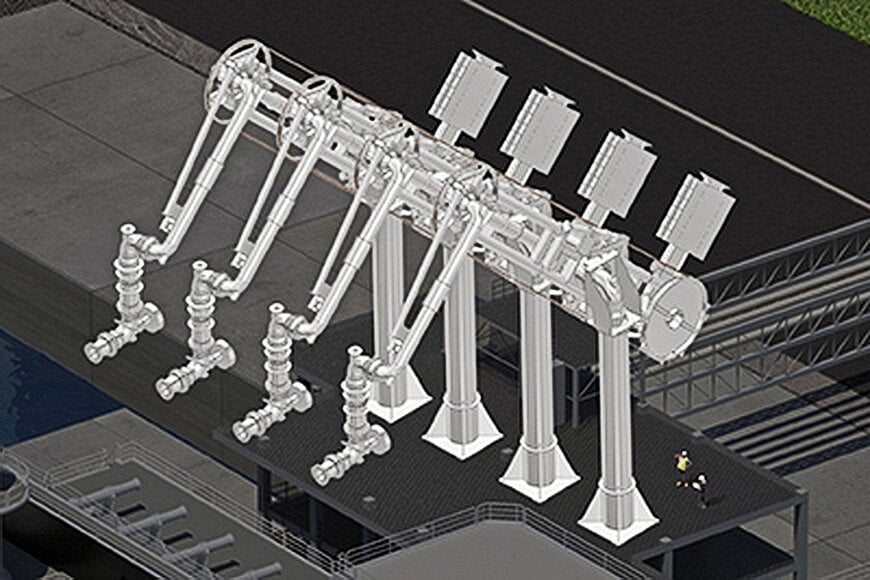
Kawasaki Heavy Industries has initiated the development of a large-scale cryogenic loading system featuring a nominal diameter of 12 inches or greater. Designed for maritime import and export terminals, the mechanical transfer system provides the fluid transfer interface between ocean-going liquefied hydrogen carriers and shore-based storage infrastructure.
Operational Challenges in Cryogenic Cargo Handling
Establishing high-volume international hydrogen supply chains requires infrastructure capable of offloading commercial cryogenic tankers efficiently. Liquefied hydrogen exists at minus 253 degrees Celsius, presenting severe operational challenges regarding thermal contraction, material embrittlement, and boil-off gas management during high-throughput transfer.
Conventional commercial-specification transfer systems utilize nominal 6-inch piping. Because cargo offloading windows directly dictate port turnaround times and terminal operational economics, maritime logistics require significantly larger cross-sectional flow areas to handle incoming cargo volumes without inducing excessive fluid velocities or pressure drops.
Engineering Specifications and System Scalability
The 12-inch transfer mechanism builds on operational data and cryogenic engineering principles established during the development of previous 6-inch prototypes. Increasing the internal conduit diameter to 12 inches quadruples the cross-sectional flow area, raising cryogenic fluid handling capacity by approximately four times at equivalent fluid velocities.
The structural design requires re-engineered counterbalance systems, swivel joints, and emergency release couplings to accommodate the increased structural weight, hydrodynamic loading, and dynamic stresses encountered during cargo transfer operations. The ship-to-shore coupler uses a standardized flange-type mechanical connection to secure tight sealing against vacuum and product leakage during vessel movement.
Compliance and Terminal Integration
Development parameters mandate full alignment with ISO 24132, the international standard governing the design, safety features, and testing requirements of marine transfer arms for liquefied hydrogen service. Adherence to this standard governs the qualification of cryogenic insulation systems, structural integrity under seismic and wind loads, fluid dynamics modeling, and fail-safe disconnect sequences.
Kawasaki Heavy Industries handles the structural engineering, fluid dynamics analysis, and cryogenic validation for the mechanical assembly. Target milestones schedule the fully qualified industrial product for commercial market introduction in fiscal year 2033, providing standardized transfer technology as next-generation, high-capacity carrier fleets enter active maritime service.
Edited by Evgeny Churilov, Induportals Media - Adapted by AI.
www.global.kawasaki.com
