
www.aero-defence.tech
08
'26
Written on Modified on
Kawasaki Signs Contract to Build World’s Largest Liquefied Hydrogen Carrier
The project advances commercial-scale liquefied hydrogen shipping by validating large-capacity marine transport, propulsion efficiency, and safety systems required for a global hydrogen supply chain.
www.kawasakirobotics.com
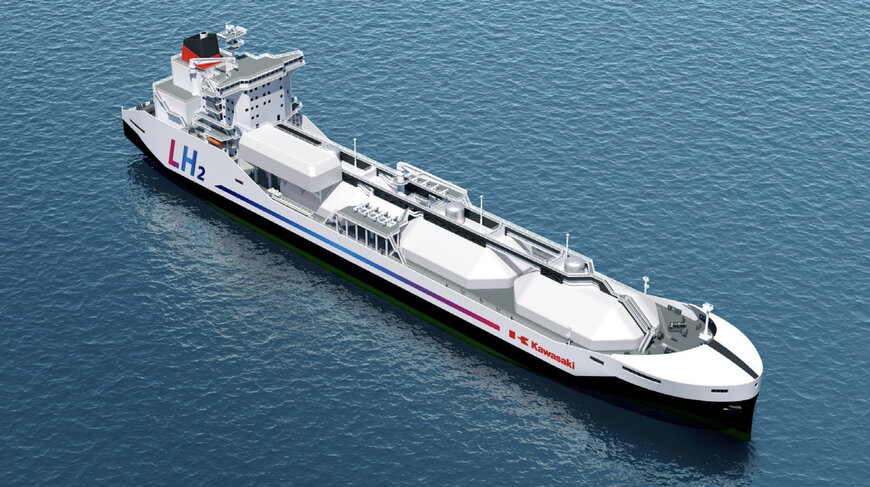
A contract has been signed to construct the world’s largest liquefied hydrogen carrier, marking a significant step toward commercializing long-distance hydrogen transport. The vessel, with a cargo capacity of approximately 40,000 m³, is intended to support the transition from pilot-scale demonstrations to a fully operational international liquefied hydrogen supply chain.
The carrier will be built at Kawasaki Heavy Industries’ Sakaide Works in Kagawa Prefecture. Japan Suiso Energy (JSE) will operate the vessel under the New Energy and Industrial Technology Development Organization (NEDO) Green Innovation Fund Project*1, which aims to demonstrate ship-to-shore loading and unloading of liquefied hydrogen and conduct ocean-going trials by fiscal year 2030.
The project builds on prior milestones in liquefied hydrogen transport. In 2021, a 1,250 m³ demonstration vessel was constructed, followed by the development of a receiving terminal and the first successful international pilot transportation of liquefied hydrogen between Japan and Australia in 2022 under the HySTRA2 framework3. The new 40,000 m³ carrier represents the next scale-up step designed to meet anticipated hydrogen demand in the 2030s.
The vessel is designed to transport cryogenic liquefied hydrogen efficiently and safely over long distances. It incorporates cargo tanks with high-performance insulation systems to minimize boil-off gas (BOG) generation caused by external heat ingress. This insulation performance is essential for maintaining cargo integrity and enabling economically viable large-volume hydrogen transport.
Propulsion is based on an electric system supported by dual-fuel generator engines capable of operating on hydrogen or conventional fuel oil*4, alongside a standard oil-fired generator engine. A dedicated hydrogen gas supply system—including compressors and heat exchangers—allows BOG generated from the cargo tanks to be reused as propulsion fuel, reducing overall CO₂ emissions during transport.
Cargo handling systems are designed for large-volume transfer of liquefied hydrogen between the vessel and onshore facilities. Double-wall, vacuum-jacketed piping maintains extremely low temperatures during loading and unloading, supporting safe and efficient operations. The vessel’s hull form and draft have been optimized for the low density of liquefied hydrogen, contributing to reduced power demand and improved propulsion efficiency.
Comprehensive risk assessments have been conducted for the hydrogen fuel system, fuel supply system, and cargo handling equipment. Safety measures are incorporated to protect the crew, the environment, and the structural integrity of the vessel during liquefied hydrogen and hydrogen gas operations.
Together with the liquefied hydrogen terminal currently under construction at Ogishima in Kawasaki City, the vessel will be used to evaluate performance, safety, durability, reliability, and economic viability of large-scale hydrogen transport. The results are expected to support the establishment of a commercial, international liquefied hydrogen supply chain and contribute to long-term decarbonization efforts across power generation, mobility, and industrial sectors.
※1 New Energy and Industrial Technology Development Organization (NEDO), Green Innovation Fund Project
※2 HySTRA: CO2-free Hydrogen Energy Supply-chain Technology Research Association. Founded by Iwatani Corporation, Kawasaki Heavy Industries, Ltd., Shell Japan Limited, and Electric Power Development Co., Ltd. (J-POWER) primarily to establish technologies and carry out demonstrations ranging from the production of hydrogen via the effective use of brown coal to the transportation, storage, and usage of such hydrogen, aimed at constructing and commercializing a CO2-free hydrogen supply chain. Marubeni Corporation, ENEOS Corporation, and Kawasaki Kisen Kaisha, Ltd. (“K” LINE) also subsequently participated. Presently consists of Iwatani Corporation and Kawasaki Heavy Industries, Ltd.
※3 NEDO project: Demonstration Project for Establishment of Mass Hydrogen Marine Transportation Supply Chain Derived from Unused Brown Coal.
※4 Hydrogen/oil-based dual-fueled engine developed in the NEDO subsidized project: Green Innovation Fund Project/Next-Generation Ship Development/Development of Hydrogen-Fueled Ships/Development of Marine Hydrogen Engine and MHFS.
www.global.kawasaki.com
