
www.aero-defence.tech
10
'26
Written on Modified on
Variable-Speed Marine Propulsion Targets Lower Fuel Consumption
Rolls-Royce Power Systems will present new marine propulsion and exhaust-treatment technologies at SMM 2026 in Hamburg, targeting workboats, ferries, offshore vessels and patrol craft.
www.rolls-royce.com
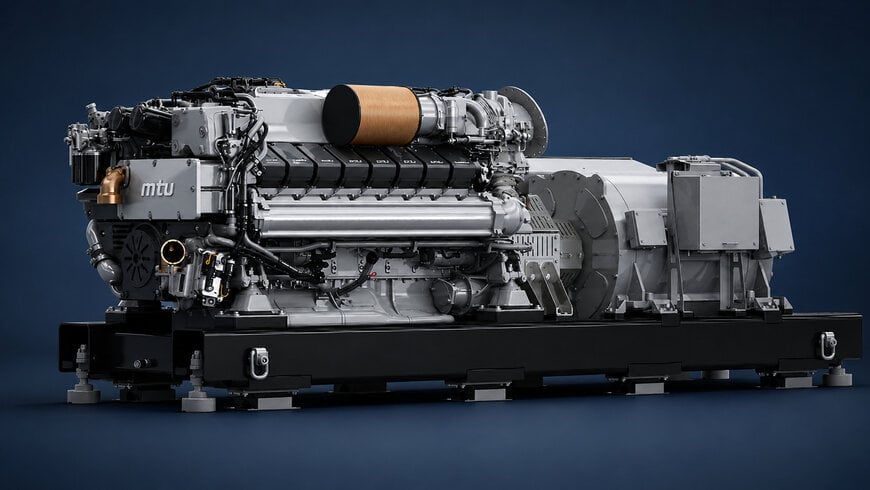
The main product announcement is a new range of standardized variable-speed mtu Series 2000 generator sets for marine applications. The units are available in 8V to 16V configurations and are intended for vessels including passenger ferries, search-and-rescue vessels, offshore support vessels, yachts and patrol boats.
Unlike constant-speed generator sets, variable-speed operation allows engine speed to be adjusted according to the electrical load. The approach can reduce the amount of energy lost when an engine operates away from its more efficient operating range, particularly in applications where power demand changes significantly during a voyage.
Rolls-Royce Power Systems states that the new generator sets can reduce fuel consumption and CO₂ emissions by up to 15 percent compared with constant-speed generator sets. The company also identifies reduced noise and vibration as additional effects of the variable-speed operating concept.
The technology is particularly relevant to electric and hybrid vessels, where generator operation can be coordinated with battery systems and propulsion loads. Variable-speed generation can provide greater flexibility in matching engine output to the vessel's instantaneous electrical demand.
Applications Across Commercial and Service Vessels
The Series 2000 range is positioned for several vessel categories with different operating profiles. Passenger ferries can experience frequent changes in propulsion and hotel loads, while search-and-rescue and patrol vessels can require rapid changes in available power. Offshore support vessels can similarly operate across widely varying load conditions depending on their onboard equipment and mission.
For hybrid vessels, the generator set can form part of a larger power-management architecture in which engines, batteries and electric propulsion systems are coordinated. The ability to vary generator speed provides an additional control parameter for managing engine loading and electrical power production.
Emission Control for IMO Tier III Operations
Rolls-Royce Power Systems is also introducing a selective catalytic reduction system for marine applications. The SCR system is designed to enable operation in areas subject to IMO Tier III nitrogen-oxide emission requirements.
SCR systems use a chemical reduction process to convert nitrogen oxides in exhaust gas into nitrogen and water. This allows the engine and exhaust-treatment system to meet emission limits that cannot be achieved through combustion optimisation alone.
The company describes the new system as flexible, with the objective of supporting vessels that operate both inside and outside emission-controlled areas. This is relevant for ships whose operating routes cross regions with different regulatory requirements.
Automation and Fleet Data Management
The propulsion systems are complemented by mtu NautIQ automation, bridge and data-analytics solutions. These systems are intended to provide operators with information for monitoring and managing vessel operations.
For newbuilds, such systems can be integrated into the vessel's control architecture during construction. For existing vessels, automation and data solutions can also form part of retrofit programmes, allowing operators to upgrade monitoring and control functions without replacing the complete propulsion system.
Lifecycle Service for Marine Propulsion
Rolls-Royce Power Systems is also presenting service solutions covering maintenance and vessel lifecycle support. The portfolio includes extended maintenance intervals, in-situ maintenance and warranties.
For commercial operators, maintenance intervals and onboard service requirements directly affect vessel availability. Extending service intervals can reduce scheduled maintenance frequency, while in-situ maintenance can limit the need to remove equipment from the vessel for workshop servicing.
SMM 2026 Presentation in Hamburg
Rolls-Royce Power Systems is presenting the technologies at SMM 2026, which takes place from 1 to 4 September 2026 at Hamburg Messe und Congress in Hamburg, Germany. The maritime trade fair covers propulsion, shipbuilding, digitalisation, energy efficiency and other technologies associated with the transition of the maritime industry.
The company's SMM programme brings together propulsion systems, sustainable-fuel technologies, automation and lifecycle services, placing the variable-speed generator sets within a broader marine power-system strategy.
Additional Context:
This section details technical specifications and competitive benchmarking not included in the original product announcement
Variable-speed marine power generation is not limited to a single manufacturer. Wärtsilä, for example, offers marine engines that can be configured for constant-speed generating sets or variable-speed mechanical-drive applications. Its marine genset portfolio covers power levels from below 1 MW to more than 10 MW, depending on the engine configuration.
Emission compliance through SCR is also an established approach in marine power systems. Caterpillar's C9.3 marine generator sets, for example, are specified for 200–300 ekW and can meet IMO II and IMO III requirements, with SCR used for IMO III compliance.
These products illustrate that the relevant competitive benchmarks extend beyond headline fuel-consumption reductions. For marine generator systems, comparison can include rated electrical output, engine speed range, fuel consumption, power density, emissions certification, installation dimensions, maintenance intervals and compatibility with hybrid or diesel-electric architectures.
The claimed 15 percent reduction in fuel consumption and CO₂ emissions for the new Series 2000 variable-speed units is therefore best understood as a comparison against constant-speed generator sets specified by Rolls-Royce Power Systems, rather than as a universal industry benchmark. Independent comparisons would require equivalent vessel operating profiles, load cycles, engine ratings and test conditions.
Edited by Sucithra Mani, Induportals editor – adapted by AI.
www.rolls-royce.com
