
www.aero-defence.tech
20
'26
Written on Modified on
Marine technologies for fuel transition and vessel efficiency
Alfa Laval will present new marine technologies for alternative fuels, energy efficiency, digital compliance and ocean protection during Posidonia 2026 in Athens, Greece.
www.alfalaval.com
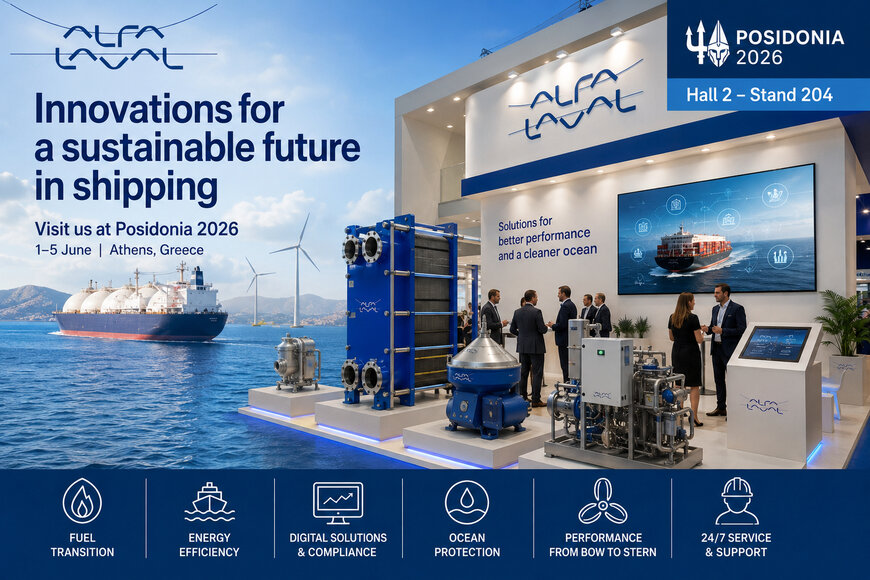
Alfa Laval has announced its participation at Posidonia 2026, taking place from 1–5 June in Athens, Greece, where the company will showcase marine technologies designed to address fuel transition, environmental compliance and vessel operational efficiency. The exhibition will feature solutions for LNG, methanol, ammonia and biofuels alongside digital tools, ballast water management systems and energy-efficiency technologies for commercial shipping applications.
The company will exhibit in Hall 2 – Stand 204, where its marine specialists and digital solutions teams will present technologies focused on decarbonization, emissions compliance and vessel performance optimization. Alfa Laval’s partner Technava will also participate at Hall 3 – Stand 111.
Alternative fuel systems for future-ready vessels
Alfa Laval is expanding its marine portfolio to support the maritime sector’s transition toward lower-carbon and alternative fuels. The company will present technologies compatible with LNG, LPG, biofuels, methanol and ammonia, targeting shipowners preparing for evolving fuel regulations and emissions reduction requirements.
The showcased systems include biofuel-ready fuel lines, Aalborg multi-fuel boilers and low-flashpoint fuel supply systems engineered to support safe fuel handling and operational flexibility across multiple fuel types. Alfa Laval will also highlight LNG fuel technologies incorporating cryogenic heat transfer systems and solutions developed for ammonia-fuelled newbuild vessels.
The technologies are particularly relevant for the growing LNG carrier segment in Greece and other markets investing in dual-fuel and alternative-fuel vessel infrastructure. The maritime industry’s transition toward ammonia and methanol is increasing demand for onboard fuel supply systems capable of handling low-flashpoint fuels under stricter safety requirements.
Energy-efficiency technologies for emissions reduction
The company will also demonstrate technologies intended to improve onboard energy efficiency and support compliance with the International Maritime Organization’s EEDI, EEXI and Carbon Intensity Indicator (CII) frameworks.
Featured technologies include the AQUA Blue Mini freshwater generator and the OceanGlide fluidic air lubrication system. Air lubrication systems reduce hull friction by generating controlled air layers beneath the vessel hull, lowering propulsion resistance and reducing fuel consumption.
Alfa Laval’s heat transfer systems are designed for compatibility with both conventional marine fuels and emerging low-carbon alternatives, allowing vessel operators to adapt propulsion and auxiliary systems without major redesigns.
Energy-efficiency technologies are becoming increasingly important as shipowners seek operational methods to reduce fuel consumption and maintain compliance with tightening emissions regulations. Improvements in hydrodynamic efficiency, heat recovery and onboard energy management are central to achieving lower lifecycle emissions across commercial fleets.
Digital voyage optimization and compliance management
StormGeo, part of Alfa Laval, will present its Voyage Intelligence platform during the exhibition. The platform combines voyage planning, route optimization, weather intelligence and fleet performance monitoring within a unified digital ecosystem.
The system supports real-time voyage monitoring, bunker procurement, environmental compliance reporting and post-voyage analysis. Such digital maritime platforms are increasingly used to optimize fuel consumption, improve route planning and support emissions reporting under IMO carbon intensity regulations.
By integrating weather forecasting, routing analytics and fleet data, digital voyage management systems can help operators reduce operational costs while improving schedule predictability and regulatory transparency.
Ballast water treatment and environmental protection systems
Alfa Laval will also present environmental protection technologies including the PureBallast 3 Ultra ballast water management system. The system is designed to maintain ballast water treatment performance under varying water conditions while minimizing energy consumption.
At Posidonia 2026, the company will additionally highlight its Compliance Service Package for PureBallast systems, providing lifecycle support, upgrades and long-term compliance assistance for IMO and United States Coast Guard ballast water regulations.
Ballast water management systems are mandatory under international maritime regulations intended to reduce the spread of invasive aquatic species between global ecosystems. Compliance requirements continue to drive retrofit activity across existing commercial fleets.
Expanded marine filtration and wind propulsion technologies
Among the additional technologies on display will be the Moatti filter platform 180, designed to improve fuel oil filtration and engine protection efficiency. Effective filtration systems remain critical for maintaining engine reliability, particularly as marine fuel characteristics evolve with the adoption of alternative fuels and blended biofuels.
Alfa Laval will also showcase Oceanbird, a wind propulsion initiative developed through a joint venture with Wallenius. The technology uses large rigid wing sails intended to reduce fuel consumption and associated carbon emissions on commercial vessels by supplementing conventional propulsion systems with wind-assisted propulsion.
Wind propulsion technologies are receiving renewed industry attention as shipowners explore operational decarbonization measures compatible with existing vessel architectures.
Additional Context: This section details technical specifications and competitive benchmarking not included in the original product announcement
The maritime industry is currently accelerating adoption of alternative fuel technologies in response to IMO greenhouse gas reduction targets. LNG remains the most widely deployed alternative marine fuel, while ammonia and methanol are emerging as long-term zero-carbon or low-carbon fuel candidates for deep-sea shipping applications.
Competing marine technology providers in this sector include Wärtsilä, MAN Energy Solutions and WinGD, which also develop low-flashpoint fuel systems, fuel gas supply systems and alternative-fuel propulsion technologies. Benchmarking criteria typically include fuel flexibility, cryogenic handling capability, safety system integration, emissions performance and retrofit compatibility.
In ballast water treatment, Alfa Laval’s PureBallast competes with systems from Optimarin, Wärtsilä Aquarius and Ecochlor. Industry comparisons generally focus on treatment reliability in different salinity conditions, energy consumption, maintenance requirements and compliance with IMO and USCG certification standards.
Within wind-assisted propulsion, Oceanbird competes with technologies such as BAR Technologies’ WindWings and Norsepower rotor sails. Performance benchmarks in this segment include fuel-saving percentage, installation complexity, operational flexibility and compatibility with different vessel classes.
Edited by Sucithra Mani, Induportals editor – adapted by AI.
www.alfalaval.com
