
www.aero-defence.tech
02
'26
Written on Modified on
Building end-to-end space sustainability
Airbus is deploying ecodesign rulebooks, magnetic detumbling systems, and atmospheric re-entry technologies to manage space mission sustainability.
www.airbus.com
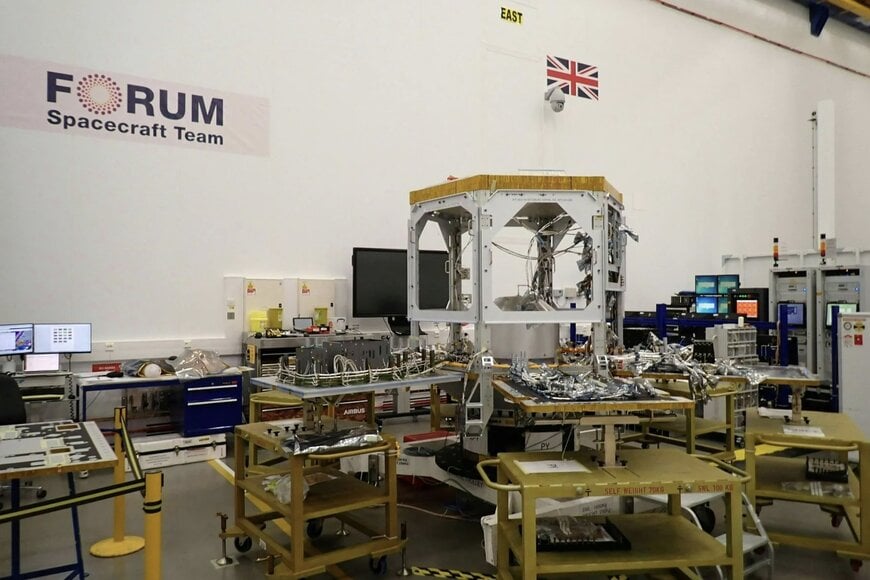
Airbus is integrating lifecycle sustainability methodologies and debris mitigation technologies across its space mission portfolio. The dual strategy encompasses environmental data mapping for operations on Earth alongside engineering developments to protect the low Earth orbit environment.
Earth-Based Lifecycle Assessments and Ecodesign Frameworks
To establish an environmental footprint baseline, the company performed a detailed Life Cycle Assessment (LCA) on FORUM, an upcoming European Space Agency (ESA) Earth observation satellite. The assessment mapped data across satellite manufacturing, ground support equipment production, transportation logistics, and engineering design workflows to identify environmental hotspots and provide data for the ESA LCA database.
To supplement this data, the ESA GMAIT (Towards Greener Manufacturing, Assembly, Integration and Test) study analyzed the environmental profiles of five core satellite subsystems: propulsion systems, solar arrays, batteries, heat pipes, and star trackers. Furthermore, Airbus and Thales Alenia Space were commissioned by the French space agency (CNES) to author a standardized Ecodesign rulebook, establishing a framework that requires engineering teams to integrate lifecycle sustainability metrics, travel reductions, and responsible procurement standards from the initial design phase.
Orbital Debris Mitigation and Re-Entry Technologies
For end-of-life spacecraft management, the company has developed the Detumbler, a passive magnetic braking device engineered to utilize Earth's magnetic field to dampen a satellite's uncontrolled rotation. Spacecraft can enter a tumbling mode due to propulsion failures, external debris impacts, or cumulative environmental disturbances, making them difficult to intercept for decommissioning. The detumbling architecture provides a stable target for capture and de-orbit maneuvers, and the function is designated to become a mandatory requirement for upcoming ESA satellites.
To prevent surviving components from reaching the ground during atmospheric re-entry, the company is participating in an ESA-funded project to develop separable structural joints. Engineers utilize thermal software to simulate re-entry heating profiles, identifying strategic weak points and evaluating 3D-printed internal structures designed to melt faster than conventional solid metal brackets.
Astronomical Preservation and Fleet Architecture
In collaboration with Eutelsat, Airbus is developing design architectures for low Earth orbit satellite fleets to minimize interference with terrestrial deep-space observation. The engineering initiatives, created in coordination with the astronomical community, incorporate anti-reflective materials and adjustable solar array angling protocols to reduce structural glare. Additionally, the design sets strict electronic volume limitations to suppress radio frequency leakage that can disrupt terrestrial radio telescopes.
Edited by Romila DSilva, Induportals Editor, with AI assistance.
www.airbus.com
