
www.aero-defence.tech
30
'25
Written on Modified on
Thales and ASI to develop the first human outpost on the lunar surface
Lunar exploration will benefit from Thales Alenia Space Italy’s cutting-edge technology, expertise and long experience in space exploration, space transportation systems and orbital infrastructures.
www.thalesaleniaspace.com
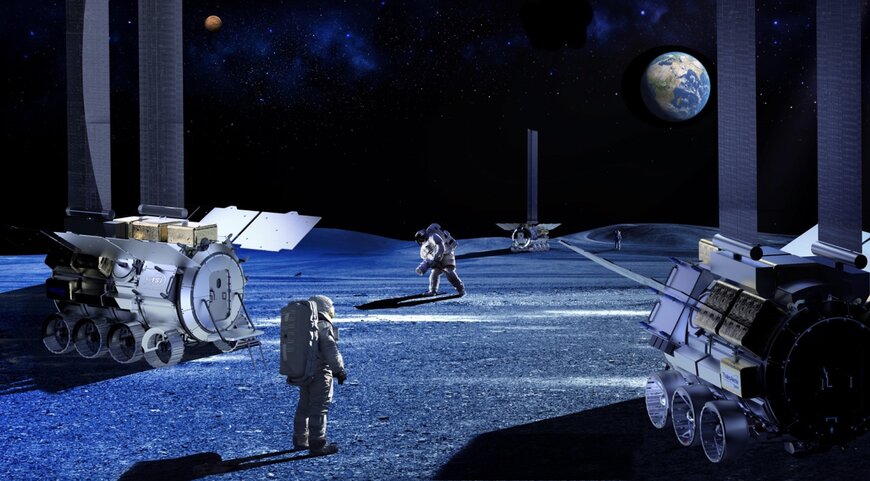
Multi-Purpose Habitation module © Thales Alenia Space_Briot
Thales Alenia Space has signed a contract with the Italian Space Agency (ASI) to perform the preliminary design phase, including development of critical enabling technologies, of the pressurized Multi-Purpose Habitation (MPH) module for the lunar surface.
Planned for launch from NASA’s Kennedy Space Center in 2033, the MPH module will be the first ever dedicated habitation asset on the lunar surface as part of the Artemis Accords between NASA and ASI for bilateral Moon cooperation. The MPH module will safely host astronauts during their missions, support surface operations, enable scientific research experiments both with and without the presence of a human crew; and have the capability to move on the surface.
Designed for a minimum operational lifespan of 10 years, the MPH will serve as a permanent surface habitat, capable of operating synergistically with other elements of the Artemis architecture.
Part rover, part lunar shelter
Over the course of the two-year contract, Thales Alenia Space Italy will act as overall prime contractor, working alongside Altec (a public-private company owned by Thales Alenia Space and ASI) and other Italian industrial entities, for the MPH preliminary design phase. The initial development will focus on enabling technologies aimed at facing the harsh environmental conditions on the lunar surface, including extreme thermal variations, pervasive lunar dust, high radiation levels, micrometeoroid impacts, and the effects of reduced lunar gravity. In collaboration with the Industrial consortium members and space agencies, the company will lead the development of the MPH module to advance scientific discovery on the Moon, enable sustainable lunar exploration and drive the knowledge and technologies needed to support human missions to Mars.
Thales Alenia Space has signed a contract with the Italian Space Agency (ASI) to perform the preliminary design phase, including development of critical enabling technologies, of the pressurized Multi-Purpose Habitation (MPH) module for the lunar surface.
Planned for launch from NASA’s Kennedy Space Center in 2033, the MPH module will be the first ever dedicated habitation asset on the lunar surface as part of the Artemis Accords between NASA and ASI for bilateral Moon cooperation. The MPH module will safely host astronauts during their missions, support surface operations, enable scientific research experiments both with and without the presence of a human crew; and have the capability to move on the surface.
Designed for a minimum operational lifespan of 10 years, the MPH will serve as a permanent surface habitat, capable of operating synergistically with other elements of the Artemis architecture.
Part rover, part lunar shelter
Over the course of the two-year contract, Thales Alenia Space Italy will act as overall prime contractor, working alongside Altec (a public-private company owned by Thales Alenia Space and ASI) and other Italian industrial entities, for the MPH preliminary design phase. The initial development will focus on enabling technologies aimed at facing the harsh environmental conditions on the lunar surface, including extreme thermal variations, pervasive lunar dust, high radiation levels, micrometeoroid impacts, and the effects of reduced lunar gravity. In collaboration with the Industrial consortium members and space agencies, the company will lead the development of the MPH module to advance scientific discovery on the Moon, enable sustainable lunar exploration and drive the knowledge and technologies needed to support human missions to Mars.
www.thalesaleniaspace.com
