
www.aero-defence.tech
30
'24
Written on Modified on
HELLAS SAT AND THALES ALENIA SPACE TO DEVELOP OPTICAL COMMUNICATION PAYLOAD FOR HELLAS SAT 5 SATELLITE
The partnership aims to provide cutting-edge communication services with very high data rates from geostationnary orbit.
© Thales Alenia Space
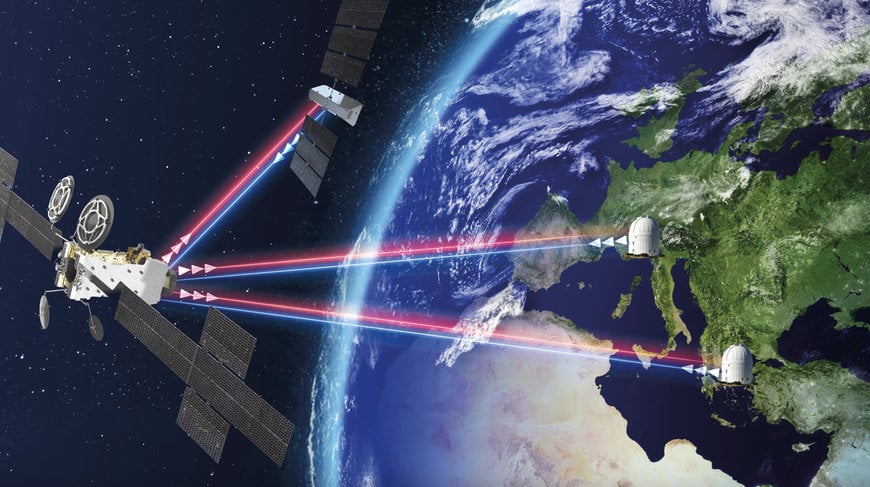
Hellas Sat and Thales Alenia Space have signed a Memorandum of Understanding to collaborate on the development of an optical communication payload for the upcoming new mission to be embarked on the future Hellas Sat 5 telecommunications satellite, operating in geostationary orbit at 39 degrees East.
The partnership between Hellas Sat and Thales Alenia Space aims to provide cutting-edge communication services with very high data rates from geostationnary orbit. This innovative payload aims to connect with Optical Ground Station of the National Athens Observatory in Greece, Optical Ground Stations in France, Optical Ground Stations of ESA and Thales Alenia Space's LEO HydRON telecommunication satellite.
After Vertigo H2020 programme, Thales Alenia Space is currently advancing the development of very high data rate capacities (up to 1 terabit/second) facing long distances from ground to geostationnary orbit and cross-atmospheric turbulence, with support from France Relance (CO-OP), CNES (DYSCO) and ESA (HydRON).
About Free Space Optical Communications
Free Space Optical laser Communications are emerging as a space standard, offering significantly greater capacities compared to current satcom systems (terabit/sec vs. gigabit/sec). This technology is poised to revolutionize space telecommunication infrastructure, similar to the impact of optical fiber on the ground.
ESA HydRON and CNES DYSCO projects target high throughput optical space links R&D and demonstrations, addressing challenges in providing connectivity to multiple users across different orbits, ground assets and applications. The system showcases the capabilities of the optical communication technology in end-to-end system implementations.
Various use cases include universal internet access, direct data transmission from observation satellites at any time, private links to data centers and optical fiber redundancy on the ground in case of crises.
Introducing optical fiber in space is expected to reduce the need for a high number of satellites in orbit, contributing to the sustainability of space infrastructure and minimizing sky pollution.
Hellas Sat and Thales Alenia Space have signed a Memorandum of Understanding to collaborate on the development of an optical communication payload for the upcoming new mission to be embarked on the future Hellas Sat 5 telecommunications satellite, operating in geostationary orbit at 39 degrees East.
The partnership between Hellas Sat and Thales Alenia Space aims to provide cutting-edge communication services with very high data rates from geostationnary orbit. This innovative payload aims to connect with Optical Ground Station of the National Athens Observatory in Greece, Optical Ground Stations in France, Optical Ground Stations of ESA and Thales Alenia Space's LEO HydRON telecommunication satellite.
After Vertigo H2020 programme, Thales Alenia Space is currently advancing the development of very high data rate capacities (up to 1 terabit/second) facing long distances from ground to geostationnary orbit and cross-atmospheric turbulence, with support from France Relance (CO-OP), CNES (DYSCO) and ESA (HydRON).
About Free Space Optical Communications
Free Space Optical laser Communications are emerging as a space standard, offering significantly greater capacities compared to current satcom systems (terabit/sec vs. gigabit/sec). This technology is poised to revolutionize space telecommunication infrastructure, similar to the impact of optical fiber on the ground.
ESA HydRON and CNES DYSCO projects target high throughput optical space links R&D and demonstrations, addressing challenges in providing connectivity to multiple users across different orbits, ground assets and applications. The system showcases the capabilities of the optical communication technology in end-to-end system implementations.
Various use cases include universal internet access, direct data transmission from observation satellites at any time, private links to data centers and optical fiber redundancy on the ground in case of crises.
Introducing optical fiber in space is expected to reduce the need for a high number of satellites in orbit, contributing to the sustainability of space infrastructure and minimizing sky pollution.
www.thalesaleniaspace.com
