
www.aero-defence.tech
04
'26
Written on Modified on
Subsea Situational Awareness Sonar Technology
Kongsberg introduces two sonars to improve underwater infrastructure protection and autonomous maritime navigation.
www.kongsberg.com
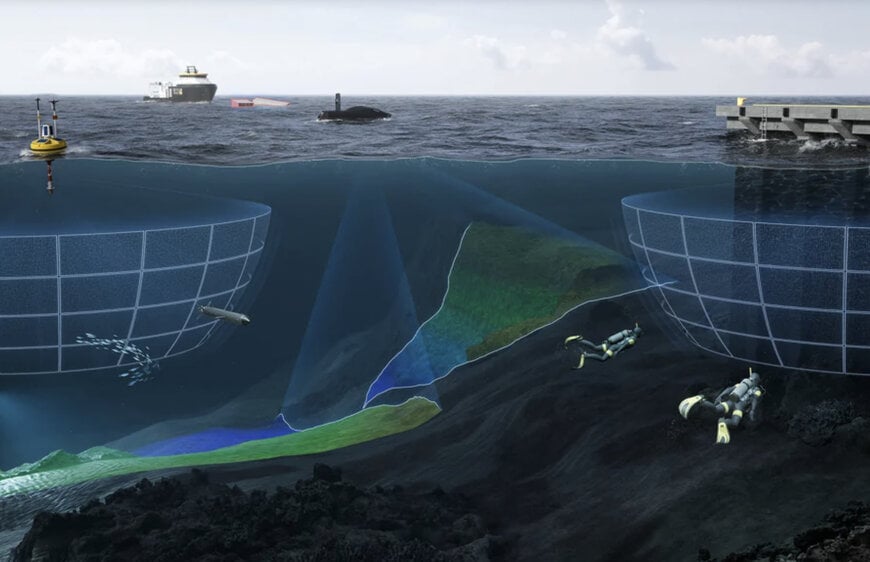
Kongsberg Gruppen has expanded its Aegir Subsea Situational Awareness sonar family with the introduction of the Aegir17 and Aegir57N models, addressing growing industrial requirements for continuous underwater infrastructure protection, safe navigation, and automated maritime security monitoring.
Maritime surveillance operations frequently contend with the challenge of monitoring expansive water columns and seabed environments without incurring excessive power consumption or requiring constant manual data interpretation. Subsea security and navigation in remote or uncrewed applications demand high-definition acoustic sensing systems capable of operating reliably on space-constrained platforms such as buoys, fixed installations, and unmanned surface vessels. Kongsberg developed the Aegir sonar family and its associated automation framework to mitigate these operational constraints by scaling advanced subsea monitoring technologies for diverse deployment environments.
Operating Principle and System Architecture
The Aegir Subsea Situational Awareness sonar family comprises three distinct models designed to fulfill varying range, resolution, and platform integration criteria.
The Aegir17 functions as a long-range, 360-degree sonar engineered for larger maritime platforms where extended detection boundaries are necessary. By utilizing a lower acoustic frequency combined with a larger transducer array, the system achieves greater detection range and target definition than smaller variants, granting operators expanded temporal windows to evaluate underwater threats and navigation hazards.
The Aegir57N integrates navigation and security capabilities within a compact matrix sonar architecture. The system directs acoustic beams toward targeted sectors to yield higher-resolution imaging of both the water column and the seabed. This directional focus supports forward-looking navigation in poorly charted waters and precise obstacle detection, matching or exceeding the range performance of comparable market alternatives. For security roles, the Aegir57N complements omnidirectional systems by concentrating surveillance on specific approach vectors. Its compact physical footprint and Ethernet interface facilitate direct integration onto unmanned surface vessels and fixed coastal structures.
The portfolio is anchored by the existing Aegir57, a compact 360-degree sonar capable of detection ranges up to 2,000 metres. Optimized for buoys, small vessels, and fixed monitoring points, the Aegir57 delivers continuous subsea monitoring while minimizing the size, weight, and power demands typical of heavier acoustic systems.
Artificial Intelligence Integration and Virtual Operation
To address the high data volumes generated by continuous acoustic monitoring, Kongsberg has expanded its collaboration with automation platform Viam to develop an artificial intelligence-powered virtual sonar operator for the Aegir family. This initiative builds upon prior joint developments, including the Sonar AI system deployed for Simrad sonars to automate fish detection and real-time crew alerting.
Designed primarily for uncrewed vessels and unattended fixed installations, the software layer automates the detection and tracking of underwater objects to decrease reliance on continuous human oversight. The architecture permits end users to deploy pre-trained models or integrate custom models tailored to specific marine environments and surveillance parameters. The system processes continuous sonar data streams to isolate anomalous contacts, allowing operators to oversee multiple remote installations concurrently and direct manual attention only toward verified detections requiring further investigation.
Real-World Applications and Industrial Workflows
The Aegir Subsea Situational Awareness sonar family integrates into industrial workflows requiring persistent underwater oversight, including the protection of subsea cables, offshore energy installations, and port facilities. Unmanned surface vessels utilize these sonars to execute autonomous patrols in complex littoral zones, while fixed installations deploy the sensors for stationary perimeter defense and environmental monitoring. The automated data filtering provided by the Viam integration reduces bandwidth requirements and operator fatigue during long-duration offshore missions.
Additional Context:
This section details technical specifications and competitive benchmarking not included in the original product announcement.
The expansion of the Aegir Subsea Situational Awareness portfolio aligns with broader technology evolution trends in the maritime sector toward uncrewed surface operations and automated sensor data reduction. Modern subsea security relies increasingly on edge computing and machine learning algorithms to convert raw acoustic backscatter into structured object tracks, reducing the communication bottlenecks associated with transmitting high-bandwidth sonar feeds over satellite or radio links. Comparable acoustic monitoring systems in the maritime defense and commercial security sectors generally offer similar omnidirectional or sector-scanning capabilities, but often require dedicated human operators or heavier power infrastructures, differentiating the Aegir architecture through its scalability across autonomous platforms.
Edited by Sucithra Mani, Induportals editor – adapted by AI.
www.kongsberg.com
