
www.aero-defence.tech
25
'26
Written on Modified on
Modular Sonar Systems for Autonomous Subsea Maritime Infrastructure Surveillance
KONGSBERG introduced scalable subsea acoustic monitoring systems with automated classification capabilities to protect critical offshore, port, and coastal infrastructure.
www.kongsberg.com
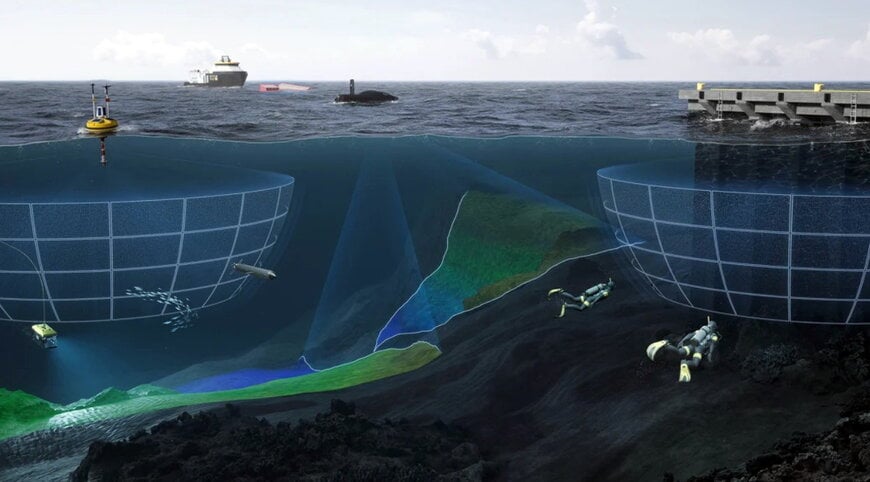
KONGSBERG partnered with Fugro to deploy continuous subsea situational awareness sonar systems on offshore marine platforms, delivering automated underwater detection, classification, and tracking for ports, coastal zones, and offshore energy assets.
Acoustic Detection Architecture and Autonomous Processing
Subsea domain awareness presents distinct challenges in shallow coastal waters and high-density ports, where acoustic reverberation, floating debris, and limited visibility impede conventional surface radar and optical tracking systems. The Aegir subsea situational awareness (SSA) sonar architecture addresses this visibility gap through scalable acoustic hardware engineered for integration across uncrewed surface vessels (USVs), stationary data buoys, submerged seabed nodes, and surface vessels.
The system incorporates an artificial intelligence-driven virtual sonar operator designed to process multi-channel acoustic feeds directly at the edge. By running automated detection, classification, and tracking algorithms locally, the platform minimizes bandwidth requirements for remote telemetry and operates without continuous human supervision. The processing pipeline allows end-user operators to train the classification models against specific mission profiles and localized acoustic signatures, retaining site-specific operational knowledge within the monitoring network.
Offshore Testbed Integration and Validation
The operational deployment of the acoustic monitoring package was demonstrated at the ONS 2026 exhibition in Stavanger, utilizing live telemetry from a continuous installation in the Oslofjord. The system was mounted on a Fugro SEAWATCH buoy integrated into the Oslofjord Testbed, combining persistent marine power management, real-time communications, and subsea acoustic sensing.
The deployment builds upon broader infrastructure surveillance programs, including the sensor integration contract for Princess Elisabeth Island in the North Sea — combining vessel traffic management and radar systems — alongside dedicated subsea security contracts for international maritime facilities.
Additional Context
This section details technical specifications and competitive benchmarking not included in the original product announcement.
Continuous underwater perimeter monitoring has traditionally relied on high-frequency active diver detection sonars (DDS), such as the Sonardyne Sentinel series or Teledyne RESON SeaBat installations, which typically operate in the 200 kHz to 450 kHz frequency bands. While these legacy systems deliver high angular resolution for localized hull and diver inspection, their high power draw and processing overhead often limit continuous deployment on energy-constrained platforms such as autonomous surface craft and solar-powered metocean buoys.
In contrast, next-generation modular sonar suites emphasize low-power digital signal processing and integrated edge computing for automated target recognition (ATR). By moving acoustic processing from shore-based control stations directly to the sensor node, modular systems decrease raw data throughput requirements, enabling continuous satellite or cellular uplinks from remote buoys. The primary engineering trade-offs in this product class center on acoustic aperture size versus platform power capacity, balancing long-range detection swathes against the payload and power limits of autonomous marine platforms.
Edited by Evgeny Churilov, Induportals Media - Adapted by AI.
www.kongsberg.com
