
www.aero-defence.tech
30
'26
Written on Modified on
GKN Aerospace achieves Nadcap accreditation for L-DED-w
First worldwide Nadcap accreditation for L-DED-w validates quality control and accelerates production-scale additive manufacturing for aerospace and defence platforms.
www.gknaerospace.com
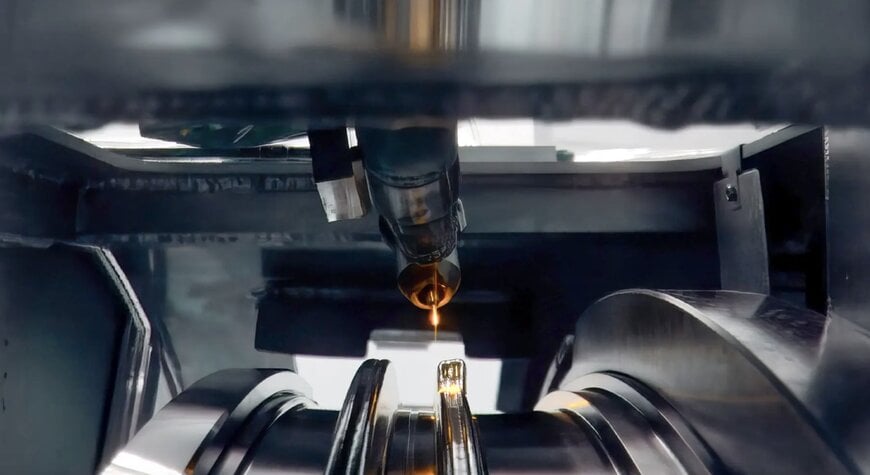
Manufacturing large-scale, structural flight components from titanium and nickel superalloys has historically relied on heavy forgings, subtractive billet machining, and investment casting. These conventional production pathways generate unfavorable buy-to-fly ratios, where as much as eighty to ninety percent of high-value raw material is converted into scrap shavings during final CNC finishing. Furthermore, long forging lead times create vulnerability across primary defense and commercial aerospace supply chains. While additive manufacturing offers design optimization and near-net-shape deposition, scaling directed energy deposition into flight-critical primary aerostructures requires rigorous metallurgical repeatability, defect mitigation, and formal independent process auditing. Without accredited process controls, industrial adoption of wire-based deposition remains largely confined to secondary non-structural fittings or rapid prototyping.
World-First Nadcap Accreditation for Wire-Fed Laser DED
GKN Aerospace became the first company globally to earn Nadcap accreditation for Laser Wire Directed Energy Deposition (L-DED-w). The certification provides independent, industry-recognized validation for the company’s wire-fed additive manufacturing systems, establishing an audited baseline for safety-critical aerospace and defence manufacturing.
Nadcap, administered by the Performance Review Institute, serves as the aerospace industry’s leading accreditation benchmark for special manufacturing processes, verifying compliance with stringent quality assurance, equipment calibration, and material traceability standards. The qualification followed a thorough audit assessing GKN Aerospace’s operating procedures, personnel competencies, process repeatability, industrial equipment capabilities, and end-to-end feedstock material controls.
Accelerating Certified Flight Hardware Industrialisation
Rather than serving purely as an experimental baseline, GKN Aerospace's additive technology is supported by active commercial aviation deployments. The company has already engineered, qualified, and delivered certified additive flight hardware that is currently in service across commercial and military platforms.
Achieving formal Nadcap accreditation allows GKN Aerospace to expand its L-DED-w production footprint, facilitating the transition of large-format aerostructures from technology demonstration into high-rate series manufacturing. By depositing metal wire directly into near-net geometries, the process minimizes raw material waste, decreases overall component weight, and shortens procurement lead times for structural engine cases, wing spars, and aircraft bulkheads.
Additional Context
This section details technical specifications and competitive benchmarking not included in the original product announcement.
In aerospace special processes governed by Nadcap and SAE International standards (such as AMS 7000 series and Nadcap AC7110/14 audit criteria for additive manufacturing), wire-fed laser directed energy deposition operates by directing a multi-kilowatt fiber laser beam onto a substrate to generate a stable melt pool, into which high-purity metal wire (such as Ti-6Al-4V Grade 5 or Inconel 718) is continuously fed via a motorized coaxial or off-axis wire guide. Unlike powder-bed or powder-blown DED systems, wire feedstocks eliminate explosion hazards associated with fine reactive powders, achieve nearly one hundred percent material deposition efficiency without overspray, and generate deposition rates typically ranging from two to five kilograms per hour. Achieving class-leading tensile fatigue limits requires inert shielding environments (argon chambers or localized trailing shields) to maintain oxygen levels below fifty parts per million, alongside closed-loop optical pyrometry to regulate thermal buildup across tall structural ribs.
Within the aerospace large-format additive sector, GKN Aerospace benchmarks against specialized advanced manufacturing primes and technology integrators including Sciaky (Electron Beam Additive Manufacturing), Norsk Titanium (Rapid Plasma Deposition), and Spirit AeroSystems. While electron beam and plasma-arc methods achieve high deposition rates, they typically produce larger heat-affected zones and require extensive vacuum chambers or secondary finish-machining passes due to coarser surface ripples. Laser wire directed energy deposition provides finer melt-pool control, tighter geometric tolerances, and the flexibility to operate inside local atmospheric shielding cells. By becoming the first global Tier-1 aerostructures supplier to secure Nadcap certification for L-DED-w, GKN Aerospace establishes an auditable manufacturing framework that enables commercial airframe OEMs and military defense primes to procure flight-critical additive structures under existing aerospace quality management protocols without proprietary supplier-specific qualification exemptions.
Edited by Romila DSilva, Induportals Editor, with AI assistance.
www.gknaerospace.com
