
www.aero-defence.tech
29
'26
Written on Modified on
Uncrewed Airborne Early Warning Radar Flight Trials on MQ-9B
General Atomics Aeronautical Systems and Saab demonstrated LoyalEye radar integration on the MQ-9B remotely piloted aircraft.
www.ga.com
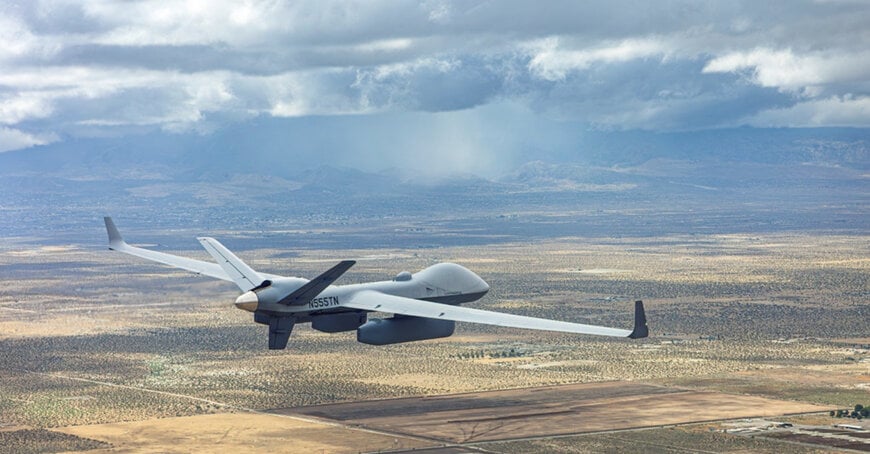
General Atomics Aeronautical Systems, Inc. (GA-ASI) collaborated with defense contractor Saab to execute flight trials evaluating an Airborne Early Warning (AEW) radar architecture integrated aboard an uncrewed aircraft system. Conducted for defense and aerospace surveillance applications, the integration trials evaluated the remote sensor platform across air, maritime, and coastal tracking operations.
Airborne Early Warning Platform Constraints
Conventional airborne early warning operations rely on large, crewed airframes that require significant operating infrastructure, crew rotation schedules, and substantial maintenance support. In high-threat areas, deploying crewed aircraft introduces high operational risk and limits mission duration based on crew flight-time limits. Defense operators increasingly require persistent, long-range radar coverage that sustains real-time detection cycles over large geographic expanses without exposing aircrews to contested airspace.
Sensor Pod Integration and Architecture
To address operational persistence requirements, Saab supplied its LoyalEye AEW radar assembly, which engineers installed onto a GA-ASI-manufactured MQ-9B aircraft using specialized external payload pods. The configuration pairs long-endurance propulsion and all-weather flight systems with active airborne sensing instruments.
During airborne operations, the LoyalEye radar functions as a high-elevation sensor node, scanning airspace and sea surface sectors simultaneously. Sensor track data transmits across line-of-sight and beyond-line-of-sight datalinks to support distributed Battle Management Command and Control (BMC2) architectures. The sensor architecture enables data ingest and control execution across ground stations, naval vessels, or adjacent crewed aircraft platforms without requiring co-located radar processing operators aboard the airframe.
Operational Verification and Range Results
Integration evaluations were conducted from GA-ASI's Desert Horizon flight operations facility in Southern California. The flight profile verified simultaneous multi-target tracking across distinct operational domains, maintaining track continuity on long-range maritime contacts alongside active airborne targets.
During range trials, the pod-mounted radar demonstrated target acquisition against commercial air traffic corridors as well as multiple instrumented red-force tactical fighter jets. The aerodynamic and electrical pod integration verified that the sensor payload operates within the platform's center-of-gravity, power supply, and thermal dissipation thresholds, enabling persistent airborne intelligence collection across the operating envelope of certified MQ-9B airframes.
“LoyalEye complements existing capabilities by adding flexibility, extending reach, and enabling a more efficient use of resources in demanding environments,” said Carl-Johan Bergholm, Head of Saab’s business area Surveillance.
By transferring airborne early warning sensing tasks to long-endurance uncrewed airframes, the integrated platform establishes persistent surveillance coverage while mitigating logistical footprints and aircrew exposure in contested operational zones.
Edited by Natania Lyngdoh, Induportals editor, with AI assistance.
www.ga.com
