
www.aero-defence.tech
21
'26
Written on Modified on
Autonomous Maritime Systems and Industrial Automation Research Platform
Deutsches Zentrum für Luft- und Raumfahrt and partner shipyards collaborate to construct a modular maritime vessel for validating digital infrastructure and alternative propulsion.
www.dlr.de
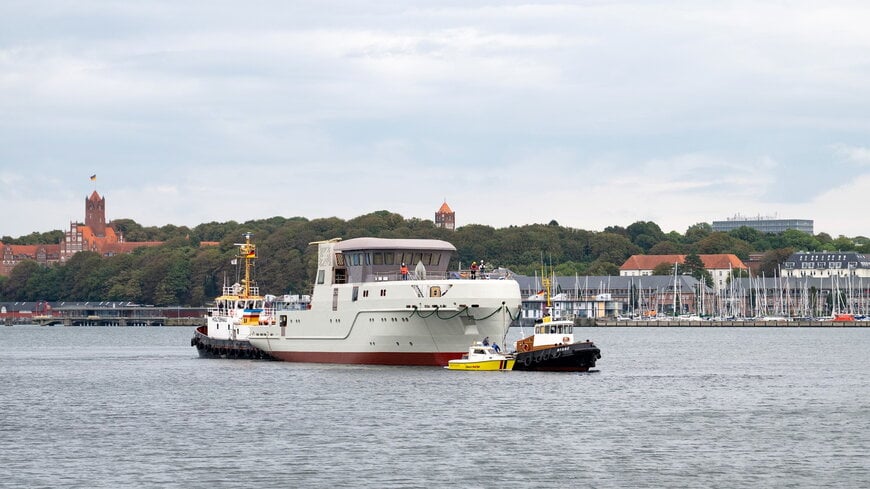
The German Aerospace Center (Deutsches Zentrum für Luft- und Raumfahrt; DLR) has initiated the outfitting phase of the MODULARIS research platform, a specialized vessel engineered for testing maritime technologies under operational open-sea conditions. The project establishes an integrated testing environment targeted at the maritime transport, industrial automation, and commercial shipping sectors.
Industrial Context and Partner Responsibilities
Maritime technology qualification requires testing components in real sea environments before commercial integration. MODULARIS provides a controlled testing architecture to address these operational constraints.
The manufacturing process relies on complementary industrial expertise across German maritime facilities. Flensburger Schiffbau-Gesellschaft (FSG Shipyard) in Flensburg executed the initial structural construction and launched the completed hull on 17 September 2026. The shipyard integrated primary mechanical systems, including fail-safe propulsion engines, climate control infrastructure, and heat pump units. Following launch, Lloyd Werft in Bremerhaven assumed responsibility for interior technical outfitting and systems integration.
Technical Architecture and Subsystems
The vessel serves as a modular deployment platform configured to evaluate subsystems independently or as integrated networks. Key functional parameters include:
- Redundant propulsion systems designed to sustain safe maneuvering during experimental trials.
- Dedicated energy storage incorporating marine battery systems.
- Sensor arrays, industrial automation modules, and navigation components engineered to evaluate autonomous functions.
- Marine data communication systems for real-time telemetry.
The engineering architecture allows researchers to measure energy efficiency, system stability, and component failure rates under operational hydrodynamic loads.
Deployment and Infrastructure Integration
Following hull completion in Flensburg, the platform undergoes transit via the Kiel Canal to Lloyd Werft in Bremerhaven. Subsequent integration stages encompass installing specialized research drives, sensory packages, and power management units.
Shore-based operational integration centers on dedicated maritime infrastructure established by DLR in Kiel on 14 September 2026. The Kiel site includes laboratory facilities, engineering offices, and vessel berths, providing a direct link between land-based development and maritime test cycles. Upon final outfitting, Kiel will serve as the operational home port.
Target Applications and Expected Impact
MODULARIS addresses the industrial validation of alternative marine drives, low-emission energy storage, digital infrastructure, and autonomous maritime navigation. The platform enables standardized verification of drive stability, automated situational awareness, and power bus efficiency, accelerating the progression of naval architectures from theoretical design to verified operational deployment.
Edited by Evgeny Churilov, Induportals Media - Adapted by AI.
www.dlr.de
Deployment and Infrastructure Integration
Following hull completion in Flensburg, the platform undergoes transit via the Kiel Canal to Lloyd Werft in Bremerhaven. Subsequent integration stages encompass installing specialized research drives, sensory packages, and power management units.
Shore-based operational integration centers on dedicated maritime infrastructure established by DLR in Kiel on 14 September 2026. The Kiel site includes laboratory facilities, engineering offices, and vessel berths, providing a direct link between land-based development and maritime test cycles. Upon final outfitting, Kiel will serve as the operational home port.
Target Applications and Expected Impact
MODULARIS addresses the industrial validation of alternative marine drives, low-emission energy storage, digital infrastructure, and autonomous maritime navigation. The platform enables standardized verification of drive stability, automated situational awareness, and power bus efficiency, accelerating the progression of naval architectures from theoretical design to verified operational deployment.
Edited by Evgeny Churilov, Induportals Media - Adapted by AI.
www.dlr.de
