
www.aero-defence.tech
03
'26
Written on Modified on
DLR at SMM 2026
From 1 to 4 September, in Hamburg, Germany, The German Aerospace Center (DLR) collaborates with maritime industry partners to deploy resilient positioning systems and autonomous vessel automation technologies across commercial shipping operations.
www.dlr.de
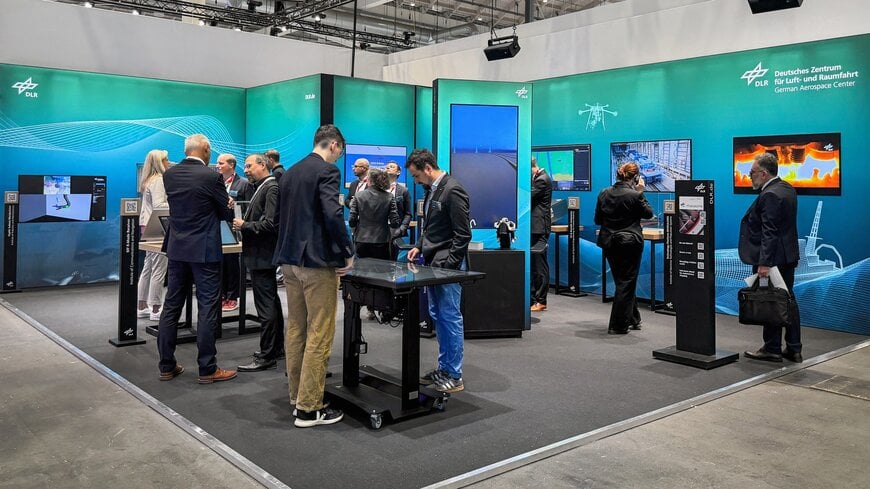
The German Aerospace Center is collaborating with industrial shipbuilders, system integrators, and maritime authorities to validate resilient digital infrastructure and automated control architectures for maritime operations. These developments address vulnerabilities in satellite-dependent navigation and enable remote underwater intervention in hazardous environments.
Operational Challenges and Collaborative Engineering
Commercial shipping faces rising operational risks from Global Navigation Satellite System (GNSS) interference, specifically signal jamming and spoofing, which impair positioning accuracy and vessel safety. Concurrently, environmental inspection and the recovery of legacy munitions in the North Sea and Baltic Sea expose personnel to hazardous conditions. Addressing these multidisciplinary challenges requires coupling fundamental navigation research with commercial naval engineering and industrial sensor integration.
Resilient Terrestrial Navigation and Retrofit Automation
To establish satellite-independent positioning, DLR is deploying Ranging Mode (R-Mode) technology, which superimposes timing and ranging signals onto existing terrestrial maritime radio networks. The architecture operates across two transmission domains:
- Medium-wave transmissions: Real-time validation routines cross-reference terrestrial signals with satellite positioning data to detect localized spoofing or transmission divergence.
- Very-high-frequency (VHF) signals: High-frequency data streams are processed directly by onboard electronic chart and navigation systems to preserve positioning continuity without satellite availability.
For autonomous surface operations, DLR developed the Navibox module. Designed for vessel retrofits, this unit integrates sensor fusion algorithms for collision avoidance and localized path planning. The system interfaces with central maritime control centers via secure telemetry links, enabling remote supervision and coordinated routing across multiple vessels.
Sea Validation and Remote Hazardous Intervention
Physical validation occurs through the MODULARIS research vessel, a specialized test platform laid down in May 2026. Designed with standardized mechanical and electrical interfaces, the vessel functions as an open-architecture platform for evaluating alternative propulsion configurations, sensory arrays, and autonomous navigation subassemblies under operational sea conditions.
For hazardous underwater subsea tasks, a remote robotic system combines teleoperation algorithms with force-feedback haptic controllers. This interface transmits mechanical resistance directly to remote operators, providing the manual precision required to identify and handle legacy explosive materials without direct personnel exposure.
Implementation and Industry Applications
These technologies are targeted at port logistics, maritime traffic management, offshore asset security, and environmental monitoring. The combined integration of R-Mode radio backup and retrofitted automation modules establishes redundancy within existing marine infrastructure, ensuring operational continuity in GNSS-denied environments while reducing crew exposure to marine hazards.
The underlying systems are presented at the Shipbuilding, Machinery & Marine Technology (SMM) trade fair from 1 to 4 September 2026 in Hamburg, Germany.
Edited by Evgeny Churilov, Induportals Media - Adapted by AI.
www.dlr.de
Sea Validation and Remote Hazardous Intervention
Physical validation occurs through the MODULARIS research vessel, a specialized test platform laid down in May 2026. Designed with standardized mechanical and electrical interfaces, the vessel functions as an open-architecture platform for evaluating alternative propulsion configurations, sensory arrays, and autonomous navigation subassemblies under operational sea conditions.
For hazardous underwater subsea tasks, a remote robotic system combines teleoperation algorithms with force-feedback haptic controllers. This interface transmits mechanical resistance directly to remote operators, providing the manual precision required to identify and handle legacy explosive materials without direct personnel exposure.
Implementation and Industry Applications
These technologies are targeted at port logistics, maritime traffic management, offshore asset security, and environmental monitoring. The combined integration of R-Mode radio backup and retrofitted automation modules establishes redundancy within existing marine infrastructure, ensuring operational continuity in GNSS-denied environments while reducing crew exposure to marine hazards.
The underlying systems are presented at the Shipbuilding, Machinery & Marine Technology (SMM) trade fair from 1 to 4 September 2026 in Hamburg, Germany.
Edited by Evgeny Churilov, Induportals Media - Adapted by AI.
www.dlr.de
