
www.aero-defence.tech
15
'26
Written on Modified on
Satellite Constellation Deployment for Global Digital Infrastructure
Boeing delivered three software-defined satellites to complete the medium Earth orbit constellation operated by SES for high-throughput connectivity services.
www.boeing.com
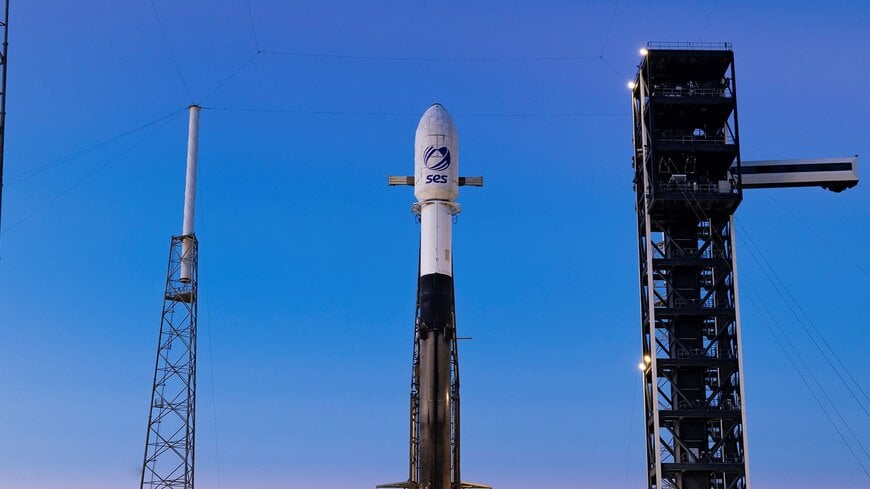
Boeing and SES finalized the deployment phase of a thirteen-satellite constellation designed to deliver reconfigurable broadband connectivity across global mobility, government, and enterprise sectors. The space-based network expands existing telecommunications capacity by integrating software-defined satellite systems into medium Earth orbit (MEO).
Industrial Challenge and Division of Responsibilities
Providing resilient, low-latency data throughput over variable geographic footprints requires flexible space infrastructure. Terrestrial networks and fixed-beam satellite systems often lack the dynamic capacity allocation necessary to serve maritime transit, aviation routes, and remote land installations efficiently.
Addressing this operational challenge required a collaboration pairing commercial fleet management with space vehicle manufacturing. SES defined the operational requirements, orbital architecture, and end-user network integration, while Boeing engineered and manufactured the spacecraft platform and payload electronics.
Technical Architecture and Operational Mechanics
The constellation operates using Boeing 702X platform architecture equipped with software-defined payloads. Unlike fixed transponder payloads, this system employs digital beamforming and dynamic frequency allocation to adjust bandwidth distributions in real time:
- Dynamic Beam Steering: The system focuses radio frequency power directly on demand points rather than fixed broad geographical areas.
- Real-Time Capacity Routing: Spacecraft reallocate gigabits of capacity programmatically across discrete beams to align with fluctuating network demand.
- Dual-Use Architecture: The underlying digital payload architecture serves as a baseline design deployed in defense systems, including the Wideband Global SATCOM (WGS) and Evolved Strategic SATCOM (ESS) systems.
Deployment and System Integration
The final three satellites (designated F11, F12, and F13) launched from the Cape Canaveral Space Force Station to join ten previously orbited units. Following deployment, the satellites initiated orbital positioning and electronic payload initialization phases. Commissioning and full commercial integration into the active network are scheduled for completion by mid-2027. Once active, the units integrate into SES's multi-orbit routing ecosystem, interfacing with existing ground stations and customer terminal equipment.
Target Applications and Network Capabilities
The completed MEO digital infrastructure serves several professional and operational environments:
The final three satellites (designated F11, F12, and F13) launched from the Cape Canaveral Space Force Station to join ten previously orbited units. Following deployment, the satellites initiated orbital positioning and electronic payload initialization phases. Commissioning and full commercial integration into the active network are scheduled for completion by mid-2027. Once active, the units integrate into SES's multi-orbit routing ecosystem, interfacing with existing ground stations and customer terminal equipment.
Target Applications and Network Capabilities
The completed MEO digital infrastructure serves several professional and operational environments:
- Maritime and Aviation Mobility: Commercial airlines and cruise operators utilize steerable beam links to maintain continuous broadband handover for passenger and operational telemetry.
- Remote Civil and Healthcare Infrastructure: High-throughput, low-latency links supply data connectivity to isolated medical stations requiring real-time telehealth imaging, as well as educational institutions in off-grid territories.
- Defense and Government Networks: Secure links support mission command transmissions where terrestrial fiber routing is unavailable or degraded.
The software-defined constellation establishes an operational baseline that mitigates orbital bandwidth congestion through real-time traffic balancing, improving link stability and network scalability across remote operational zones.
Edited by Evgeny Churilov, Induportals Media - Adapted by AI.
www.boeing.com
Edited by Evgeny Churilov, Induportals Media - Adapted by AI.
www.boeing.com
