
www.aero-defence.tech
14
'26
Written on Modified on
Microchip Advances Space Timing with Radiation-Tolerant Atomic Clock Technology
Space CSAC-SA65 combines atomic accuracy, low power consumption and extended temperature performance for compact, cost-efficient satellite timing applications.
www.microchip.com
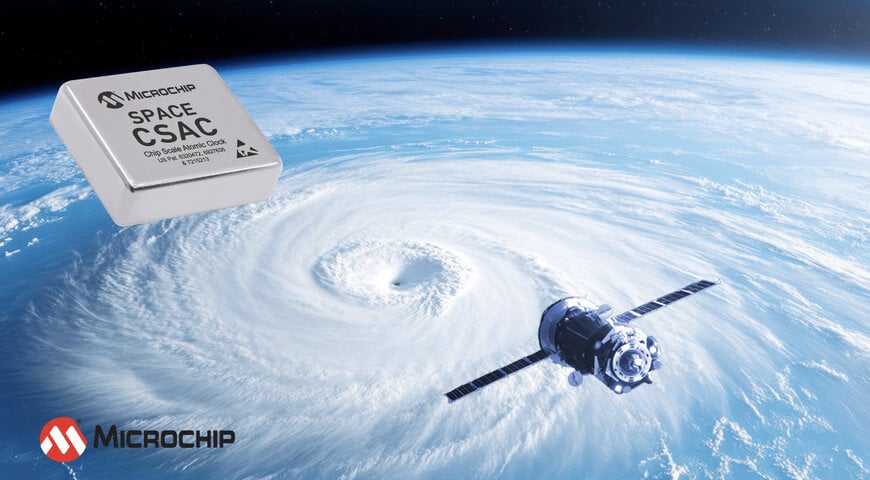
Microchip Technology has expanded its portfolio with the Space CSAC-SA65, a chip-scale atomic clock designed to deliver precise space-grade timing. This new hardware provides a low-power synchronization solution specifically engineered for the New Space market, targeting satellite-to-cellular communications, alternative navigation, and Earth imaging.
Technical Specifications and Radiation Tolerance
The CSAC-SA65 builds upon previous designs to extend radiation tolerance to a minimum of 30 kRad. The unit operates across an extended temperature spectrum from -40 degrees Celsius to +80 degrees Celsius. To meet the constraints of smaller satellite designs, the device consumes less than 120 milliwatts of power and occupies a volume of less than 17 cubic centimeters. These parameters present an alternative to traditional radiation-hardened timing solutions by reducing the size, weight, power, and cost footprint for orbital hardware.
Synchronization and Autonomous Timing Mechanisms
The atomic clock integrates a built-in 1 Pulse Per Second (PPS) input and output capability, which operates as a standard mechanism for satellite synchronization across distributed systems. The atomic stability of the device allows for extended autonomous operation during periods when external timing references, such as Global Navigation Satellite System signals, are disrupted or unavailable. Randy Brudzinski, corporate vice president of the frequency and time systems business unit at Microchip, noted that the device allows size-constrained CubeSats to maintain timing accuracy in extreme conditions without continuous reliance on external references.
Commercial Production and Deployment Scope
Manufactured as a Commercial Off-The-Shelf component utilizing radiation-tolerant commercial electronic parts, the device aims to reduce lead times and associated costs relative to traditional space-grade oscillators. The primary deployment environments are Low Earth Orbit missions requiring satellite timing and frequency control, satellite clock reference generation, assured positioning, navigation and timing, and satellite cross-linking operations. System configuration and analysis are managed via Clockstudio software and a dedicated developer kit.
Additional Context:
This section details technical specifications and competitive benchmarking not included in the original product announcement
Within the low-size, weight, and power atomic clock market for space and aerospace applications, the Microchip Space CSAC-SA65 competes alongside miniature rubidium oscillators such as the Safran mRO-50. When evaluated on measurable operational characteristics, the CSAC-SA65 prioritizes extreme power efficiency, whereas the Safran mRO-50 typically consumes around 1.5 watts. In terms of physical footprint, the Safran mRO-50 requires a volume of approximately 51 cubic centimeters. While rubidium-based miniature clocks and cesium-based chip-scale atomic clocks rely on different atomic physics packages, both compete directly to provide autonomous holdover capabilities and timing stability for alternative positioning, navigation, and timing architectures in space.
Edited by Natania Lyngdoh, Induportals editor, assisted by AI.
www.microchip.com
