
www.aero-defence.tech
26
'26
Written on Modified on
Radiation-Tolerant Programmable Clock Generator For Spacecraft Timing Systems
Microchip Technology introduces the DSA504RT to streamline frequency generation, reduce component count, and synchronize subsystems in aerospace applications.
www.microchip.com
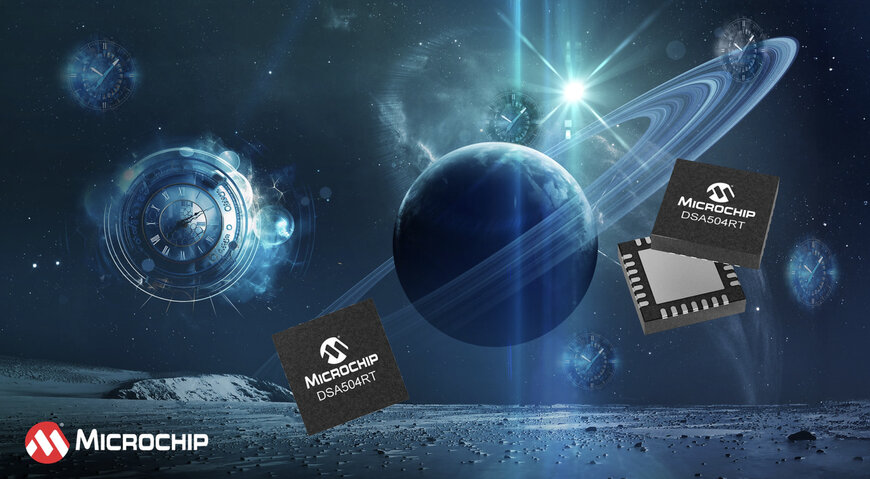
Microchip Technology has released the DSA504RT, a radiation-tolerant, six-output programmable clock generator designed for spacecraft timing architectures. This component consolidates frequency generation for navigation, communications, and scientific instruments in aerospace and defense applications.
Spacecraft Timing Architecture and Component Consolidation
Spacecraft systems require precise signals to operate effectively, especially when GNSS signals are disrupted or unavailable. Traditionally, engineers design these networks using multiple discrete oscillators and buffers to supply specific frequencies to various subsystems. This approach increases mass, requires more circuit board space, and elevates design complexity. The DSA504RT streamlines this architecture by generating multiple clean, phase-aligned frequencies from a single master source. Consolidating the timing network eliminates the need for numerous crystals and synthesizers, which directly lowers power consumption, reduces mass, and improves the overall system Failures in Time rate by minimizing the component count.
Programmable Frequency Generation and Hardware Specifications
To support varied technical requirements, the device incorporates an Analog Phase-Locked Loop with spread spectrum capability, alongside two fractional and two integer dividers. It features six highly configurable output buffers. Each buffer can be independently programmed as a differential driver using LVPECL, LVDS, or HCSL standards, or as a pair of single-ended CMOS outputs. According to Maamoun Abou Seido, appointed vice president of the timing communications group at Microchip Technology, the component produces three distinct clock families and up to six different frequencies, effectively saving board space while maintaining strict timing synchronization for high-reliability components.
Jitter Performance and System Integration
The clock generator delivers an ultra-low jitter metric of 200 femtoseconds across the 12kHz to 20MHz range and is compliant with PCIe Gen 1 through Gen 7 standards. Packaged in both QFN28 and CQFP32 formats, the hardware serves as a timing reference distributor for subsystems built around radiation-tolerant or radiation-hardened FPGAs and MCUs. Deploying a single integrated space-grade component lowers overall Bill of Materials costs and screening expenses while allowing designers to rely on standard documentation and established technical support pipelines to reduce program risk.
Additional Context:
This section details technical specifications and competitive benchmarking not included in the original product announcement
Within the space-grade timing market, manufacturers evaluate clock generators based on jitter metrics, output channel capacity, and configuration flexibility. Texas Instruments produces comparable radiation-hardened solutions, utilizing BAW-based oscillators that achieve sub-100 femtoseconds of jitter for extreme precision, alongside devices like the LMX1906-SP which feature up to 15 outputs to support higher-frequency applications. By comparison, the Microchip Technology DSA504RT is optimized for a consolidated six-output architecture with 200 femtoseconds of jitter, prioritizing direct component reduction and multi-format compatibility (LVPECL, LVDS, HCSL, CMOS) driven from a single analog phase-locked loop source.
Edited by Natania Lyngdoh, Induportals editor, assisted by AI.
www.microchip.com
