
www.aero-defence.tech
09
'26
Written on Modified on
Ammonia Marine Engine Study Advances Combustion Development
Ricardo completes the FASTMOVE feasibility study for ammonia-fuelled marine engines, supporting future low-emission propulsion systems for offshore vessels.
www.ricardo.com
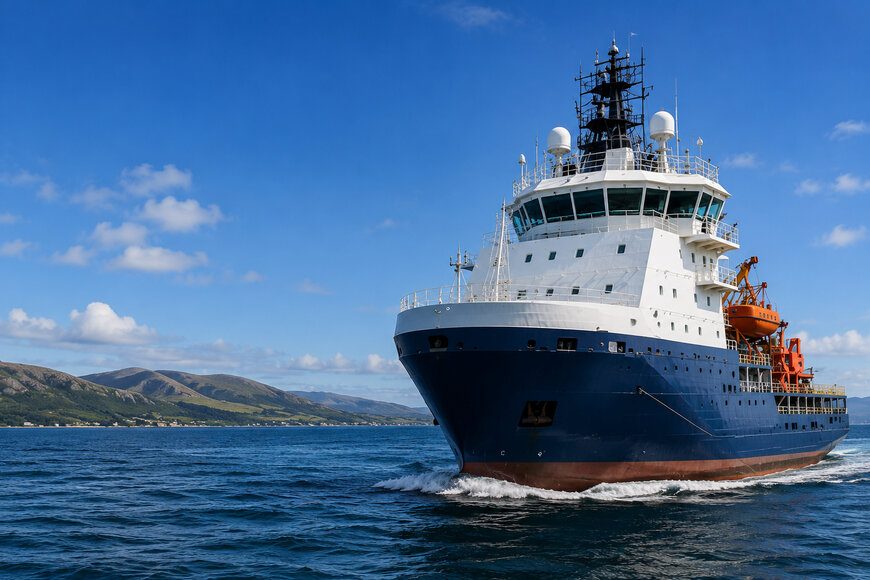
Ricardo has completed the FASTMOVE feasibility study, evaluating ammonia as a future marine fuel through the development of combustion concepts, injection modelling and safety assessments. The project supports the design of next-generation four-stroke marine engines for offshore support vessels and contributes to the development of a low-emission maritime sector.
Combustion system development for ammonia marine engines
The FASTMOVE project, short for Feasibility of Ammonia 4-STroke Marine engines in Offshore VEssels, was carried out by Ricardo in partnership with Brunel University of London and the Port of Cromarty Firth. The initiative examined how ammonia could contribute to maritime decarbonisation while establishing the technical foundations for an ammonia combustion engine suitable for offshore marine applications.
The programme forms part of the UK SHORE initiative led by the UK Department for Transport. Since 2022, UK SHORE has committed more than £230 million to over 247 projects while attracting more than £107 million in private investment and supporting around 500 organisations across the United Kingdom.
High-pressure injection testing and combustion modelling
Ricardo developed the initial combustion concepts using its experience in combustion engineering and marine propulsion. The engineering work included high-pressure ammonia injection testing at 200 bar, computational fluid dynamics (CFD) modelling of ammonia spray behaviour, validation of injection characteristics, development of high-pressure dual-fuel (HPDF) combustion models, and the creation of a concept combustion system for a future marine engine.
The project focused on understanding fuel injection behaviour and combustion performance, providing validated engineering data for subsequent engine development phases.
Optimising HPDF combustion concepts
Engineers developed three HPDF combustion system concepts during the feasibility study. The most technically promising concept was selected for further optimisation, with additional analysis performed to improve injection timing, combustion characteristics and emissions predictions.
The resulting combustion models are intended to support the design of a future single-cylinder engine demonstrator that will experimentally validate combustion processes before larger-scale engine development.
Safety assessment for ammonia fuel infrastructure
Alongside combustion development, the project evaluated safety requirements associated with ammonia storage, handling and bunkering operations.
The assessment covered ammonia storage infrastructure at the Port of Cromarty Firth, onboard storage systems for offshore support vessels and fuel transfer during bunkering. Safety considerations were evaluated against existing regulatory frameworks and environmental risk assessment methodologies to support future implementation of ammonia-powered vessels.
Richard Osborne, Global Technical Expert in Sustainable Engines at Ricardo, said the study provides a technical foundation for assessing whether ammonia can become a viable marine fuel. He added that the project outcomes will guide the development of a single-cylinder engine to validate combustion behaviour while informing future commercialisation studies.
Additional Context: Technical specifications and competitive benchmarking
FASTMOVE focuses on feasibility and combustion system development rather than delivering a commercial engine. Its validated 200-bar ammonia injection data, CFD spray modelling and HPDF combustion simulations provide engineering inputs for future prototype development.
Several engine manufacturers are progressing ammonia propulsion technologies using similar dual-fuel approaches. Wärtsilä has introduced the commercially available Wärtsilä 25 Ammonia, a four-stroke marine engine platform designed for ammonia operation with integrated safety systems. MAN Energy Solutions is developing the MAN B&W ME-LGIA two-stroke ammonia engine, targeting operation with approximately 95% ammonia energy at full load while incorporating ammonia containment, ventilation and selective catalytic reduction systems to control emissions. These commercial programmes place strong emphasis on combustion stability, ammonia slip reduction, NOx control and safe onboard fuel handling, reflecting the same engineering priorities investigated through the FASTMOVE research programme. Industry-wide development continues to focus on reliable combustion, regulatory compliance, bunkering infrastructure and safe storage, which remain key requirements for large-scale adoption of ammonia within the maritime digital supply chain and low-emission marine propulsion ecosystem.
Edited by Sucithra Mani, Induportals editor – adapted by AI.
www.ricardo.com
