
www.aero-defence.tech
03
'26
Written on Modified on
ABS reviews aerodynamic methodology for wind propulsion calculations
bound4blue's aerodynamic force matrix methodology has undergone an independent technical review by ABS to support regulatory compliance for wind-assisted ship propulsion.
bound4blue.com
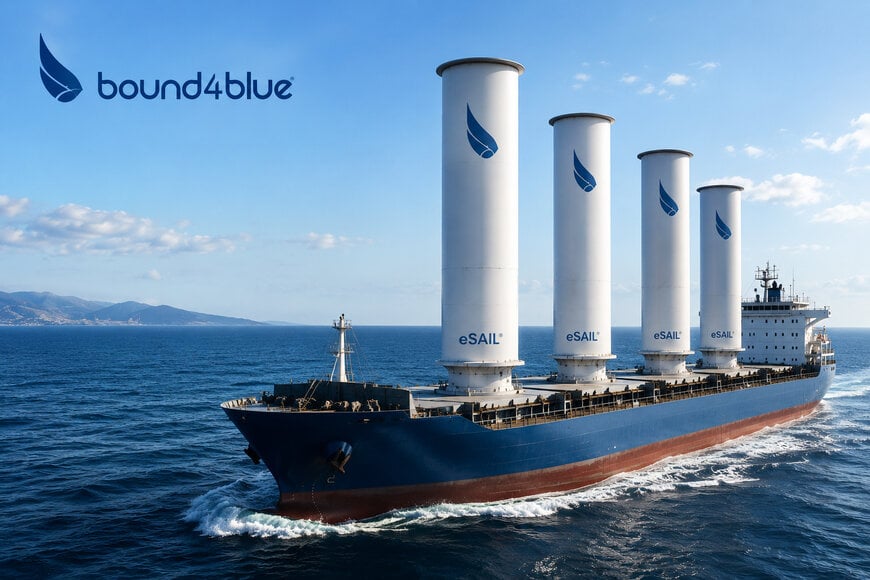
Wind-assisted propulsion is becoming an important option for improving vessel energy efficiency and meeting maritime decarbonization requirements. An independent review by ABS has assessed bound4blue's methodology for calculating aerodynamic force matrices used to determine Pwind values for eSAIL installations, supporting their use in regulatory compliance for commercial shipping.
Technical validation for regulatory calculations
The reviewed methodology combines Computational Fluid Dynamics (CFD), wind tunnel validation and aerodynamic analysis to generate vessel-specific force matrices. These matrices quantify the aerodynamic contribution of wind-assisted propulsion systems under different operating conditions.
Unlike full-scale performance testing, the methodology estimates aerodynamic forces through numerical simulation while accounting for sail-to-sail and ship-to-sail aerodynamic interactions. This enables calculations that reflect the characteristics of individual vessel configurations without requiring extensive onboard testing.
ABS reviewed the methodology in accordance with applicable International Maritime Organization (IMO) regulations and International Towing Tank Conference (ITTC) guidelines.
Supporting maritime compliance
Verified Pwind values can be incorporated into Energy Efficiency Design Index (EEDI) and Energy Efficiency Existing Ship Index (EEXI) calculations. They can also be used when determining the Wind Reward Factor under the FuelEU Maritime regulation.
Although the methodology does not estimate fuel consumption, hydrodynamic performance or emission reductions directly, it provides a standardized approach for quantifying the aerodynamic contribution of wind propulsion systems within regulatory frameworks.
Methodology assessment
According to bound4blue, the methodology integrates Reynolds-Averaged Navier-Stokes (RANS)-based CFD simulations, wind tunnel model testing and potential-based aerodynamic interference analysis for multiple eSAIL installations. The review concluded that the methodology provides a technically consistent process for generating aerodynamic polars and force matrices for individual vessel applications.
José Miguel Bermúdez, CEO and co-founder of bound4blue, said: "Independent review from leading Class Societies such as ABS gives stakeholders confidence that the aerodynamic methodology behind our Pwind calculations is robust, credible, and suitable for regulatory use. This creates a clear pathway to compliance, making it easier for shipowners to capture not only the environmental benefits of wind propulsion, but also the significant financial advantages available through today's regulatory frameworks."
Michael Kei, ABS Vice President of Technology, said: "ABS is committed to supporting the safe adoption of innovative technologies that help the industry comply with evolving regulations. We are pleased to work with bound4blue on their technology, helping provide a clear and consistent framework for evaluation of wind-assisted propulsion systems and supporting informed decision-making across the industry."
Technology context
bound4blue's eSAIL systems are autonomous suction sails designed for commercial vessels including tankers, bulk carriers, ro-ro vessels, ferries, cruise ships, gas carriers and general cargo ships. According to the company, the systems have been deployed on eleven vessels, with additional installations under contract.
Edited by Sucithra Mani, Induportals editor – adapted by AI.
www.bound4blue.com
