
www.aero-defence.tech
05
'26
Written on Modified on
Wind Propulsion Cuts Energy Use on South Pacific Vessel
SNA Tuha'a Pae Shipping Company integrates wind-assisted propulsion aboard Na Hiro E Pae to reduce energy consumption while maintaining passenger and cargo operations.
bound4blue.com
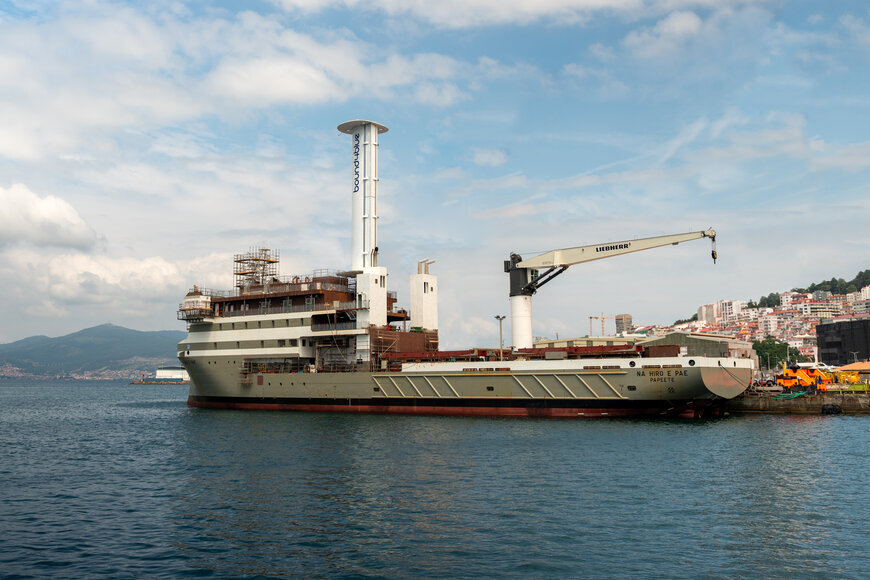
Application areas: Wind-assisted propulsion, marine energy efficiency, passenger and cargo transport
Industry sectors: Maritime transport, shipbuilding
SNA Tuha'a Pae Shipping Company has equipped its new multipurpose vessel Na Hiro E Pae with a 22-metre suction sail as part of a broader strategy to reduce energy consumption and the environmental impact of maritime services between Tahiti and the Austral Islands in French Polynesia.
The vessel combines passenger transport with the movement of food supplies and general cargo to remote island communities. Its operating profile requires sufficient flexibility for passenger services and frequent cargo handling, making the integration of wind-assisted propulsion more complex than on vessels with simpler operating patterns.
Reducing Energy Use Without Restricting Operations
Na Hiro E Pae, locally classified as a "goelette", has capacity for up to 200 passengers and can transport as much as 1,500 tonnes of cargo. It provides transport for residents, students and workers while carrying supplies required by communities across the Austral Islands.
For SNA Tuha'a Pae Shipping Company, improving the vessel's environmental performance therefore had to be balanced against operational requirements. The propulsion system could not interfere with loading and unloading activities or compromise the flexibility required by a multipurpose vessel.
Energy efficiency was incorporated into the vessel design from the outset. Alongside wind propulsion, the ship uses engines capable of operating with biofuel or e-fuel, electric pod propulsion, waste-management systems and equipment supporting onboard freshwater autonomy.
Using Wind to Reduce Engine Load
To supplement the vessel's conventional propulsion, SNA Tuha'a Pae Shipping Company selected a suction-sail system supplied by bound4blue.
Unlike a conventional fabric sail, the system uses a vertical aerodynamic profile combined with controlled air suction. The suction manages airflow around the profile and increases the aerodynamic lift generated by the available wind. This force is converted into forward thrust that assists the vessel's main propulsion system.
According to bound4blue, the configuration can generate up to seven times the propulsive force of a conventional rigid sail of equivalent size. By supplying part of the thrust required to move the vessel, the wind propulsion system reduces the load placed on the engines and consequently lowers energy consumption when operating conditions allow effective wind assistance.
The automated system was also relevant to the vessel's operating profile because it can provide wind assistance without requiring the crew to handle traditional sails.
Integrating Wind Propulsion on a Multipurpose Vessel
Multipurpose ships present particular integration challenges because deck space, cargo operations, passenger requirements and propulsion equipment must coexist without restricting vessel functionality.
For Na Hiro E Pae, the project required coordination between the shipowner, technology supplier, naval architects and shipyard to incorporate the 22-metre system into the newbuild design.
"Multipurpose vessels have traditionally been seen as a challenging segment for wind power, due to the required flexibility of operations and related integration demands," said José Miguel Bermúdez, CEO and co-founder of bound4blue.
The installation was completed at Astilleros Armon Vigo in Vigo, Spain, before delivery of the vessel. The ship was designed by Cotenaval.
Approximately 10% Lower Energy Consumption Expected
The single suction sail is expected to reduce Na Hiro E Pae's energy consumption by approximately 10%. Because wind-generated thrust reduces the propulsion demand placed on the engines, the system is also intended to lower associated fuel consumption and greenhouse gas emissions.
The installation is expected to contribute to improvements in the vessel's Energy Efficiency Design Index (EEDI) and Carbon Intensity Indicator (CII), linking the operational energy savings with maritime efficiency and emissions requirements.
For the shipowner, the technology is one component of a combined efficiency strategy rather than a standalone replacement for conventional propulsion.
"Sustainability was a key objective throughout the design process, and the eSAIL forms an important part of a wider package of technologies that will help us reduce energy consumption and environmental impact, while maintaining the reliable transport services our communities depend upon," said Boris Piel, Technical Director at SNA Tuha'a Pae Shipping Company.
Combining Efficiency With Regional Transport Requirements
Na Hiro E Pae demonstrates how wind-assisted propulsion can be integrated into a vessel whose operating requirements extend beyond point-to-point cargo transportation.
The ship must accommodate passengers, carry substantial cargo volumes and support loading and unloading operations while maintaining regular connections with remote islands. Integrating wind propulsion into the newbuild allowed SNA Tuha'a Pae Shipping Company to target lower propulsion energy demand without changing the vessel's fundamental transport role.
The project also forms part of a wider modernization of maritime links serving the Austral Islands. It received support through the French Polynesian Government's Appel à Manifestation d'Intérêt initiative for its contribution to fleet renewal, regional connectivity and improved environmental performance.
Edited by Sucithra Mani, Induportals editor – adapted by AI.
www.bound4blue.com
