
www.aero-defence.tech
15
'26
Written on Modified on
Synopsys supports Artemis with simulation for spacesuits and lunar networks
Digital engineering tools enable analysis of electrostatic effects and communication performance in simulated lunar environments for safer and more reliable missions.
www.synopsys.com
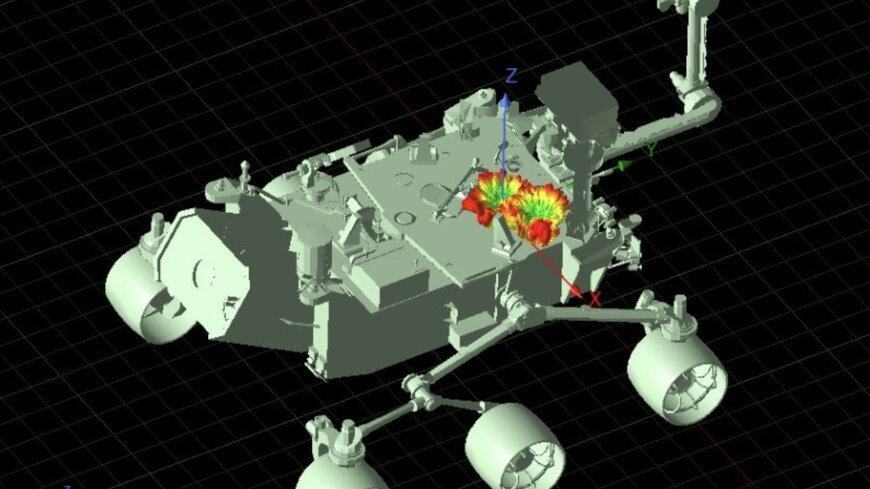
Aerospace engineering, space exploration, and communication systems require advanced simulation tools to validate performance under extreme conditions. Synopsys is contributing to NASA’s Artemis program by providing digital engineering solutions to analyze spacesuit safety and develop lunar communication systems through high-fidelity simulation and digital twin technologies.
Working with Electro Magnetic Applications, Inc. (EMA) and Cesium, part of Bentley Systems, Synopsys supports multiple NASA research initiatives, including projects at Johnson Space Center and Glenn Research Center. These efforts focus on reducing risks associated with lunar operations and enabling reliable communication infrastructure on the Moon.
Simulating electrostatic effects on spacesuits
One of the key challenges in lunar missions is managing electrostatic charging caused by interactions with lunar regolith and the surrounding plasma environment. These effects can lead to electrostatic discharge (ESD), which may damage critical electronics used for life support and communication in spacesuits.
To address this, Synopsys and EMA are using physics-based simulation workflows to evaluate how Artemis spacesuits respond to charging conditions. The analysis considers material properties, multi-layer structures, and environmental factors to estimate charge accumulation and discharge risks.
The simulations are conducted using specialized electromagnetic tools capable of modeling plasma interaction, surface charging, and charge transport in three-dimensional systems. These results are complemented by validation tests performed in controlled laboratory environments that replicate key aspects of space conditions.
Digital twin approach for lunar communication systems
In parallel, Synopsys is collaborating with Cesium and NASA’s Space Communications and Navigation (SCaN) program to support the development of a lunar cellular network. This involves integrating high-resolution 3D models of the Moon’s surface into a digital mission engineering environment.
Using this approach, engineers can simulate radio frequency (RF) signal propagation across realistic lunar terrain, including craters and rock formations. This enables the evaluation of antenna performance on spacesuits and rovers, as well as the identification of potential coverage gaps or “shadow zones.”
Such simulations help optimize the placement of communication infrastructure and ensure reliable connectivity for astronauts and autonomous systems operating on the lunar surface.
Reducing risk through virtual testing
The combined use of simulation and physical testing allows engineers to identify critical design factors before hardware deployment. By analyzing worst-case scenarios and validating results through laboratory experiments, teams can reduce uncertainty and improve system reliability.
This approach is particularly relevant for long-duration lunar missions, where equipment must operate continuously in harsh and unpredictable environments. Digital engineering tools enable faster iteration cycles, allowing design improvements to be implemented earlier in the development process.
Enabling future lunar missions
The integration of electromagnetic simulation, digital twin technology, and system-level modeling reflects a broader shift toward virtual validation in aerospace engineering. These tools support the design of both life-support systems and communication infrastructure, which are essential for sustained human presence on the Moon.
While similar simulation platforms exist in aerospace and defense, differentiation lies in the ability to combine multi-physics modeling with realistic environmental data and mission-level analysis. In this context, Synopsys’ contribution supports both safety-critical systems and communication networks required for future lunar exploration.
Edited by Natania Lyngdoh, Induportals Editor — Adapted by AI.
www.synopsys.com
