
www.aero-defence.tech
26
'26
Written on Modified on
Space Domain Awareness Platform Unifies Multi-Domain Command & Control
Saab launches the Allied Mission System to aggregate multi-sensor orbital tracking data and automate space command and control.
www.saab.com
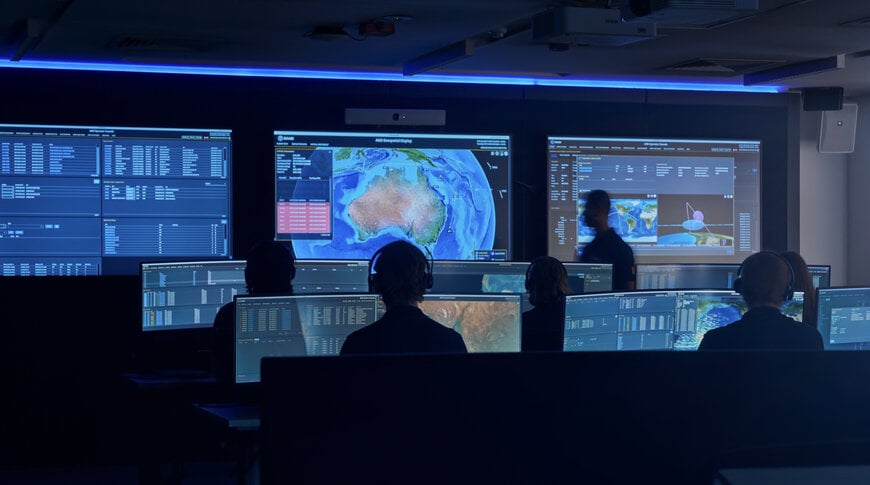
Rapidly expanding commercial satellite constellations and orbital debris have created congested orbital corridors where military and civil operators struggle to synthesize tracking telemetry across disparate sensing networks. To resolve these coordination challenges across space operations, Saab introduced the Allied Mission System (AMS), a cloud-based software platform engineered to aggregate multi-source surveillance data, perform automated threat analysis, and execute real-time command-and-control functions.
Data Fusion Architecture for High-Density Orbital Tracking
Monitoring objects across low Earth orbit and geosynchronous regimes requires processing disparate telemetry streams from optical telescopes, phased-array radars, passive radio frequency sensors, and commercial tracking feeds. Conventional space situational awareness tools frequently isolate these data sources within proprietary silos, producing conflicting orbital parameters and delaying collision or anomaly assessments.
The Allied Mission System resolves these bottlenecks through an open, modular software architecture that decouples underlying data pipelines, analytical algorithms, and operator applications. By utilizing standardized data ingestion layers, the platform normalizes heterogeneous sensor inputs and performs automated data correlation. This continuous processing workflow supports pattern-of-life analysis, behavioural anomaly tracking, and automated event prioritization. Ingested sensor telemetry is translated into a dynamic common operating picture, enabling operators to identify orbital trajectory deviations without manual data reconciliation.
Automated Sensor Tasking and Closed-Loop Mission Management
Beyond tracking and monitoring, effective space domain management requires closed-loop operational control. The platform links analytics directly to operational workflows, transitioning from situational tracking to mission planning and active sensor tasking. When the system detects orbital deviations or close-approach events, the built-in decision support engine determines sensor availability and automatically coordinates tracking queues across distributed network assets.
The software incorporates artificial intelligence modules that monitor internal system health and diagnostic telemetry, ensuring high software availability during mission-critical events. Delivering the platform via a Software as a Service model allows defense and civil space agencies to deploy tailored instances, update analytic modules independently, and interface directly with joint multi-domain operations ecosystems.
Additional Context:
This section details technical specifications and competitive benchmarking not included in the original product announcement.
The deployment of automated space domain awareness platforms coincides with a transition from static catalog tracking toward dynamic, multi-source space traffic coordination. As low Earth orbit catalog entries exceed 45,000 tracked objects, civil operators and defense organizations face severe scalability limits with legacy two-line element sets and manual orbital determination routines.
Comparable operational platforms in the space domain awareness sector include the United States Space Force Unified Data Library, which acts as a centralized repository ingesting military and commercial surveillance telemetry, and commercial analytical platforms such as Palantir WarpCore and Slingshot Aerospace's Slingshot Beacon. In contrast to purely analytical tools or static data clearinghouses, systems like the Allied Mission System merge space surveillance with active command and control architectures, mirroring the modular open system approaches established by standards such as NATO STANAG data models.
By integrating multi-sensor ingestion—including passive radio frequency tracking feeds from external sensor networks—the platform ingests upwards of ten million observations per day. This capability aligns with the broader defense transition toward Combined Joint All-Domain Command and Control frameworks, where space domain telemetry feeds directly into terrestrial, maritime, and air defense tasking networks.
Edited by Natania Lyngdoh, Induportals editor, with AI assistance.
www.saab.com
