
www.aero-defence.tech
06
'26
Written on Modified on
Core Stage Performance Validates Heavy-Lift Launch System
Boeing-built core stage powers NASA’s Space Launch System, demonstrating propulsion, control, and separation functions during crewed lunar mission.
www.boeing.com
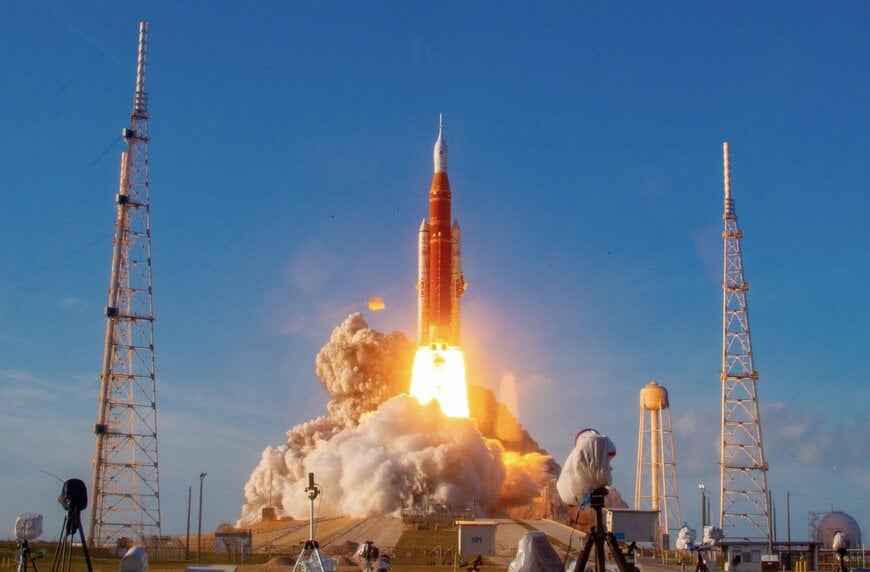
NASA successfully launched its Space Launch System (SLS), supported by a core stage developed by Boeing, marking a key milestone in human spaceflight beyond low Earth orbit. The launch enabled the Orion spacecraft to proceed on a crewed lunar trajectory, validating critical rocket stage operations.
Core stage propulsion and system performance
The SLS core stage operated for approximately eight and a half minutes, completing its primary propulsion phase before separating from the upper stage. During this period, it executed multiple mission-critical functions, including propellant loading, engine ignition, thrust vector control, and controlled shutdown.
The stage is powered by four RS-25 engines, delivering a combined thrust of approximately 2.2 million pounds. These engines, derived from Space Shuttle heritage systems, provide high-efficiency cryogenic propulsion using liquid hydrogen and liquid oxygen.
Cryogenic fuel system architecture
The core stage incorporates large-scale cryogenic storage, including:
- A liquid oxygen tank with a capacity of approximately 196,000 gallons
- A liquid hydrogen tank with a capacity of approximately 537,000 gallons
These tanks are connected via an intertank structure, with additional sections supporting integration with the upper stage and housing propulsion systems. The design enables sustained high-thrust operation required for deep-space missions.
Flight control and structural integration
During ascent, the core stage demonstrated thrust vector control, adjusting engine direction to maintain trajectory stability. Hydraulic systems enabled precise control of engine gimbaling under high dynamic loads.
Successful separation from the upper stage confirmed correct timing, structural integrity, and control system performance.
Manufacturing and supply chain coordination
The core stage is manufactured at NASA’s Michoud Assembly Facility in Louisiana, with components sourced from suppliers across more than 38 U.S. states. This distributed production model reflects the complexity of large-scale aerospace systems and the need for coordinated supply chains.
Role in lunar exploration missions
The launch supports a crewed lunar mission involving astronauts from NASA and the Canadian Space Agency. The validated performance of the core stage is critical for future missions in the Artemis program, including planned lunar landings and extended exploration.
Additional core stages for upcoming missions are already in production, indicating a transition from demonstration to sustained operational capability.
Relevance to high-reliability systems engineering
While primarily an aerospace development, the SLS core stage reflects broader principles relevant to advanced engineering domains, including:
Flight control and structural integration
During ascent, the core stage demonstrated thrust vector control, adjusting engine direction to maintain trajectory stability. Hydraulic systems enabled precise control of engine gimbaling under high dynamic loads.
Successful separation from the upper stage confirmed correct timing, structural integrity, and control system performance.
Manufacturing and supply chain coordination
The core stage is manufactured at NASA’s Michoud Assembly Facility in Louisiana, with components sourced from suppliers across more than 38 U.S. states. This distributed production model reflects the complexity of large-scale aerospace systems and the need for coordinated supply chains.
Role in lunar exploration missions
The launch supports a crewed lunar mission involving astronauts from NASA and the Canadian Space Agency. The validated performance of the core stage is critical for future missions in the Artemis program, including planned lunar landings and extended exploration.
Additional core stages for upcoming missions are already in production, indicating a transition from demonstration to sustained operational capability.
Relevance to high-reliability systems engineering
While primarily an aerospace development, the SLS core stage reflects broader principles relevant to advanced engineering domains, including:
- Integration of complex subsystems (propulsion, control, structures)
- High-reliability operation under extreme conditions
- Precision control through real-time feedback systems
These characteristics align with challenges in other high-performance industrial systems, where reliability, system integration, and control accuracy are critical.
Edited by Romila DSilva, Induportals Editor, with AI assistance.
Edited by Romila DSilva, Induportals Editor, with AI assistance.
