
www.aero-defence.tech
25
'25
Written on Modified on
Firefly picks Blue Origin's Honeybee Robotics for lunar rover
As part of Firefly’s third mission to the Moon, Blue Origin’s Honeybee Robotics rover will help investigate the composition of the Gruithuisen Gamma Dome.
fireflyspace.com
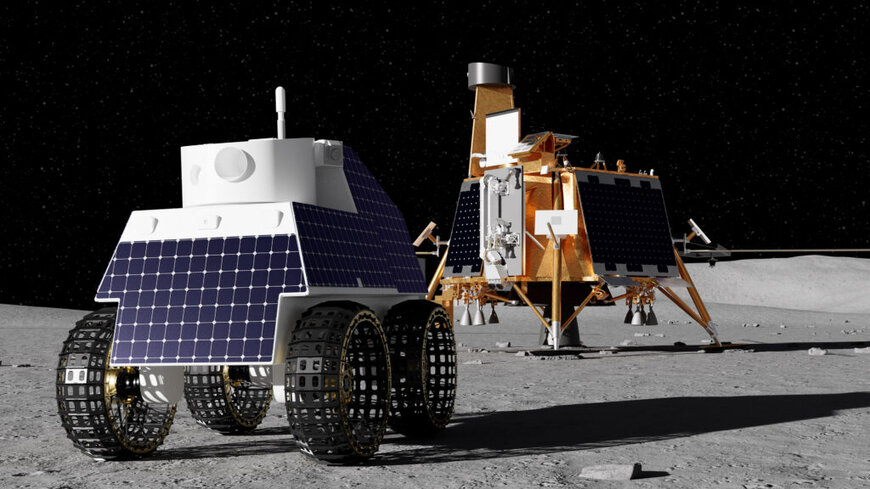
Firefly Aerospace and Honeybee Robotics, a Blue Origin company, today announced Honeybee was contracted by Firefly to provide the lunar rover for the company’s recently awarded NASA task order to explore the Gruithuisen Domes on the Moon’s near side in 2028. Once deployed on the Moon by Firefly’s Blue Ghost lander, Honeybee’s rover will carry NASA instruments to investigate the unique composition of the Gruithuisen Domes – a part of the Moon that has never been explored.
During mission operations, Firefly’s Elytra Dark transfer vehicle will first deploy the Blue Ghost lander into lunar orbit and then remain on orbit to provide long-haul communications. Blue Ghost will then land in the Gruithuisen Domes, deploy the Honeybee Robotics rover, and support payload operations for approximately 14 days on the lunar surface.
“Firefly is proud to partner with Honeybee Robotics to help us explore the challenging Gruithuisen Domes terrain on our third mission to the Moon,” said Shea Ferring, Chief Technology Officer at Firefly Aerospace. “The Firefly team has worked closely with Honeybee on two payloads – the Lunar PlanetVac and LISTER subsurface drill – that were successfully operated on our first Blue Ghost mission to the Moon. Their stellar team, robust rover solution, and flight proven technologies made Honeybee the obvious choice!”
As part of Firefly’s third mission to the Moon, Honeybee’s rover will help investigate the subsurface composition of the Gruithuisen Gamma Dome carrying elements of NASA’s Lunar Vulkan Imaging and Spectroscopy Explorer (Lunar-VISE) suite. Lunar-VISE has multiple instruments, including two cameras attached to Firefly’s Blue Ghost lander that will characterize the landing site and rover traverse as well as an infrared multi-spectral camera system and a spectrometer attached to Honeybee’s rover that will measure gamma ray and neutron emissions.
The rover will travel along the southern edge of the Gruithuisen Gamma Dome and through a boulder field to reach the rim of a recent impact crater. The rover will then traverse back to the lander just before sunset to enable repeat observations of boulder targets at different solar illumination angles.
In total, there are six NASA-sponsored payloads onboard Firefly’s Blue Ghost Mission 3 that aim to uncover the composition and fundamental volcanic processes that formed the domes, in addition to other science investigations and technology demonstrations. This mission will follow Firefly’s first mission to the Moon that successfully landed in Mare Crisium and completed 14 days of surface operations in March 2025. Firefly’s second lunar mission is set to launch in 2026 with operations in lunar orbit and on the far side of the Moon.
www.fireflyspace.com
