
www.aero-defence.tech
20
'26
Written on Modified on
Radioisotope Heating Supports Extended Lunar Surface Operations
Firefly Aerospace and Zeno Power are cooperating on a lunar payload demonstration designed to provide thermal energy during the 14-day lunar night for future spacecraft and surface infrastructure.
fireflyspace.com
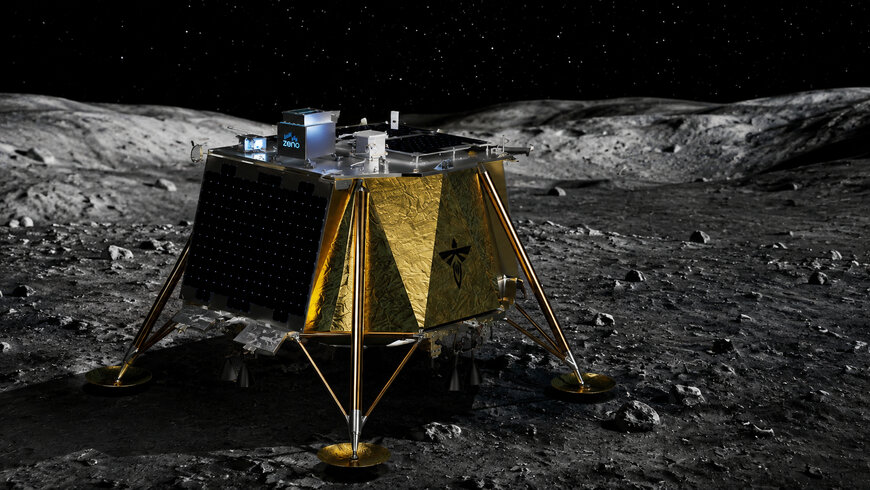
The cooperation targets robotic lunar missions, future surface infrastructure and Moon Base systems that require operation beyond the approximately 14 Earth days of daylight. During lunar night, surface temperatures can fall below -275°F, creating thermal conditions that can affect electronics, batteries, communications equipment and other spacecraft subsystems.
Firefly Aerospace will host Zeno Power Systems’ Survive-the-Night Package on a planned mission to the Moon’s near side, scheduled for launch no earlier than 2028. The mission will use Firefly’s lunar landing and surface-operation capabilities, while Zeno provides the radioisotope heating technology and associated payload platform.
Radioisotope heater provides continuous thermal energy
The payload includes a 5-watt thermal radioisotope heater unit (RHU) using americium-241. The RHU produces heat through the natural radioactive decay of the isotope, allowing thermal energy to be generated without solar illumination or active electrical heating.
Zeno’s payload also incorporates structural, communications, electrical power, command and data handling, and thermal management subsystems. These components provide the interfaces required to operate the RHU payload and transmit operational data during the lunar night.
The approach is relevant to digital infrastructure and other lunar systems in which maintaining a controlled thermal environment is necessary for continued operation. Permanently shadowed regions are another potential application area because they do not receive direct sunlight.
Deployment after lunar-day operations
Following landing, Blue Ghost will first operate multiple NASA Commercial Lunar Payload Services (CLPS) payloads using solar power throughout the lunar day. Zeno’s system will subsequently operate during the lunar night and transmit performance data to Earth.
The demonstration is intended to generate operational data on radioisotope-based thermal management under lunar environmental conditions. This can help evaluate system behavior during prolonged darkness and extreme cold, providing engineering information for future robotic and human lunar missions.
Complementary roles support system integration
Firefly’s role combines lunar transportation, landing and surface operations, while Zeno contributes the radioisotope heating system and its supporting platform. The division of responsibilities allows the thermal technology to be evaluated within an operational lunar mission rather than as an isolated ground demonstration.
The mission follows Firefly’s first successful lunar landing in 2025 and is intended to contribute data for technologies supporting longer-duration lunar surface operations.
Edited by Sucithra Mani, Induportals editor – adapted by AI.
www.fireflyspace.com
