
www.aero-defence.tech
31
'24
Written on Modified on
ZF MARINE EXPANDS THRUSTER PORTFOLIO WITH NEW ZF AT 50 SERIES
The new azimuth thruster provides propulsion for vessels with power outputs of max. 815 kW per single unit and a bollard pull of up to 28 tonnes with a twin thruster installation.
www.zf.com
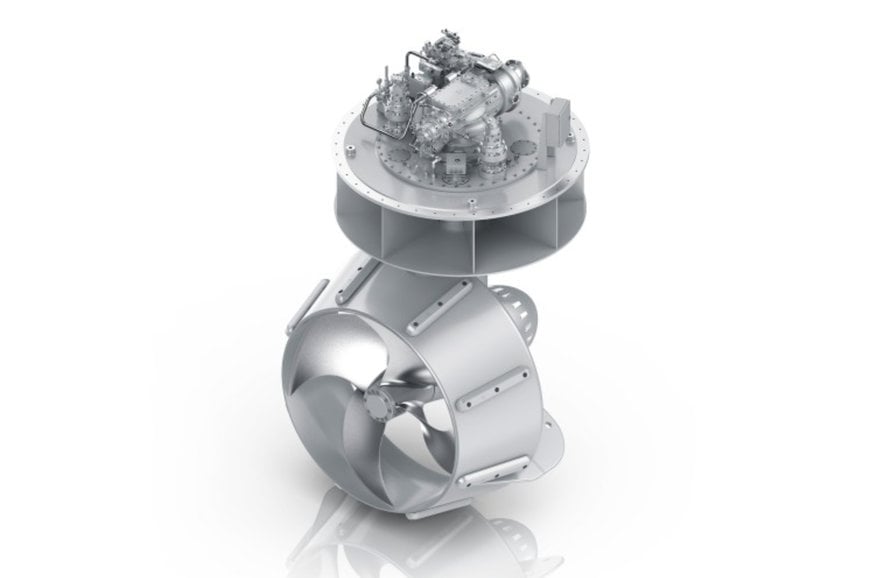
Photo: ZF
With the new azimuth thruster ZF AT 50, ZF is making optimized propulsion available to a wider range of maritime vessels with outputs of up to 815 kW. Sporting a new gear design and casing, the ZF AT 50 is up to 17 percent more efficient than its predecessor and comparable market solutions. The ZF AT 50 is available as an L- or Z-drive and can be installed as a well-mounted, deck-mounted, stern-mounted as well as a tunnel or retractable thruster. This, combined with a variety of possible add-ons, makes the new model the perfect fit for many different vessel types and applications – from tugboats to superyachts.
Building upon its experience and reputation as a maritime propulsion expert, ZF has expanded its azimuth thruster portfolio with the new AT 50 for vessels with an output of up to 815 kW.
German-Dutch collaboration, world-class efficiency
Besides its performance class, another notable metric is the thruster’s bollard pull of 28 tonnes in a twin installation (max., depending on engine power). This makes it especially useful for tugboats, offshore support vessels, icebreakers, dredgers as well as salvage and rescue ships.
The new AT propulsion series also marks the first time where a maritime product was developed jointly with ZF’s Friedrichshafen (Germany) location.
This synergy is unique in the Maritime world: as a result, the ZF AT 50 boasts an optimized gear design and hydrodynamic casing, offering up to 17 percent more thrust and bollard pull than its predecessor. This means that vessels can achieve the same level of performance with less engine power, thus potentially reducing emissions and lifecycle costs. Alternatively, the thruster enables higher vessel speed and bollard pull with the same engine power.
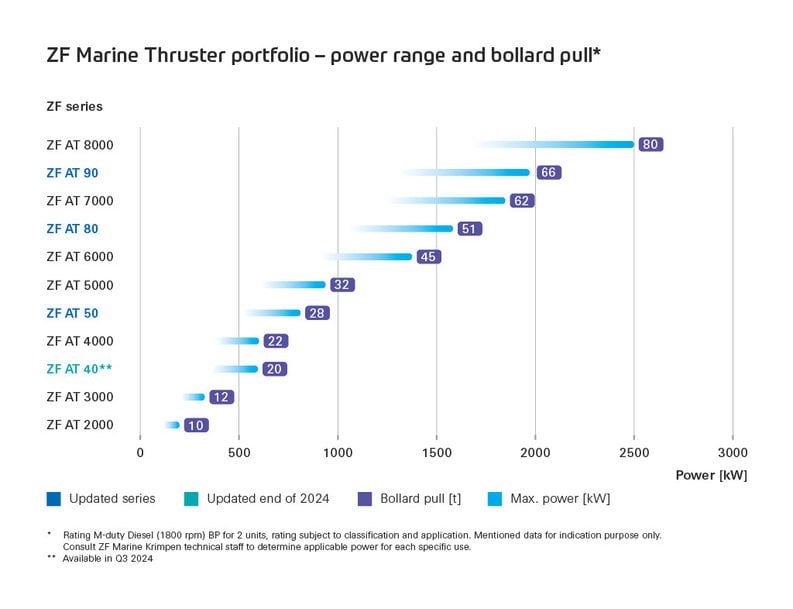
ZF Marine Thruster Portfolio: Power range and bollar pull Photo: ZF
Pick and choose: Suitable for a wide range of vessel types
The ZF AT 50 is available as a well-mounted, deck-mounted and stern-mounted type as well as tunnel or retractable thruster, plus configurable as either an L- or Z-Drive. A flat and lean design saves on installation space.
In addition, ZF offers a variety of possible add-ons. For operators, this includes the ZF AutoTroll feature, which allows for precision adjustments to thrust when manoeuvring even below the engine’s idle speed. For more sustainability, ZF can supply a special seal arrangement for environmental protection. The WM type of the ZF AT 50 Z-drive can also be outfitted as a hybrid drive for locally emission-free propulsion. Further on-board equipment can be driven by an optional PTO.
Customers can also expect the ease of mind that comes with ZF’s worldwide 24/7 support and spare parts availability. Even better maintenance is possible with the ZF ProVID condition monitoring system that can detect potential damages early on. This optimizes the availability and operating times of the ship, reduces operating costs and improves the performance of the components in terms of service life and efficiency.
With the new azimuth thruster ZF AT 50, ZF is making optimized propulsion available to a wider range of maritime vessels with outputs of up to 815 kW. Sporting a new gear design and casing, the ZF AT 50 is up to 17 percent more efficient than its predecessor and comparable market solutions. The ZF AT 50 is available as an L- or Z-drive and can be installed as a well-mounted, deck-mounted, stern-mounted as well as a tunnel or retractable thruster. This, combined with a variety of possible add-ons, makes the new model the perfect fit for many different vessel types and applications – from tugboats to superyachts.
Building upon its experience and reputation as a maritime propulsion expert, ZF has expanded its azimuth thruster portfolio with the new AT 50 for vessels with an output of up to 815 kW.
German-Dutch collaboration, world-class efficiency
Besides its performance class, another notable metric is the thruster’s bollard pull of 28 tonnes in a twin installation (max., depending on engine power). This makes it especially useful for tugboats, offshore support vessels, icebreakers, dredgers as well as salvage and rescue ships.
The new AT propulsion series also marks the first time where a maritime product was developed jointly with ZF’s Friedrichshafen (Germany) location.
This synergy is unique in the Maritime world: as a result, the ZF AT 50 boasts an optimized gear design and hydrodynamic casing, offering up to 17 percent more thrust and bollard pull than its predecessor. This means that vessels can achieve the same level of performance with less engine power, thus potentially reducing emissions and lifecycle costs. Alternatively, the thruster enables higher vessel speed and bollard pull with the same engine power.
ZF Marine Thruster Portfolio: Power range and bollar pull Photo: ZF
Pick and choose: Suitable for a wide range of vessel types
The ZF AT 50 is available as a well-mounted, deck-mounted and stern-mounted type as well as tunnel or retractable thruster, plus configurable as either an L- or Z-Drive. A flat and lean design saves on installation space.
In addition, ZF offers a variety of possible add-ons. For operators, this includes the ZF AutoTroll feature, which allows for precision adjustments to thrust when manoeuvring even below the engine’s idle speed. For more sustainability, ZF can supply a special seal arrangement for environmental protection. The WM type of the ZF AT 50 Z-drive can also be outfitted as a hybrid drive for locally emission-free propulsion. Further on-board equipment can be driven by an optional PTO.
Customers can also expect the ease of mind that comes with ZF’s worldwide 24/7 support and spare parts availability. Even better maintenance is possible with the ZF ProVID condition monitoring system that can detect potential damages early on. This optimizes the availability and operating times of the ship, reduces operating costs and improves the performance of the components in terms of service life and efficiency.
www.zf.com
