
www.aero-defence.tech
23
'24
Written on Modified on
AIRBUS AWARDED SPACE WEATHER SPACECRAFT MISSION VIGIL
Vigil will provide more accurate warning of impending solar storms to help protect satellites in space and electronics on Earth.
www.airbus.com
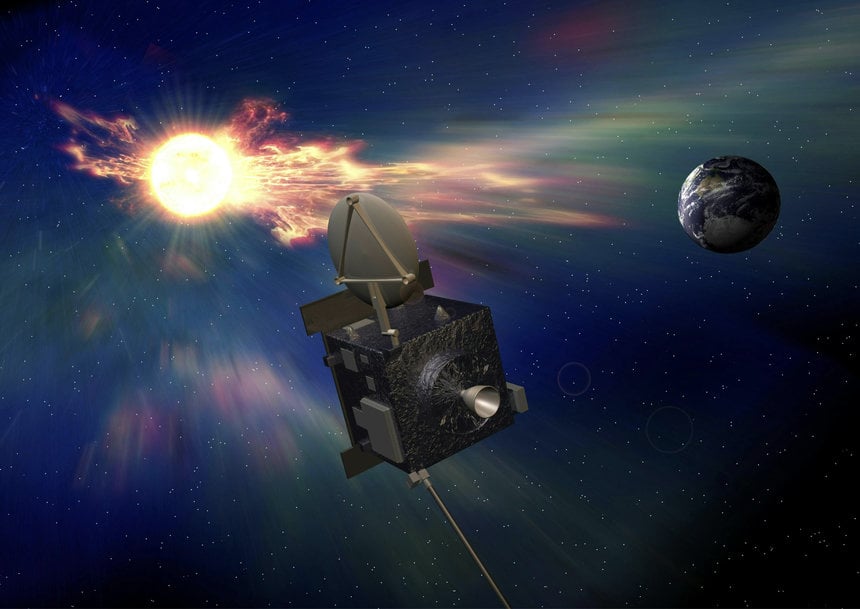
Artist view: Vigil space weather satellite Copyright Airbus
Airbus has been selected by the European Space Agency (ESA) to design and build the space weather forecasting satellite Vigil, the first operational mission in ESA’s Space Situational Awareness (SSA) Space Safety Programme (S2P). The spacecraft will give vital extra warning to Earth about incoming solar storms and coronal mass ejections which can potentially disrupt satellites in orbit and electronic and power distribution systems on Earth.
Vigil will be positioned at Lagrange point L5 on the same orbit as the Earth, 150 million km behind it as the Earth orbits the Sun. This will enable Vigil to see the Sun as it rotates, and see the size and speed of solar weather heading towards the Earth. Data from Vigil could provide notice of four to five days of solar winds streaming toward Earth.
From its particular vantage point, Vigil will complement other satellites monitoring the Sun from closer to the Earth. Among the most potentially damaging events are coronal mass ejections (CMEs) from the Sun, consisting of a magnetised plasma containing protons, electrons and other charged particles. In 1989 a major geomagnetic storm struck Earth and caused a nine-hour outage of electricity transmission across Quebec.
Advance warning of incoming CME will enable power companies and authorities to shut down systems temporarily to protect them from power surges and ensure they can be powered up quickly after the danger has passed. This will avoid longer power outages and major damage to electronic systems used for global positioning and communication services.
Vigil, which will be built in the UK, will include a compact coronagraph developed by the U.S. Naval Research Laboratory, a heliographic imager from Florence-based Leonardo SpA and a photo-magnetospheric field Imager from Germany’s Max Planck Institute. In addition, Vigil will carry a plasma analyser from the Mullard Space Science Laboratory in London and a magnetometer from Imperial College London. NASA is providing Vigil’s sixth instrument, an extreme ultraviolet imager.
The spacecraft platform will provide the best environment for high-quality scientific measurements, including tight magnetic cleanliness and contamination control measures. Being an operational mission, the design of the satellite has to be extremely resilient to ensure the continuous, flawless operation of its instruments and high reliability in data transmission for users, especially in case of a major solar event.
Vigil, due to be launched in 2031, will be the first ESA spacecraft to be positioned at L5 and is designed to operate in orbit for more than 7.5 years.
Airbus has been selected by the European Space Agency (ESA) to design and build the space weather forecasting satellite Vigil, the first operational mission in ESA’s Space Situational Awareness (SSA) Space Safety Programme (S2P). The spacecraft will give vital extra warning to Earth about incoming solar storms and coronal mass ejections which can potentially disrupt satellites in orbit and electronic and power distribution systems on Earth.
Vigil will be positioned at Lagrange point L5 on the same orbit as the Earth, 150 million km behind it as the Earth orbits the Sun. This will enable Vigil to see the Sun as it rotates, and see the size and speed of solar weather heading towards the Earth. Data from Vigil could provide notice of four to five days of solar winds streaming toward Earth.
From its particular vantage point, Vigil will complement other satellites monitoring the Sun from closer to the Earth. Among the most potentially damaging events are coronal mass ejections (CMEs) from the Sun, consisting of a magnetised plasma containing protons, electrons and other charged particles. In 1989 a major geomagnetic storm struck Earth and caused a nine-hour outage of electricity transmission across Quebec.
Advance warning of incoming CME will enable power companies and authorities to shut down systems temporarily to protect them from power surges and ensure they can be powered up quickly after the danger has passed. This will avoid longer power outages and major damage to electronic systems used for global positioning and communication services.
Vigil, which will be built in the UK, will include a compact coronagraph developed by the U.S. Naval Research Laboratory, a heliographic imager from Florence-based Leonardo SpA and a photo-magnetospheric field Imager from Germany’s Max Planck Institute. In addition, Vigil will carry a plasma analyser from the Mullard Space Science Laboratory in London and a magnetometer from Imperial College London. NASA is providing Vigil’s sixth instrument, an extreme ultraviolet imager.
The spacecraft platform will provide the best environment for high-quality scientific measurements, including tight magnetic cleanliness and contamination control measures. Being an operational mission, the design of the satellite has to be extremely resilient to ensure the continuous, flawless operation of its instruments and high reliability in data transmission for users, especially in case of a major solar event.
Vigil, due to be launched in 2031, will be the first ESA spacecraft to be positioned at L5 and is designed to operate in orbit for more than 7.5 years.
www.airbus.com
