
www.aero-defence.tech
07
'23
Written on Modified on
EUCLID EUROPEAN SCIENTIFIC SATELLITE SUCCESSFULLY LAUNCHED
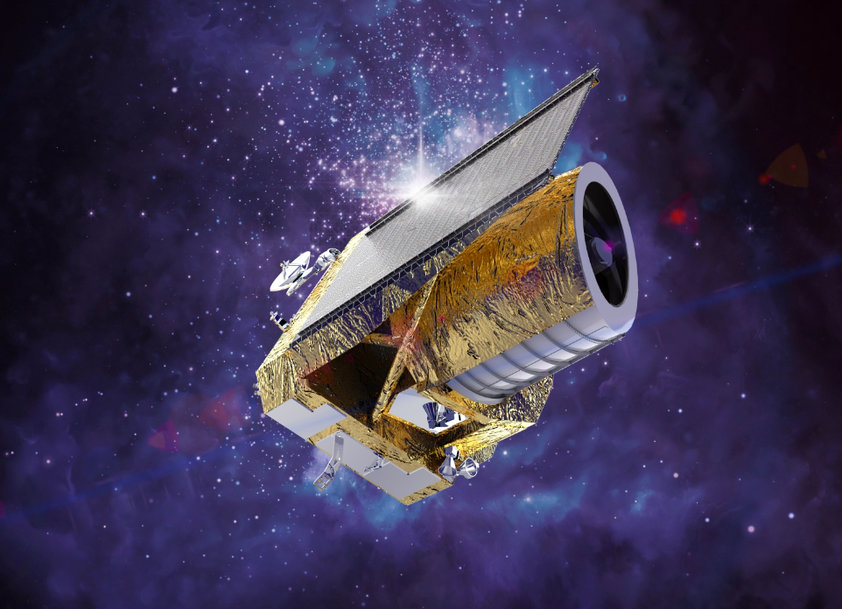
Thales Alenia Space is the prime contractor for the European scientific satellite Euclid which has been successfully launched to explore dark energy and the mysteries of dark matter, thus contributing to understanding some of the secrets of the universe.
© Thales Alenia Space
The Euclid ESA mission will explore dark energy and dark matter to better understand the origin of the accelerated expansion of the universe.
Euclid is the technological gem in the ambitious scientific missions of the European Space Agency (ESA) with the contribution of many national space agencies, including ASI, CNES and UKSA - the Italian, French and UK Space Agencies. It was successfully launched atop a SpaceX Falcon 9 vehicle from Cape Canaveral in Florida.
During its six-year mission, Euclid will map the universe's large-scale structure out to a distance of more than 10 billion light-years to show how it has expanded and how its structure has evolved over the last three-quarters of its history.
The mission is designed to answer some of the most fundamental questions in modern cosmology, such as how the universe formed and why it is expanding at an accelerating rate instead of being slowed by gravitational attraction.
Euclid is set to map several billion galaxies in three dimensions. The light from these galaxies is deflected by gravitational interaction with dark and luminous interstellar matter before it reaches us on Earth, an effect known as gravitational lensing, producing a distortion in the galaxies' shape. By measuring such distortions in imagery obtained by Euclid, scientists will be able to observe how the mysterious dark matter is distributed throughout the universe and how it is evolving over cosmic timescales, under the combined effect of gravity and dark energy—key to understanding why the universe’s expansion is now accelerating after billions of years from the Big Bang.
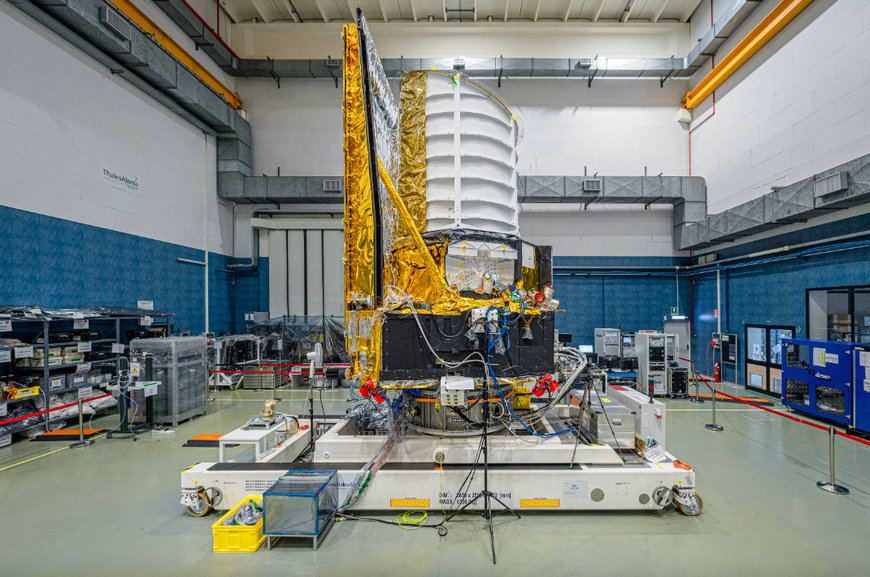
Thales Alenia Space is the prime contractor for Euclid mission satellite and is also responsible for its service module, as well as leading the industrial team of more than 80 highly specialized companies and 140 subcontractors from 20 European countries, among them Airbus Defence and Space supplying the telescope, Leonardo providing key equipment, and a variety of highly-skilled small and medium-sized companies. Thales Alenia Space program team and the entire industrial consortium have been working on this amazing mission for ten years, since July 2013. This mission is particularly important for Thales Alenia Space’s teams as it perfectly illustrates the company’s purpose – Space for Life – for a better understanding of Earth and the Universe.
© Thales Alenia Space
A complex orchestra with instruments playing together
Euclid’s payload consists of a 1.2-meter-diameter telescope and a cold optical bench housing the focal plane of the two optical instruments: the Visible Instrument (VIS) and the Near Infrared Spectrometer and Photometer (NISP). Euclid’s telescope is designed to operate in the visible portion of the spectrum and the near-infrared, just beyond the range of red wavelengths the human eye can see. It will collect light from distant cosmic objects and convey it to the two instruments. These two instruments will operate in tandem, simultaneously recording data from the same patch of sky targeted by the telescope.
The Euclid ESA mission will explore dark energy and dark matter to better understand the origin of the accelerated expansion of the universe.
Euclid is the technological gem in the ambitious scientific missions of the European Space Agency (ESA) with the contribution of many national space agencies, including ASI, CNES and UKSA - the Italian, French and UK Space Agencies. It was successfully launched atop a SpaceX Falcon 9 vehicle from Cape Canaveral in Florida.
During its six-year mission, Euclid will map the universe's large-scale structure out to a distance of more than 10 billion light-years to show how it has expanded and how its structure has evolved over the last three-quarters of its history.
The mission is designed to answer some of the most fundamental questions in modern cosmology, such as how the universe formed and why it is expanding at an accelerating rate instead of being slowed by gravitational attraction.
Euclid is set to map several billion galaxies in three dimensions. The light from these galaxies is deflected by gravitational interaction with dark and luminous interstellar matter before it reaches us on Earth, an effect known as gravitational lensing, producing a distortion in the galaxies' shape. By measuring such distortions in imagery obtained by Euclid, scientists will be able to observe how the mysterious dark matter is distributed throughout the universe and how it is evolving over cosmic timescales, under the combined effect of gravity and dark energy—key to understanding why the universe’s expansion is now accelerating after billions of years from the Big Bang.
Thales Alenia Space is the prime contractor for Euclid mission satellite and is also responsible for its service module, as well as leading the industrial team of more than 80 highly specialized companies and 140 subcontractors from 20 European countries, among them Airbus Defence and Space supplying the telescope, Leonardo providing key equipment, and a variety of highly-skilled small and medium-sized companies. Thales Alenia Space program team and the entire industrial consortium have been working on this amazing mission for ten years, since July 2013. This mission is particularly important for Thales Alenia Space’s teams as it perfectly illustrates the company’s purpose – Space for Life – for a better understanding of Earth and the Universe.
© Thales Alenia Space
A complex orchestra with instruments playing together
Euclid’s payload consists of a 1.2-meter-diameter telescope and a cold optical bench housing the focal plane of the two optical instruments: the Visible Instrument (VIS) and the Near Infrared Spectrometer and Photometer (NISP). Euclid’s telescope is designed to operate in the visible portion of the spectrum and the near-infrared, just beyond the range of red wavelengths the human eye can see. It will collect light from distant cosmic objects and convey it to the two instruments. These two instruments will operate in tandem, simultaneously recording data from the same patch of sky targeted by the telescope.
- The VIS instrument will precisely measure galaxy shapes by using the clearest images of distant galaxies, via a mosaic of 36 CCD sensors, each composed of a matrix of 4,000 x 4,000 pixels. This gives the detector a total of more than 600 megapixels.
- The NISP instrument will use 16 HgCdTe near-infrared detectors, each composed of a matrix of 2000 x 2000 pixels, and will obtain spectroscopic measurements of galaxies by splitting their light into individual wavelengths to deduce their redshift. This will allow cosmologists to estimate from their recession speed how far away these galaxies are.
Combining VIS and NISP data will help scientists to determine the growth rate of galactic structures and thus measure the amount of dark matter and dark energy and discern a possible effect of different behaviour of gravity at the cosmic scale from Einstein’s General Relativity predictions. Euclid’s data will constitute the largest, most accurate 3D survey of the Universe ever undertaken.
Communicating at a 1.5 million kilometres distance
Standing 4.7 meters tall and weighing about 2 metric tons at launch, Euclid will deliver 150,000 high-definition images and associated chromatic and spectral information, amounting up to 850 gigabits of data per day. This huge amount of data will be transmitted by the satellite from its orbit around the L2 Sun-Earth Lagrangian point at a distance of 1.5 million kilometres from the Earth, using its K-band (26 GHz) radiofrequency data transmission system. Euclid also incorporates an X-band system to control and monitor the spacecraft and measure its distance to Earth.
Communicating at a 1.5 million kilometres distance
Standing 4.7 meters tall and weighing about 2 metric tons at launch, Euclid will deliver 150,000 high-definition images and associated chromatic and spectral information, amounting up to 850 gigabits of data per day. This huge amount of data will be transmitted by the satellite from its orbit around the L2 Sun-Earth Lagrangian point at a distance of 1.5 million kilometres from the Earth, using its K-band (26 GHz) radiofrequency data transmission system. Euclid also incorporates an X-band system to control and monitor the spacecraft and measure its distance to Earth.
