
www.aero-defence.tech
17
'23
Written on Modified on
JUPITER'S MOONS TO BE STUDIED WITH HENSOLDT TECHNOLOGY
HENSOLDT supplies essential technology for the JUICE mission (Jupiter Icy Moons Explorer) of the European Space Agency ESA.
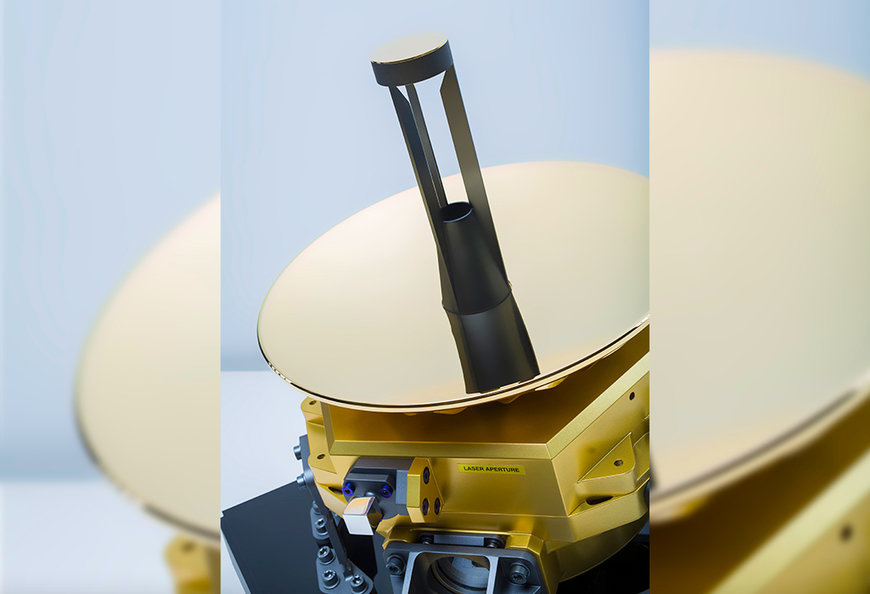
The GALA laser altimeter is used to create a surface profile of Ganymede. Photo: HENSOLDT AG
The JUICE space probe was recently launched from the European spaceport Kourou in French Guyana. HENSOLDT in Oberkochen supplies essential technology for the JUICE mission.
The Ganymede Laser Altimeter GALA of the German Aerospace Center (DLR) will be used to measure Jupiter's largest moon Ganymede. HENSOLDT supplies the transmitter-receiver unit for the GALA laser altimeter as well as the laser electronics unit that controls the laser transmitter. GALA is crucial for the exploration of the Jupiter system and the creation of a surface profile of Ganymede.
HENSOLDT's lasers for space applications benefit from insights and experience gained with its very successful laser rangefinders for military applications. The best practices and lessons learned with terrestrial lasers, paired with excellence in space instrumentation, enabled HENSOLDT’s engineers to enter the field of laser-assisted planetary observation. In the past, HENSOLDT participated in BepiColombo, the first ESA mission to Mercury, with its BELA laser altimeter.
One of the main technical challenges in the Jupiter system is the immense ionising radiation exposure caused by the trapping of energetic charged particles in Jupiter's strong magnetic field. The spacecraft must fly through this intense radiation belt and therefore have appropriate protection. The power supply for the laser transmitter-receiver unit is provided by solar panels. However, due to the large distance to the sun, their efficiency is very limited.
HENSOLDT Space Consulting from France has also contributed to JUICE. In close collaboration with the French research institute Centre National de Recherche Scientifique (CNRS), it has contributed to the product assurance of three instruments starting from the early design phase: MAJIS (Moon And Jupiter Imaging Spectrometer), SWI (Submillimetre Wave Instrument) and the Search Coil Magnetometer Sub-system, as well as the MIME Electronic Board to the RPWI (Radio & Plasma Waves Investigation) instrument.
The JUICE mission will explore Ganymede, Europa and Callisto, three icy moons of Jupiter. The satellite is launched on an Ariane 5 launcher. The flight to Jupiter will take almost eight years. The space probe should then reach Ganymede at the end of 2034. JUICE will observe the gas planet Jupiter for at least three years and study its icy moons in detail.
The JUICE space probe was recently launched from the European spaceport Kourou in French Guyana. HENSOLDT in Oberkochen supplies essential technology for the JUICE mission.
The Ganymede Laser Altimeter GALA of the German Aerospace Center (DLR) will be used to measure Jupiter's largest moon Ganymede. HENSOLDT supplies the transmitter-receiver unit for the GALA laser altimeter as well as the laser electronics unit that controls the laser transmitter. GALA is crucial for the exploration of the Jupiter system and the creation of a surface profile of Ganymede.
HENSOLDT's lasers for space applications benefit from insights and experience gained with its very successful laser rangefinders for military applications. The best practices and lessons learned with terrestrial lasers, paired with excellence in space instrumentation, enabled HENSOLDT’s engineers to enter the field of laser-assisted planetary observation. In the past, HENSOLDT participated in BepiColombo, the first ESA mission to Mercury, with its BELA laser altimeter.
One of the main technical challenges in the Jupiter system is the immense ionising radiation exposure caused by the trapping of energetic charged particles in Jupiter's strong magnetic field. The spacecraft must fly through this intense radiation belt and therefore have appropriate protection. The power supply for the laser transmitter-receiver unit is provided by solar panels. However, due to the large distance to the sun, their efficiency is very limited.
HENSOLDT Space Consulting from France has also contributed to JUICE. In close collaboration with the French research institute Centre National de Recherche Scientifique (CNRS), it has contributed to the product assurance of three instruments starting from the early design phase: MAJIS (Moon And Jupiter Imaging Spectrometer), SWI (Submillimetre Wave Instrument) and the Search Coil Magnetometer Sub-system, as well as the MIME Electronic Board to the RPWI (Radio & Plasma Waves Investigation) instrument.
The JUICE mission will explore Ganymede, Europa and Callisto, three icy moons of Jupiter. The satellite is launched on an Ariane 5 launcher. The flight to Jupiter will take almost eight years. The space probe should then reach Ganymede at the end of 2034. JUICE will observe the gas planet Jupiter for at least three years and study its icy moons in detail.
www.hensoldt.net
