
www.aero-defence.tech
04
'26
Written on Modified on
Leonardo Unveils Advanced Naval Combat Management Systems
The company strengthens naval command and control capabilities through modular architectures and artificial intelligence designed to counter modern maritime threats across all diverse combat platforms.
www.leonardo.com
Modern naval defense environments require rapid automated data processing to manage saturation attacks from unmanned systems, ballistic trajectories, and hypersonic weapons across multidomain operational theaters. To resolve the sensor-to-shooter latency bottlenecks inherent in legacy centralized architectures, modern command and control platforms must decouple individual functional services while delivering real-time situational awareness across diverse ship classes.
Microservice Architecture and High-End Combat Management
At the Euronaval exhibition in Paris-Nord Villepinte, Leonardo introduced SADOC 5, a command and control system designed to serve as the technological standard for future naval combatants, including the Italian Navy DDX destroyers. Moving away from monolithic legacy software, the platform uses a modular microservice architecture. In this design, discrete functional services such as sensor integration, track correlation, threat evaluation, and weapon assignment operate as containerized or independently deployable units. This structural decoupling prevents localized computing bottlenecks, accelerates software deployment cycles, and allows individual capability upgrades without requiring complete system recertification.
The platform integrates artificial intelligence algorithms specifically targeted at reducing operator cognitive workload and accelerating decision-making loops during saturation scenarios. In air defense missions, the system automates multi-sensor data fusion to track and prioritize high-velocity and asymmetric threats, such as unmanned aerial vehicles, ballistic missiles, and hypersonic glide vehicles. By executing real-time threat evaluation and weapon assignment calculations, the architecture coordinates effector responses to compress engagement cycle timelines. Furthermore, the framework is engineered for multidomain integration, coordinating external sensor feeds and strike assets within wider system-of-systems networks, including the Michelangelo Dome operational architecture.
Tailored Command and Control for Light Naval Vessels
For smaller surface combatants, patrol vessels, and auxiliary units that operate with constrained power, space, and crewing, Leonardo subsidiary GEM Elettronica developed the ATHENA L system. Built for platforms requiring a light combat system, ATHENA L scales the operational workload down to match optimized physical and computational footprints without losing core command and control capabilities.
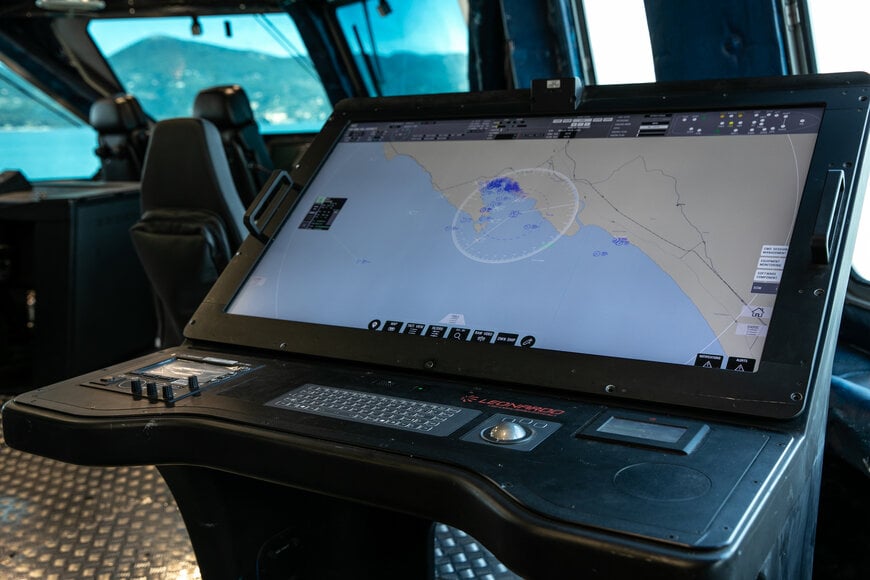
The core engineering function of ATHENA L centers on generating a consolidated tactical picture by synchronizing shipboard navigation sensors with combat sensors. The system natively integrates an electronic navigation suite compliant with certified cartography standards, consolidating navigational radar tracks and positioning inputs into the primary tactical display. This unified presentation reduces operator cross-referencing errors during navigation in contested waters, littoral patrols, and multi-vessel coordinated maneuvers.
Additional Context
This section details technical specifications and competitive benchmarking not included in the original product announcement.
Naval combat management architectures across NATO and allied fleets are transitioning toward open system standards, specifically adhering to modular open systems approach (MOSA) directives and NATO STANAG standards to ensure cross-fleet interoperability. Historically, proprietary bus protocols and tightly coupled hardware limited tactical computers from processing non-native sensor inputs without specialized interface units. Contemporary systems increasingly standardize on high-bandwidth, deterministic Ethernet protocols alongside standardized middleware, such as Object Management Group Data Distribution Service (OMG DDS), to handle real-time telemetry distribution.
In the global defense sector, benchmark systems serving comparable operational tiers include the Lockheed Martin Aegis Weapon System, Naval Group SETIS, and Saab 9LV. High-tier air defense platforms like the Aegis Baseline 9 and 10 suites similarly incorporate ballistic missile defense capabilities and open architecture upgrades, though traditionally scaled for major cruisers and destroyers. For smaller and modular vessels, light tactical suites such as Saab 9LV Compact and Thales TACTICOS provide scalable command and control frameworks that deploy across corvettes and offshore patrol vessels. The dual release of SADOC 5 and ATHENA L demonstrates the broader industrial transition toward tiered software scalability, where core tracking, sensor fusion, and situational awareness algorithms are shared across vessel categories while underlying compute hardware is proportioned to platform displacement.
Edited by Evgeny Churilov, Induportals Media - Adapted by AI.
www.leonardo.com
