
www.aero-defence.tech
23
'26
Written on Modified on
Leonardo and Baykar Successfully Complete Live Combat Drone Testing
The K-SWARM programme achieved a milestone in crewed and uncrewed aircraft interoperability by validating advanced autonomous formation flight algorithms during live trials in Türkiye.
www.leonardo.com
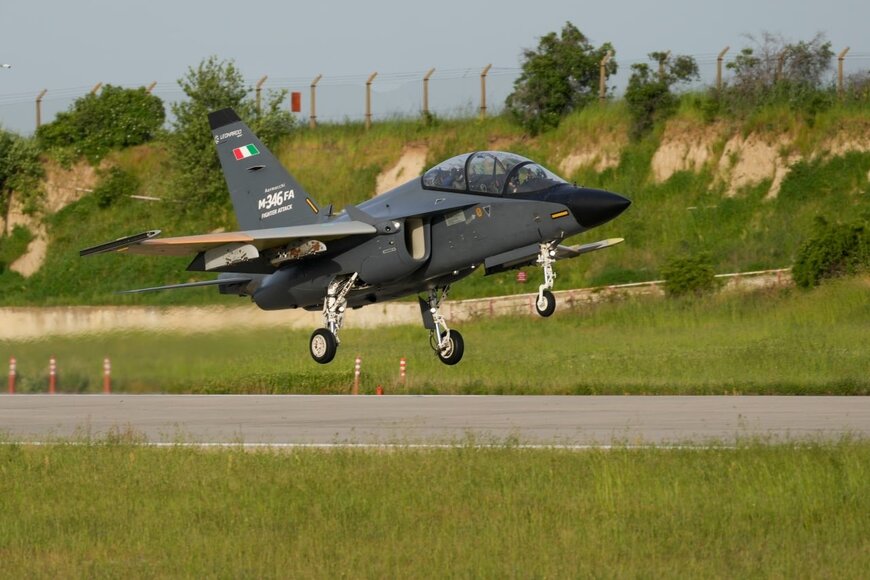
Leonardo and Baykar have completed initial live flight testing to integrate uncrewed fighter aircraft with crewed training and attack platforms. The flight campaign, conducted under the K-SWARM programme, validates autonomous tactical coordination and data synchronization systems required for modern digital infrastructure in defense aviation.
Project Scope and Partner Roles
The K-SWARM programme addresses the complex operational challenge of Crewed/UnCrewed Teaming (CUC-T). This methodology transitions uncrewed aerial systems from traditional remote piloting to high-level autonomy to optimize pilot workload during multidomain operations.
Leonardo supplied two M-346 aircraft — a Fighter Attack variant and a T-346A chase aircraft — alongside its Avionic and Flight Control Innovation Labs and the Product Capability and Concept Laboratory (PC2LAB) in Turin, Italy. Baykar provided the Bayraktar KIZILELMA uncrewed fighter aircraft and integrated its proprietary smart fleet autonomy systems developed at its Hardware-in-the-Loop (HIL) Laboratory.
Technical Solution and Architecture
The technical solution establishes an interoperable command-and-control framework between differing flight platforms. The system functions via a dedicated crewed/uncrewed computing system that processes advanced autonomy algorithms.
- Data Synchronization: An advanced radio frequency data exchange system maintains real-time telemetry and command alignment between the platforms.
- Cyber Security: The data link is secured by the Leonardo GCC Tactical Platform, a proprietary cyber defense system that monitors data integrity in real time to prevent external interference.
- Autonomy Integration: Baykar integrated smart fleet autonomy software directly into the CUC-T architecture, allowing the uncrewed platform to translate high-level pilot commands into precise flight maneuvers without manual piloting inputs.
Implementation and Deployment Testing
The live testing phase occurred in May 2024 at the Baykar flight and test center in Çorlu, Türkiye. The deployment bridged hardware-in-the-loop simulation with physical flight operations through the following phases:
The live testing phase occurred in May 2024 at the Baykar flight and test center in Çorlu, Türkiye. The deployment bridged hardware-in-the-loop simulation with physical flight operations through the following phases:
- Autonomous Departure: The KIZILELMA executed autonomous taxiing and take-off procedures.
- Rendezvous and Control Transfer: Utilizing smart fleet autonomy algorithms, the uncrewed aircraft joined the M-346 formation, allowing the crewed aircraft to assume operational command.
- Tactical Maneuvers: Pilots inside the M-346 commanded flight formation changes, separations, and rejoins using the integrated onboard avionic suite, which the uncrewed aircraft executed autonomously.
Ground infrastructure played a vital role, as the live aircraft were linked with an M-346 Full Mission Simulator in Venegono, Italy, to monitor algorithmic performance and tactical procedures safely.
Expected Operational Impact
The integration of these digital architectures reduces the cognitive tracking load on crewed flight teams by shifting the uncrewed asset's behavior from human-guided piloting to predictable, algorithmic autonomy. The verified synchronization of data links and cyber defense protocols ensures process stability during joint maneuvers. Data collected from this initial phase will inform upcoming test cycles designed to evaluate higher situational awareness variables and complex swarm tactics.
Edited by Evgeny Churilov, Induportals Media - Adapted by AI.
www.leonardo.com
