
www.aero-defence.tech
02
'26
Written on Modified on
Rheinmetall unveils hybrid naval fleet technologies at Euronaval 2026
The portfolio features the Kraken K3 USV, MASS Nova decoy system, and advanced loitering munitions for maritime defense.
www.rheinmetall.com
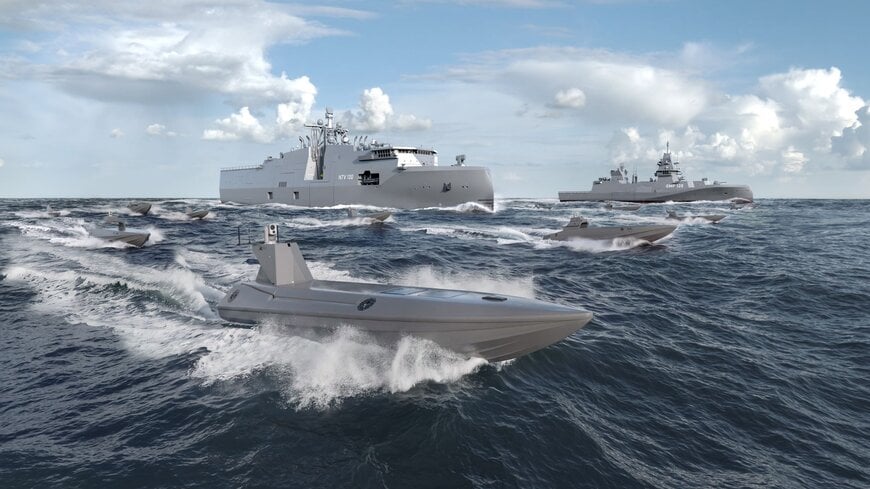
Rheinmetall is presenting a comprehensive portfolio of cross-domain naval technologies at Euronaval 2026 in Paris. Addressing the shifting demands of modern maritime warfare, the Düsseldorf-based systems provider is focusing on the development of high-performance "hybrid fleets" that intelligently integrate capable crewed platforms—such as the newly developed GMF 140 (Guided Missile Frigate)—with advanced unmanned systems. This networked approach is designed to give naval forces the flexibility to respond rapidly to highly dynamic and contested threat environments.
Unmanned surface vessels and precision munitions
Making its debut to a wider audience, the Kraken K3 Unmanned Surface Vessel (USV) highlights Rheinmetall’s push into autonomous maritime systems, backed by series production at the company's Hamburg site. Alongside the USV, the company is showcasing the FV-014 loitering munition system. Engineered for highly mobile operations with an engagement range of up to 100 kilometers, the FV-014 integrates reconnaissance, target identification, and precision strikes against armored and unarmored assets. Utilizing advanced sensors and high autonomy, the munition remains fully operational even in heavily contested environments experiencing GNSS interference.
Autonomous defense and smart sea mines
For platform-independent vessel modernization, Rheinmetall is exhibiting a fully self-contained configuration of the Millennium Gun. Operating independently of the host ship’s data infrastructure, it integrates an electro-optical tracker, a mini-CMS (command and weapon control system), and the Oerlikon AMMR (AESA Multi-Mission Radar) to autonomously engage highly dynamic aerial and surface threats in real-time. The exhibition also marks the premiere of the MASS Nova, a next-generation decoy system featuring a variable-angle launcher with an expanded 40+4 capacity for 81 mm Omni-Trap munitions. Furthermore, Rheinmetall has introduced Asteria, a new generation of multi-effect sea mines that can be deployed via surface ships, submarines, or aircraft and remotely controlled through a bidirectional acoustic link to protect critical harbor infrastructure.
Additional Context: AESA radar and GNSS-denied operations in naval combat
This section details sensor architectures and electronic warfare principles not included in the original press release.
In modern littoral combat, surface vessels face highly dynamic, sea-skimming anti-ship missiles and drone swarms in heavily contested electromagnetic environments. Traditional mechanically steered radars suffer from mechanical latency, struggling to track multiple supersonic targets simultaneously. Active Electronically Scanned Array (AESA) radars, such as the Oerlikon AMMR, solve this by utilizing hundreds of individual solid-state transmit/receive modules (TRMs). These modules can steer radar beams electronically in microseconds, allowing the system to simultaneously search, track, and guide weapons against multiple asynchronous threats. Furthermore, navigating and targeting in environments with GNSS (Global Navigation Satellite System) interference—often caused by deliberate enemy jamming or spoofing—requires loitering munitions like the FV-014 to rely on alternative guidance. This typically involves high-grade Inertial Navigation Systems (INS) paired with electro-optical/infrared (EO/IR) scene-matching algorithms (Digital Scene-Mapping Area Correlator), ensuring terminal precision even when satellite signals are completely jammed.
Edited by an industrial journalist, Lekshman Ramdas, with AI assistance.
www.rheinmetall.com
