
www.aero-defence.tech
26
'26
Written on Modified on
Q5D showcases automated drone wiring robot at Advanced Engineering
The CY10W five-axis robotic platform automates electrical assembly to accelerate unmanned aerial vehicle production and reduce labor.
q5d.com
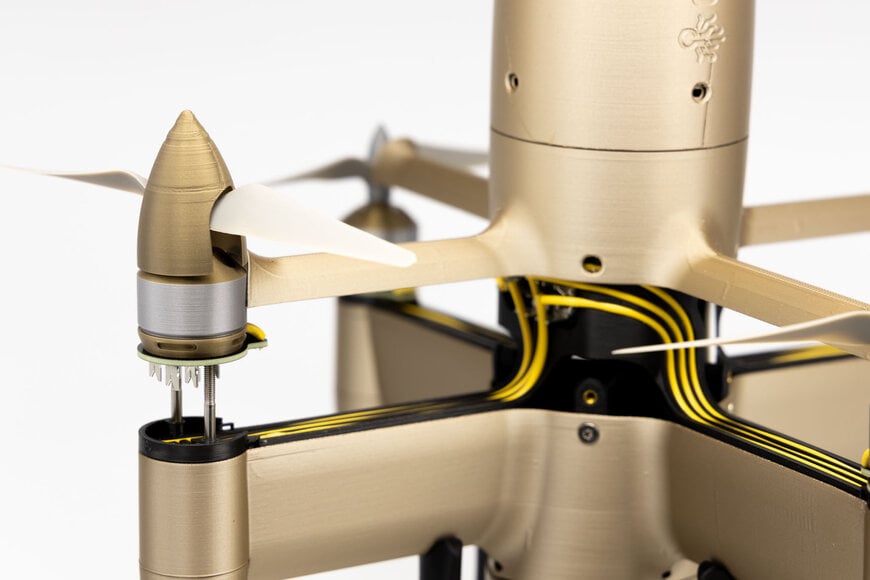
Q5D Technologies will demonstrate its latest automated wire harness production technology at the Advanced Engineering 2026 exhibition in Birmingham (Stand H150). The UK-based robotics company will present live demonstrations of its CY10W five-axis robotic manufacturing platform, showcasing a scalable and deployable approach to automating complex electrical wiring assembly in unmanned aerial vehicles (UAVs).
Automating UAV electrical assembly
Wiring remains one of the most labor-intensive stages of drone manufacturing, often creating a production bottleneck as OEMs attempt to rapidly scale volumes and adapt to changing designs. Q5D's technology addresses this challenge by automatically routing and placing wires directly into pre-formed channels within the drone's physical structure. The robotic platform completes the electrical connections to critical components—such as batteries, cameras, and control electronics—and utilizes automated termination with insulation displacement connectors (IDCs) to drastically simplify the assembly process.
Reshoring and manufacturing resilience
By replacing traditional manual wire harness assembly with a digitally controlled, fully enclosed five-axis robotic process, the CY10W allows manufacturers to scale production without relying on large, remote labor forces. According to Stephen Bennington, CEO of Q5D Technologies, this flexibility allows manufacturing equipment to be deployed much closer to final assembly or operational locations. This localized approach not only reduces dependence on extended, vulnerable supply chains but also enables rapid iteration of drone designs while maintaining strict quality control and consistency across multiple industrial sectors.
Additional Context: Insulation Displacement Connectors (IDCs) and additive wiring
This section details electromechanical assembly methods not included in the original press release.
In traditional aerospace and automotive manufacturing, wiring harnesses are built manually on large 2D pegboards, requiring workers to measure, cut, strip, crimp, and route hundreds of individual wires before installing the heavy, inflexible bundle into the chassis. Q5D's robotic approach essentially treats wiring as an additive manufacturing process. By routing wires directly into the structural polymers or composites of the UAV in 3D space, the need for heavy protective looms and zip-ties is eliminated, significantly reducing the drone's overall takeoff weight. Furthermore, the use of Insulation Displacement Connectors (IDCs) is a critical enabler for robotic automation. Unlike traditional terminal crimping, which requires a robot to strip the wire casing and precisely align delicate copper strands into a tiny metal pin, an IDC simply forces the unstripped wire into a sharpened metal V-blade. The blade slices through the insulation and creates a gas-tight electrical connection with the inner conductor in a single, downward pressing motion, making it highly reliable for high-speed robotic end-effectors.
Edited by an industrial journalist, Lekshman Ramdas, with AI assistance.
www.q5d.com
