
www.aero-defence.tech
24
'26
Written on Modified on
Lunar Infrastructure Development via Commercial Space Station Architecture
Vast establishes a specialized lunar division to deploy modular power stations, communications satellites, and human-rated habitats based on orbital flight heritage.
www.vastspace.com
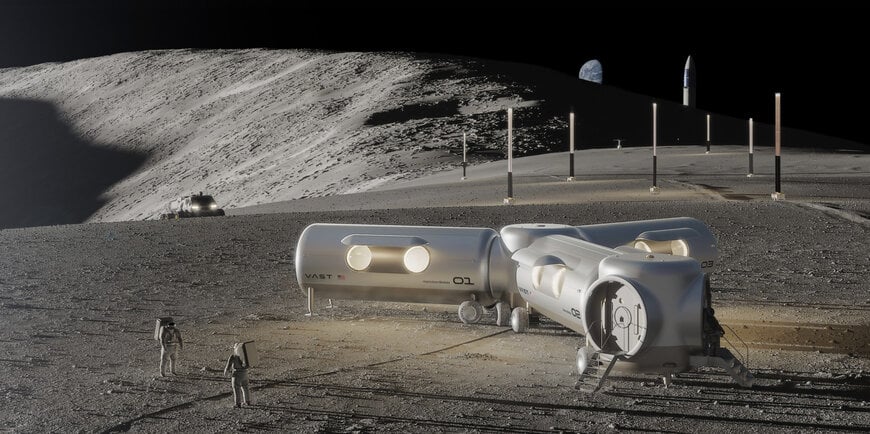
The expansion of permanent human presence on the lunar surface requires scalable engineering frameworks that adapt low-Earth orbit aerospace technologies to extraterrestrial environments. Vast addresses this industrial requirement by organizing a dedicated lunar systems division to manufacture modular space infrastructure. This initiative supports multi-phase space agency exploration roadmaps by integrating established life support systems, pressure vessel manufacturing, and automated power distribution architectures into a unified lunar supply chain.
Technical Solution and Division of Responsibilities
The proposed lunar architecture comprises three primary systems: a solar-generation power station, a free-standing pressure airlock, and a multi-module habitat. Vast oversees vertical integration, encompassing hull welding, internal wiring harnesses, environmental control and life support systems testing, and avionics development. Engineering teams manage the transition from commercial space station manufacturing protocols to lunar surface tolerance standards, utilizing shared subsystem designs across low-Earth orbit and lunar flight articles.
The technical framework relies on modular scaling principles. The power station integrates high-capacity photovoltaic arrays, energy storage units, and localized power distribution buses. Subsequent elements utilize a standardized airlock structure equipped with dust mitigation mechanisms and pressure vessel seals compatible with extravehicular activity suits. Communication infrastructure incorporates an orbital satellite constellation designed to provide continuous South Pole coverage, utilizing high-power radio frequency links compliant with deep-space telemetry standards.
Deployment and Implementation
Implementation follows a phased technological maturation model designed to reduce operational risks prior to crewed landings. The initial deployment phase focuses on uncrewed surface delivery of foundational power and communication assets, accompanied by autonomous technology demonstrations. Phase two introduces structural surface elements including the airlock module to validate pressure vessel integrity and dust management protocols. The final deployment phase establishes the multi-module habitat capable of sustaining long-duration human operations, integrating directly with existing lunar payload delivery services.
Applications and Operational Impact
Target application areas encompass lunar surface logistics, autonomous resource utilization support, and scientific experimentation in high-radiation environments. Concrete technical use cases involve autonomous power grid establishment, continuous orbital relay routing for surface rovers, and controlled atmospheric habitation testing. The operational benefit centers on risk reduction through hardware commonality; utilizing flight-proven pressure vessel designs and environmental control systems derived from low-Earth orbit test articles ensures high system reliability, thermal stability, and structural longevity without requiring unvalidated clean-sheet engineering.
Edited by Sucithra Mani, Induportals editor – adapted by AI.
www.vastspace.com
