
www.aero-defence.tech
23
'26
Written on Modified on
Firefly Aerospace Expands Cleanroom Capacity for Lunar Spacecraft Production
New ISO Class 8 facility is four times larger, supporting simultaneous assembly of up to 12 Blue Ghost landers and Elytra orbital vehicles.
fireflyspace.com
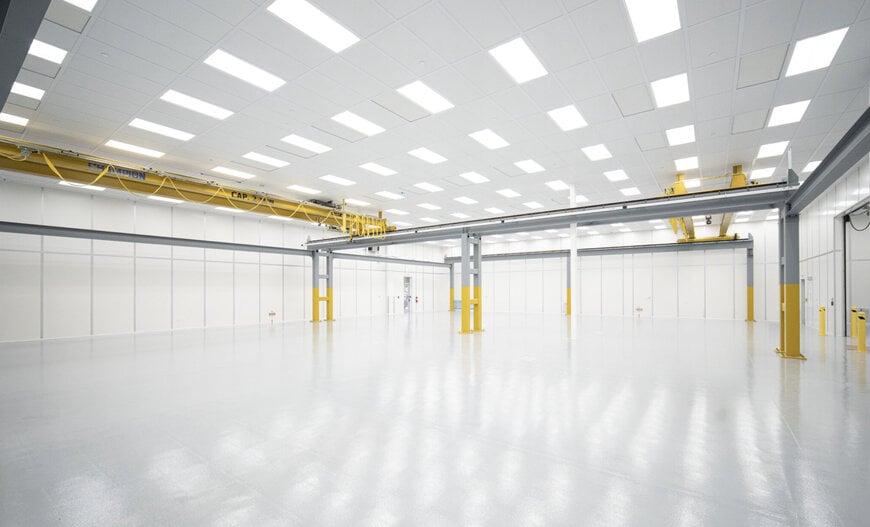
Firefly Aerospace completed an expanded spacecraft integration cleanroom at its Cedar Park, Texas manufacturing campus, supported by funding from the Texas Space Commission, to scale concurrent integration capacity for lunar and orbital transport platforms. The specialized manufacturing infrastructure targets commercial and government aerospace applications, including surface payload delivery, in-space mobility, and orbital domain awareness missions.
Integration Infrastructure and Environmental Particulate Control
On September 22, 2026, Firefly Aerospace marked the completion of the facility with an inaugural ceremony in Cedar Park, Texas, attended by representatives from the Texas Space Commission, state and federal agencies, and representatives from the Moon Base Program and Commercial Lunar Payload Services (CLPS) initiative of the National Aeronautics and Space Administration (NASA).
The newly constructed cleanroom quadruples the surface area of the previous spacecraft processing workspace on the 144,000-square-foot Cedar Park manufacturing site. Operating in tandem, the dual cleanrooms establish a dedicated assembly line engineered to support parallel assembly, mechanical integration, and verification testing for up to 12 lunar landers and orbital vehicles simultaneously.
The facility operates under an International Organization for Standardization (ISO) Class 8 classification (ISO 14644-1), which maintains airborne particulate limits below 3,520,000 particles per cubic meter for particles 0.5 microns and larger. This environmental monitoring baseline prevents particulate fouling during optical sensor alignment, propulsion system integration, and delicate payload encapsulation.
Contracted Mission Manifest and Vehicle Production Scope
Ramon Sanchez, Chief Operating Officer at Firefly Aerospace, stated: "With support from the Texas Space Commission, the company has built the infrastructure needed to meet growing demand for in-space services and lunar delivery capabilities, supporting reliable, high-cadence spacecraft operations for government and commercial customers."
The operational scale accommodates expanding contractual obligations across multi-orbit and surface trajectories. Following the inaugural flight of Blue Ghost Mission 1, the company maintains five additional contracted lunar missions utilizing Blue Ghost landers and Elytra orbital vehicles. Engineering development is actively scaling the baseline lunar delivery architecture into larger lander classes configured for heavier surface cargo, uncrewed terrain vehicles, permanent infrastructure units, and surface power grids.
In parallel with lunar logistics, the facility processes hardware for two task orders awarded by the Defense Innovation Unit (DIU), which specify orbital spacecraft configured for tactical space domain awareness and active orbital deorbit operations. Grant funding from the Texas Space Commission via the Space Exploration and Aeronautics Research Fund (SEARF) provided capital backing for the cleanroom installation to scale high-throughput spacecraft manufacturing.
Additional Context:
This section details technical specifications and competitive benchmarking not included in the original product announcement
The primary production output of the Cedar Park cleanrooms centers on the Blue Ghost lunar lander and the Elytra orbital transfer vehicle family. The baseline Blue Ghost lander features a landed payload mass capacity of 150 kilograms to the lunar surface and provides up to 650 watts of continuous electrical power to onboard instruments. Propulsion is governed by a Nammo LEROS 4-ET bipropellant main engine delivering over 1,000 newtons of thrust using mixed oxides of nitrogen and hydrazine, supplemented by eight reaction control thrusters for fine attitude stabilization. The Elytra platform operates across three variants (Dawn, Dark, and Deep), serving low Earth orbit dispersion, cislunar transit, and long-duration hosting.
In the commercial lunar lander sector, Firefly Aerospace operates alongside Intuitive Machines and Astrobotic Technology under the NASA CLPS initiative. Intuitive Machines manufactures the Nova-C class lander, which delivers a comparable 130-kilogram payload capacity to the lunar surface. Unlike Firefly’s hypergolic chemical architecture, Nova-C uses cryogenic liquid methane and liquid oxygen propulsion. Intuitive Machines manufactures and integrates its flight vehicles at its 125,000-square-foot Lunar Production and Operations Center in Houston, which features dedicated ISO Class 8 integration bays.
Astrobotic Technology operates two distinct lander categories out of its 47,000-square-foot integration facility in Pittsburgh: the lightweight Peregrine lander (120-kilogram payload capacity) and the medium-class Griffin lander (625-kilogram payload capacity). In orbital mobility, Firefly's Elytra platform competes with high-cadence orbital transfer vehicle manufacturers such as Impulse Space and Apex, which similarly optimize dedicated multi-bay cleanroom layouts to compress lead times for defense and commercial orbital delivery. Firefly's Cedar Park layout differentiates its operation by co-locating production lines for both planetary landers and orbital transfer stages within a unified contamination-controlled integration flow.
Edited by Natania Lyngdoh, Induportals editor, assisted by AI.
www.fireflyspace.com
