
www.aero-defence.tech
16
'26
Written on Modified on
GA-ASI and Tactical Air Support Demonstrate Multi-Ship IRST Ranging in CCA Flight Test
GA-ASI and Tactical Air Support demonstrated passive multi-ship IRST ranging and human-machine teaming using an unmanned CCA testbed and an F-5 Advanced Tiger during a large force exercise.
www.ga.com
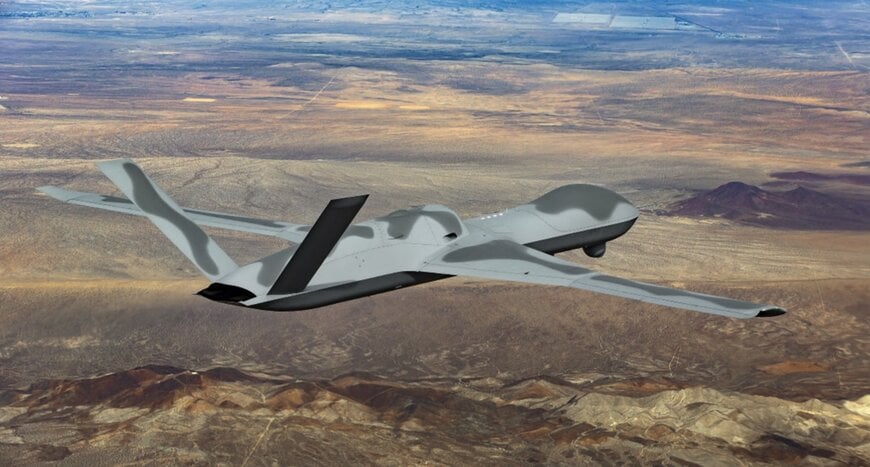
GA-ASI and Tactical Air Support, Inc. conducted a collaborative flight test during a large force exercise on July 21 to evaluate Infrared Search and Track (IRST) Multi-Ship Ranging (MSR). The demonstration paired a crewed Tactical Air Support F-5 Advanced Tiger with an unmanned GA-ASI Collaborative Combat Aircraft (CCA) test platform to validate human-machine teaming capabilities and close the tactical kill chain utilizing passive sensor architectures and onboard autonomy.
Autonomous Software Integration and Beyond Line of Sight Routing
Both aircraft operated GA-ASI’s TacACE (Tactical Autonomy Ecosystem) software package, which aligns with the latest Autonomy Government Reference Architecture (A-GRA) and the Agile Mission Suite (AMS-GRA). Each air vehicle carried an infrared search-and-track system to gather target track files passively without radiating radio-frequency energy.
During the live-fire simulation, the crewed fighter and the autonomous CCA fused line-of-sight tracking data across an AMS-GRA-compliant network. The aircraft exchanged target vectors and tactical commands across a Beyond Line of Sight (BLOS) data link, enabling the F-5 to transmit threat coordinates to the CCA's TacACE software to execute coordinated tracking, engagement geometry, and target defeat sequences.
"With this flight, we moved beyond simply flying an autonomous jet and showed how a manned fighter and an autonomous CCA can work together to find, track, and engage a target using passive sensors and shared autonomy," stated Michael Roberts, Advanced Programs Emerging Technology Director at GA-ASI. "This is the kind of operationally relevant mission that will allow autonomous CCAs to deploy alongside manned aircraft and deliver real combat capability for the warfighter. The flight test marks another milestone in warfighter adoption of the CCA solution and confirms its readiness for production."
Open Systems Architecture and Fleet Integration
The test validated plug-and-play operability across disparate airframes without vendor lock-in, confirming that multi-manufacturer platforms can interoperate through standardized government reference architectures. The flight forms part of a multi-phase GA-ASI test campaign designed to transition operational human-machine teaming concepts from test environments into frontline fleet service alongside crewed fighter platforms such as the F-35 and F-22.
Additional Context
This section details technical specifications not included in the original news release.
Infrared Search and Track (IRST) Multi-Ship Ranging (MSR) bypasses the physical distance-estimation limitations of passive angle-only optical sensors by using multi-node triangulation. When two or more dispersed aircraft detect the same target's mid-wave infrared (MWIR) or long-wave infrared (LWIR) thermal signature, onboard Kalman filtering algorithms correlate the intersecting bearing angles and ownship GPS/INS coordinates to compute real-time three-dimensional range, speed, and heading data without activating active radar emitters. The Autonomy Government Reference Architecture (A-GRA) and Open Mission Systems (OMS) frameworks mandate standardized message passing using Universal Command and Control Interface (UCI) protocols over low-latency tactical datalinks. These software architectures segregate flight-critical guidance controls from tactical mission autonomy engines, allowing open-source and third-party algorithmic payloads to process target tracking solutions and command aircraft kinematic maneuvers through safety-certified vehicle management system (VMS) autopilots.
Edited by Romila DSilva, Induportals Editor, with AI assistance.
www.ga.com
