
www.aero-defence.tech
15
'26
Written on Modified on
Linear Motion Systems for High-Dynamic Aerospace Vehicle Testing and Actuation
Rollon provides linear motion components to Skyward Experimental Rocketry for structural airbrake actuation and vertical test stand validation.
www.rollon.com
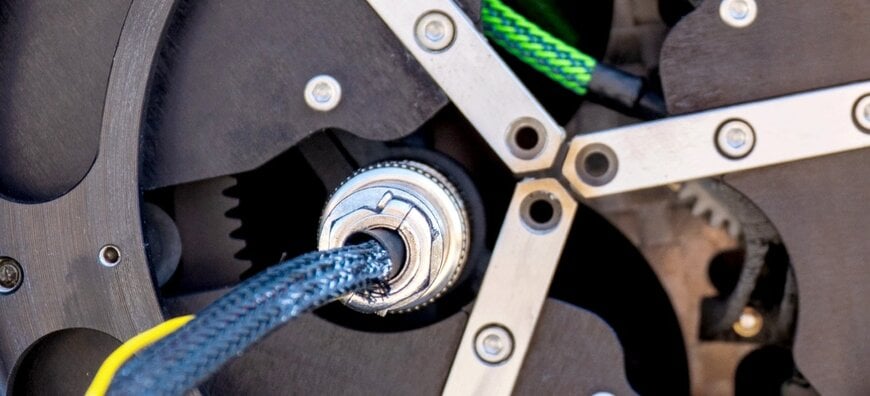
Rollon and Skyward Experimental Rocketry, a student association from Politecnico di Milano, are collaborating to deploy precision mechanical hardware for the Hydra sounding rocket. The partnership integrates industrial automation and linear guidance components into both flight-critical aerodynamic control systems and ground-based propulsion testing infrastructure for university aerospace competitions.
Technical Challenge and Operational Parameters
Sounding rockets require precise altitude management to reach specific operational targets during ascent. The Hydra rocket utilizes a bi-propellant propulsion system powered by nitrous oxide and ethanol, targeted to reach an altitude of 3,000 metres and flight velocities up to 1,000 km/h. Operating in these conditions requires airbrake petals to deploy and retract symmetrically against dynamic airflow, withstanding operational loads of approximately 20 kg per guide assembly without mechanical binding or structural failure. Concurrently, ground validation requires static firing systems capable of measuring mass variations and axial thrust in a flight-representative vertical orientation.
Actuation Mechanisms and Flight Systems
To address flight control requirements, the vehicle's airbrake mechanism incorporates linear guides and cam followers supplied by Rollon. The cam followers interface directly with dedicated cam profiles to convert rotary motor input into controlled linear displacement, ensuring synchronous movement of the airbrake petals.
"Previously we relied on a self-built solution, but Rollon cam followers have proven to be more reliable, which is particularly important considering that the airbrake system is one of Skyward’s flagship technologies," states Tommaso Daino, Head of Structures Department at Skyward.
Ground Test Bench Infrastructure
The collaboration extends to structural test equipment. A dedicated ground stand was reconfigured into a vertical orientation using two parallel Compact Rail Plus linear guide assemblies. The vehicle is mounted between the guides, allowing the structure to interface directly with load cells during static engine firings. This layout facilitates simultaneous thrust acquisition and continuous mass tracking during propellant filling under flight-like constraints.
For research into next-generation propulsion architectures, an additional test apparatus utilizes Rosa Sistemi MG Rail linear guides to ensure positioning accuracy during experimental measurements.
"The support we receive during testing is just as important as the support on the rocket itself," states Tommaso Daino. "Being able to rely on a trusted technology partner throughout the entire development process helps us accelerate innovation, improve the quality of our validation activities and begin laying the groundwork for future projects."
Validation Phases and Deployment
System integration undergoes staged validation. Ground engine verification preceded full-scale vehicle assembly, followed by flight trials scheduled at Campo Felice, Italy, to evaluate total system behavior at the nominal 3,000-metre ceiling. Following validation, the platform is scheduled for deployment at the European Rocketry Challenge in Constância, Portugal, conducted from 15 to 21 October 2026.
Edited by Evgeny Churilov, Induportals Media - Adapted by AI.
www.rollon.com
