
www.aero-defence.tech
11
'26
Written on Modified on
American Rheinmetall Secures $7.28M USMC Mission Master Contract
The order provides 12 A-UGVs and five amphibious kits to enhance Marine Corps expeditionary logistics capabilities.
www.rheinmetall.com
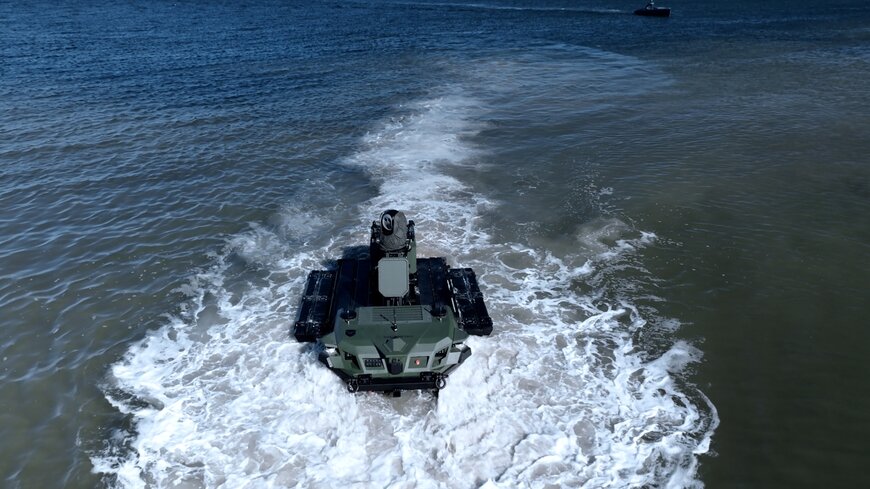
American Rheinmetall has secured a $7.28 million contract to supply 12 Mission Master SP Autonomous Unmanned Ground Vehicles (A-UGVs) and five amphibious Marine Kits to the U.S. Marine Corps Warfighting Laboratory. Executed through the Defense Logistics Agency with ADS Inc. serving as the prime contractor, this procurement aims to enhance the Marines' autonomous logistics, extend operational reach, and minimize personnel exposure to risk in hostile environments.
The latest Mission Master SP systems utilize Rheinmetall’s AI-enabled PATH autonomy architecture, which facilitates autonomous navigation and dynamic obstacle avoidance. The addition of the new Marine Kit specifically upgrades these vehicles for reliable, extended amphibious operations in littoral waters. Program management and delivery will be led by American Rheinmetall in the United States, supported by Rheinmetall Canada, paving the way for a future Advanced Land Autonomy Center of Excellence (ALACOE) at the company’s facility in Maine.
Additional Context
This section provides technological and market background not explicitly detailed in the original release.
The U.S. Marine Corps is currently restructuring its strategy to focus on decentralized, agile units capable of operating across contested island chains and littoral zones, often referred to as Expeditionary Advanced Base Operations (EABO). In these dispersed scenarios, traditional logistical resupply lines are highly vulnerable to enemy fire. A-UGVs like the Mission Master SP act as robotic pack mules, capable of transporting heavy payloads, conducting casualty evacuations, or providing tactical fire support without risking human convoys. The underlying PATH Autonomy Kit allows these vehicles to navigate complex, GPS-degraded environments through advanced perception and decision-making algorithms, while the amphibious kits ensure they can transition seamlessly from landing craft to coastal beaches. By utilizing an open-architecture, platform-agnostic AI system, the USMC ensures these robotic platforms can continually modernize alongside rapidly advancing commercial artificial intelligence.
Edited by Lekshman Ramdas, Induportals editor – adapted by AI.
www.rheinmetall.com
