
www.aero-defence.tech
10
'26
Written on Modified on
Hermeus Unveils Ramjet-X for Low-Cost Sustained High-Mach Flight Testing
Expendable vehicle launches from reusable Quarterhorse aircraft, enabling payload testing and Flight Test as a Service with integrated high-speed infrastructure.
www.hermeus.com
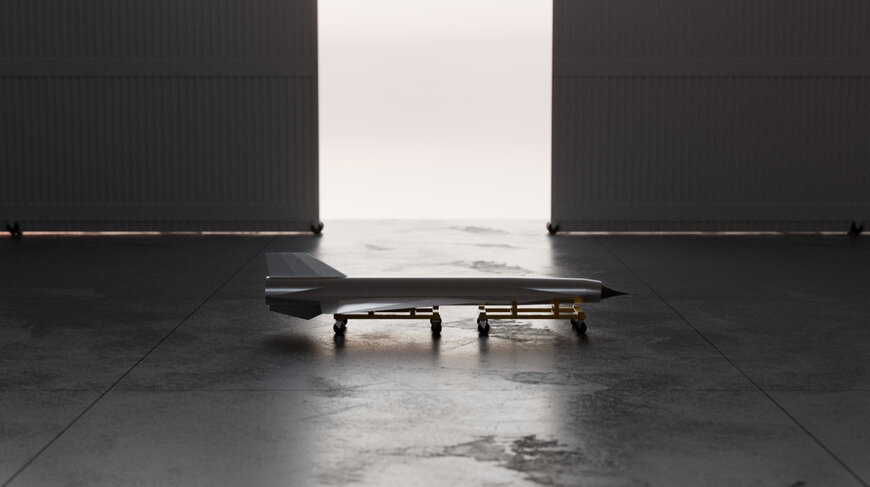
Hermeus has announced development plans for Ramjet-X, an expendable flight vehicle designed to conduct high-speed aerodynamic, thermal, and propulsion testing. The platform will serve defense, aerospace, and advanced computing sectors by providing a standardized testbed for evaluating experimental hardware in sustained high-Mach regimes.
Two-Stage Air-Launch Architecture for Ramjet Ingestion
Conventional ramjet engines require high forward velocity to achieve the internal aerodynamic compression necessary for ignition and sustained thrust. Historical test programs have predominantly used multi-stage solid rocket boosters to accelerate test articles from ground level or subsonic drop points up to operating velocity. These rocket-based launch architectures incur substantial costs per sortie and require specialized range facilities.
Ramjet-X resolves this operational dependency by using Hermeus's reusable Quarterhorse aircraft as a primary carrier stage. The Quarterhorse platform transports Ramjet-X to the necessary speed and altitude envelope before release. Following separation, Ramjet-X initiates ramjet-powered flight to reach its target velocities, while the carrier aircraft returns to base for subsequent missions, eliminating the need for expendable primary boost stages.
Commercial High-Mach Flight Test Service Framework
Through the Ramjet-X program, Hermeus will offer a commercial framework designated as high-Mach Flight Test as a Service. The vehicle is engineered to accommodate external and internal customer payloads, including autonomous guidance packages, high-temperature thermal protection materials, high-frequency communications gear, and compact sensor arrays.
Standardizing payload integration onto a common airframe allows aerospace research institutions and commercial developers to evaluate experimental components in sustained operational environments. This approach bypasses the engineering overhead, program risk, and lead times typically associated with designing customized, single-use hypersonic test hardware.
Manufacturing Timeline and Propulsion Testing Operations
Hermeus has commenced ground-based subsystem qualification across multiple corporate facilities. Propulsion engineering teams are conducting ramjet test campaigns at the company's HEAT facility in Jacksonville, Florida. Simultaneously, structural engineers at the company's headquarters in El Segundo, California, are developing the aerothermal structural components required to survive high thermal loads.
Integrated vehicle flight trials combining the Quarterhorse carrier aircraft and Ramjet-X are scheduled for 2027.
Additional Context:
This section details technical specifications and competitive benchmarking not included in the original product announcement
The development of commercial high-Mach testbeds addresses a bottleneck caused by limited national wind-tunnel capacity and scarce rocket-boosted flight test opportunities. Historically, high-Mach test articles relied on converted ballistic missiles, sounding rockets, or specialized rocket planes such as the NASA X-43 to evaluate air-breathing ramjet and scramjet systems.
In the emerging commercial test sector, Stratolaunch operates the Talon-A platform, a rocket-powered, autonomous test vehicle carried aloft by the Roc aircraft. While Talon-A utilizes liquid-propellant rocket propulsion to achieve Mach 5+ speeds with recovery capability, its operating profile relies on rocket thrust rather than atmospheric air-breathing ramjet propulsion. Similarly, companies like Rocket Lab with its HASTE suborbital rocket and Kratos Defense with its Oriole rocket system provide hypersonic velocity test environments via solid rocket ascent trajectories.
Ramjet-X differs fundamentally from rocket-propelled competitors by utilizing air-breathing ramjet combustion during its free-flight phase. This approach subjects experimental thermal protection materials, aerodynamic control surfaces, and internal sensors to the specific combustion, airflow, and heat-flux parameters found in operational air-breathing hypersonic cruise configurations.
Edited by Natania Lyngdoh, Induportals editor, assisted by AI.
www.hermeus.com
