
www.aero-defence.tech
24
'26
Written on Modified on
Saab showcases full-scale uncrewed aircraft concept
The concept, called A3-001, illustrates the possible evolution of future combat air capabilities, where crewed and uncrewed platforms operate together as part of an integrated system.
www.saab.com
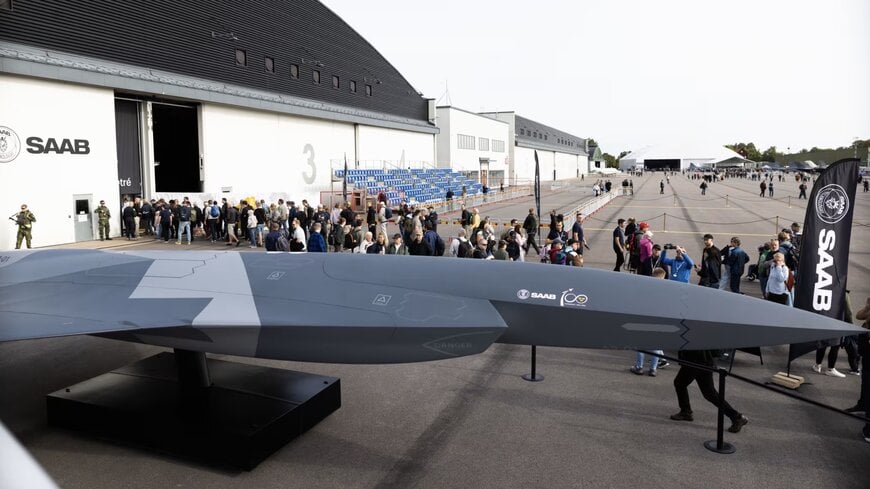
Saab has unveiled a full-scale concept model of its A3-001 uncrewed combat air system at the Swedish Armed Forces Jubilee Air Show at Malmen Air Base in Linköping, Sweden.
The A3-001 concept illustrates the evolution of future combat air architectures, operating as an uncrewed platform designed to integrate with crewed fighters such as the Gripen and future next-generation combat aircraft.
Operational Roles and Mission Profiles
The platform is designed to execute high-risk operations in contested airspace, including:
- Suppression and destruction of enemy air defenses
- Airborne electronic warfare and jamming
- Precision strike missions in contested environments
The aircraft concept incorporates low-observable airframe design features, autonomous mission-management systems, and multi-domain connectivity to operate as part of a wider combat network.
Development Roadmap and Demonstrator Flight Goals
Saab plans to conduct flight trials with uncrewed technology demonstrators featuring fighter-like flight performance before 2030. The standalone A3 concept is positioned for potential operational deployment in the mid-2030s, leveraging systems integration and aerospace engineering experience from platforms including the Gripen fighter and the GlobalEye Airborne Early Warning and Control system.
Additional Context
This section details technical specifications not included in the original news release.
Collaborative Combat Aircraft and uncrewed loyal wingman platforms incorporate tailless delta or lambda-wing planforms with chined forebodies, blended fuselage contours, and top-mounted serpentine (S-duct) engine air intakes. This configuration shields the engine compressor face from incoming electromagnetic radar waves, significantly minimizing the frontal and lateral radar cross-section. The composite airframe structures utilize carbon-fiber-reinforced polymers with embedded radar-absorbent materials to attenuate high-frequency radio reflections across tactical radar bands.
For crewed-uncrewed teaming operations, the autonomous platform utilizes open-architecture mission computers compliant with NATO Standardization Agreements and Future Airborne Capability Environment standards. Tactical datalinks, including directional line-of-sight wideband radios and low-probability-of-intercept waveforms, allow real-time cooperative target distribution, autonomous swarm sensor correlation, and dynamic task allocation between crewed host fighters and uncrewed platforms. Internal weapons bays maintain aerodynamic cleanliness and low-observable signatures while carrying miniature precision-guided munitions or stand-off electronic attack payloads.
Edited by Romila DSilva, Induportals Editor, with AI assistance.
Development Roadmap and Demonstrator Flight Goals
Saab plans to conduct flight trials with uncrewed technology demonstrators featuring fighter-like flight performance before 2030. The standalone A3 concept is positioned for potential operational deployment in the mid-2030s, leveraging systems integration and aerospace engineering experience from platforms including the Gripen fighter and the GlobalEye Airborne Early Warning and Control system.
Additional Context
This section details technical specifications not included in the original news release.
Collaborative Combat Aircraft and uncrewed loyal wingman platforms incorporate tailless delta or lambda-wing planforms with chined forebodies, blended fuselage contours, and top-mounted serpentine (S-duct) engine air intakes. This configuration shields the engine compressor face from incoming electromagnetic radar waves, significantly minimizing the frontal and lateral radar cross-section. The composite airframe structures utilize carbon-fiber-reinforced polymers with embedded radar-absorbent materials to attenuate high-frequency radio reflections across tactical radar bands.
For crewed-uncrewed teaming operations, the autonomous platform utilizes open-architecture mission computers compliant with NATO Standardization Agreements and Future Airborne Capability Environment standards. Tactical datalinks, including directional line-of-sight wideband radios and low-probability-of-intercept waveforms, allow real-time cooperative target distribution, autonomous swarm sensor correlation, and dynamic task allocation between crewed host fighters and uncrewed platforms. Internal weapons bays maintain aerodynamic cleanliness and low-observable signatures while carrying miniature precision-guided munitions or stand-off electronic attack payloads.
Edited by Romila DSilva, Induportals Editor, with AI assistance.
