
www.aero-defence.tech
30
'26
Written on Modified on
New underwater surveillance system targets maritime security threats
Saab introduces Ocean Barrier, a scalable underwater surveillance solution integrating multiple sensor systems to detect threats and protect coastlines, ports and critical maritime infrastructure.
www.saab.com
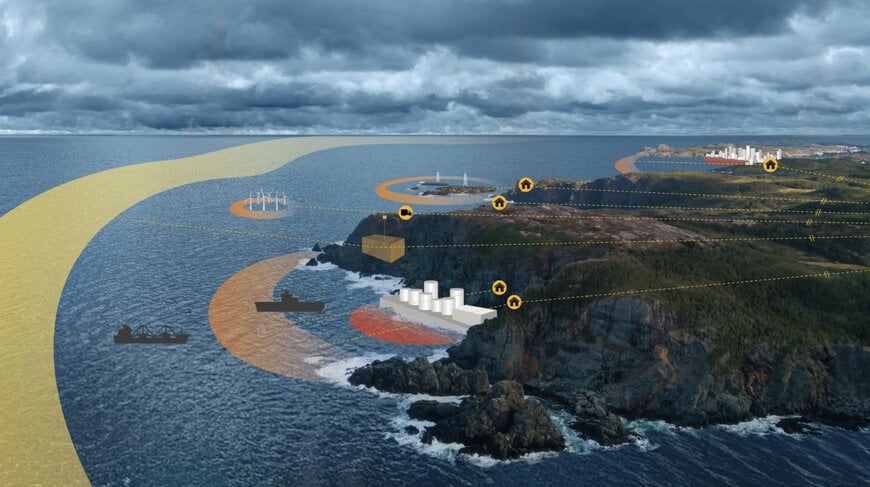
Protecting subsea infrastructure and territorial waters from covert underwater threats presents persistent operational challenges due to acoustic attenuation, high environmental noise, and the complexity of integrating disparate subsea sensor arrays. Conventional surveillance methods often suffer from fragmented data streams, leaving critical gaps in real-time threat detection across vital sea lines of communication and coastal installations.
To address these security vulnerabilities, Saab has introduced Ocean Barrier, a fully integrated, scalable underwater surveillance solution designed to deliver continuous maritime domain awareness. By networking diverse sensors and analytics capabilities into a unified operational architecture, the system enables operators to detect, track, and analyze subsea activity across ports, naval bases, and extensive coastal areas.
Operating Principles and System Architecture
Ocean Barrier operates on a modular, cyber-secure framework that integrates acoustic sensors, data collection nodes, and operator command interfaces into a single connected system. The architecture is sensor-agnostic, allowing seamless integration with existing surveillance infrastructure and third-party sensor payloads. The system organizes defensive operations into three distinct perimeters: Detect, Prevent, and Protect. These layers can be tailored to specific operational environments or deployed independently depending on mission requirements.
Data collected from distributed subsea sensors is processed in real time to convert raw acoustic and telemetry inputs into actionable situational awareness. As demonstrated during the REPMUS 2026 exercise held in Portugal, the system successfully integrates multi-vendor sensor data and utilizes NATO-standard protocols to autonomously hand off tracked underwater objects to central command and control networks. This interoperability ensures rapid response coordination during grey-zone scenarios or asymmetric conflicts where rapid threat evaluation is critical.
Real-World Applications
Deployment environments for Ocean Barrier span national naval bases, commercial harbors, offshore energy installations, and extensive territorial waters. In these operational workflows, the system provides continuous monitoring of underwater approaches, safeguarding vital sea lines of communication against unauthorized intrusions. By combining automated target tracking with standardized communication protocols, operators reduce latency in threat evaluation and improve coordination across multi-agency naval defense assets.
"The free flow of goods is the fundamental engine of the modern global economy. In a grey zone scenario or conflict an aggressor may try to disrupt vital sea lines of communication thereby damaging both economic activity and military logistics. With Ocean Barrier we provide customers with a scalable and future-ready solution that delivers continuous awareness, enabling faster decisions and more effective protection of critical assets and maritime areas," states Åsa Schöllin, head of business unit Underwater Systems at Saab’s business area Naval.
Additional Context:
This section details technical specifications and competitive benchmarking not included in the original product announcement.
Industry adoption trends reflect an accelerated transition toward modular, decentralized subsea architectures as navies and critical infrastructure operators prioritize resilience against sophisticated undersea threats. Compared to legacy fixed hydrophone arrays or closed proprietary sonar systems, modern networked solutions like Ocean Barrier emphasize open-standard data exchange, cyber-secure transmission protocols, and scalability across wide geographic zones. Recognized engineering standards governing these deployments include NATO interoperability guidelines and rigorous environmental durability standards required for long-term underwater sensor deployment in corrosive marine environments.
Edited by Sucithra Mani, Induportals editor – adapted by AI.
www.saab.com
