
www.aero-defence.tech
17
'26
Written on Modified on
Optical Communications Integration for Spacecraft Atmospheric Re-entry Telemetry
ATMOS Space Cargo integrates Astrolight laser terminals to establish real-time data links between re-entry capsules and low Earth orbit satellite infrastructure.
astrolightspace.com
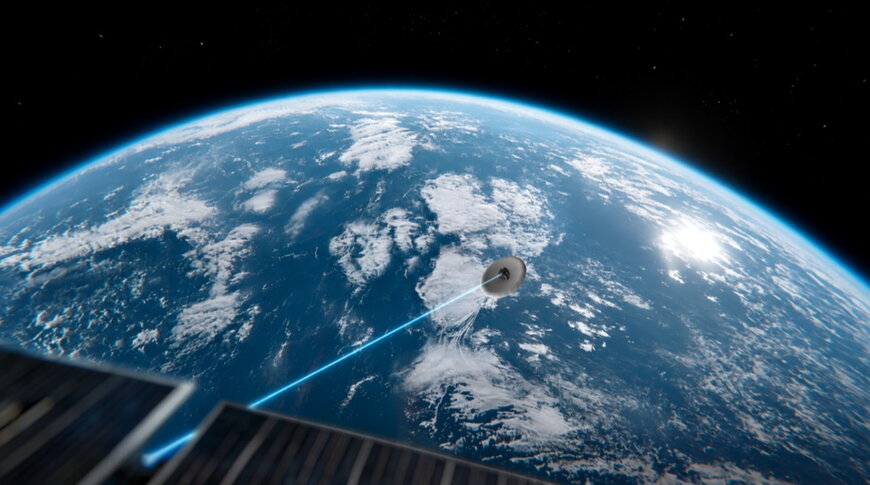
Astrolight and ATMOS Space Cargo have formed a technical partnership to demonstrate optical data transmission between a re-entry spacecraft and an orbiting satellite. The joint project develops digital infrastructure for cargo-return logistics by establishing continuous telemetry during orbital descent.
Operational Challenge and Partnership Scope
Spacecraft returning from low Earth orbit face telemetry degradation during atmospheric interface when relying on standard radio-frequency links. Maintaining real-time monitoring of vehicle health, trajectory, and payload status requires high-bandwidth transmission channels capable of bypassing terrestrial line-of-sight constraints. To address this integration challenge, ATMOS Space Cargo is pairing its PHOENIX return capsule architecture with Astrolight’s optical communication payload.
Technical Architecture and Implementation
The technical solution relies on Astrolight ATLAS-X laser communication terminals installed on both the PHOENIX re-entry vehicle and a target satellite operating in low Earth orbit. The system functions by establishing a direct optical intersatellite link, routing mission and sensor data through the orbital node to ground stations.
Operating with narrow optical beam divergence, the terminal architecture supports data transfer rates up to 2.5 Gbps while maintaining low size, weight, and power profiles required for mass-constrained space vehicles. The in-flight demonstration is scheduled for 2027 to validate link acquisition, tracking, and continuous data throughput across orbital operations and descent.
Industrial Applications and Operational Impact
The system targets commercial and defense space logistics, including orbital manufacturing return, scientific sample recovery, and Earth observation hardware retrieval. Utilizing laser communications instead of traditional radio spectrum provides higher data throughput and reduces electromagnetic interference vulnerabilities. Real-time telemetry access prior to physical recovery improves flight guidance verification, shortens post-flight analysis cycles, and enhances overall process stability for autonomous space-return operations.
Technical Perspectives
"Testing a laser link between PHOENIX and an orbiting satellite will mark an important first for re-entry communications. Until now, this capability has only been explored in ground-based laboratory conditions. Together with ATMOS Space Cargo, we are bringing it into space," said Laurynas Mačiulis, CEO of Astrolight. "Our goal is to help re-entry vehicles connect directly with satellites and, in the future, satellite constellations, so operators can access as much data as possible in real time and make missions more controlled and scalable."
"As cargo-return missions grow more autonomous and data-intensive, real-time connectivity across the entire mission cycle is becoming increasingly important," said Sebastian Klaus, CEO of ATMOS Space Cargo. "Our partnership with Astrolight is a step toward integrating laser communication into PHOENIX as a strategic layer for payload monitoring, autonomous de-orbit, and re-entry operations."
Edited by Evgeny Churilov, Induportals Media - Adapted by AI.
www.astrolight.com
