
www.aero-defence.tech
12
'26
Written on Modified on
Rocket Lab Unveils GHOST Deployable Launch System for Space Missions
New containerized system enables flexible suborbital and orbital launches worldwide, supporting high-frequency campaigns and time-critical national security missions across locations.
www.rocketlabusa.com
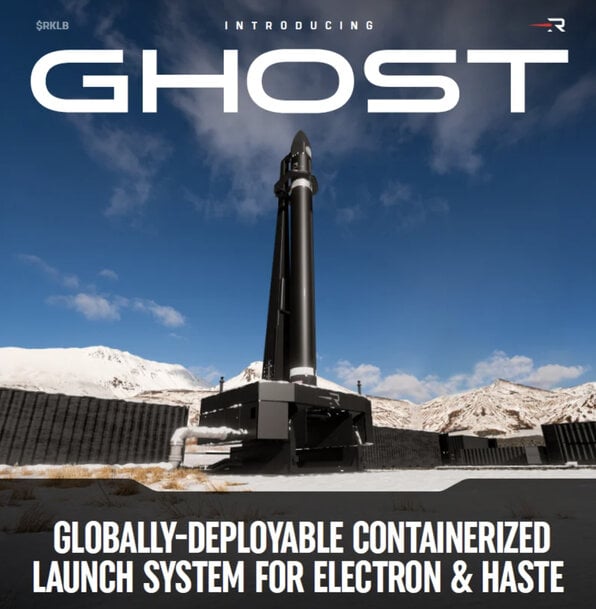
Rocket Lab Corporation has unveiled the Global Hypersonic and Orbital Spaceport Technology (GHOST), a containerized launch system designed to support Electron and HASTE rockets. This deployable infrastructure targets aerospace, defense, and national security sectors by enabling rapid suborbital and orbital missions from non-traditional geographic locations.
Modular Launch Infrastructure and Site Activation
The GHOST system packages complete rockets, ground support equipment, and range control systems within standard shipping containers. By eliminating the requirement for permanent, concrete spaceport infrastructure, this containerized approach allows operators to establish launch capabilities rapidly. This mobility is highly relevant for responsive space operations, where decoupling launch capabilities from fixed geographical sites provides necessary redundancy and complicates adversary tracking for national security and missile defense programs.
Dual-Vehicle Compatibility and Launch Complex Expansion
Because the Electron orbital launch vehicle and the HASTE suborbital rocket utilize identical ground infrastructure, the GHOST system provides a dual-launch capability from a single mobile setup. The initial operational deployment of this system will occur at Rocket Lab Launch Complex 4, located at the Pacific Spaceport Complex in Kodiak, Alaska. The installation will feature two pads specifically designated for high-frequency flight campaigns. This deployment will expand the company's infrastructure to a total of six operational launch pads distributed across two hemispheres, complementing Launch Complex 1 in New Zealand and Launch Complexes 2 and 3 in Virginia.
Operational Deployment and Technical Capabilities
The deployable architecture is scheduled to make its operational debut with a suborbital launch from the Alaska site in 2027. Packaging the launch operations into a modular footprint allows allied nations to acquire sovereign launch capabilities without the significant capital expenditure associated with purpose-built spaceports. Peter Beck, founder and CEO of Rocket Lab, noted that packaging the company's existing launch architecture into a deployable format expands the available trajectories for orbital missions and enables sovereign launch capabilities in allied nations from any required location.
Additional Context:
This section details technical specifications and competitive benchmarking not included in the original product announcement
Within the responsive space sector, several aerospace organizations have developed comparable containerized infrastructure to support tactical launch requirements. ABL Space Systems utilizes the GS0 ground system for its RS1 launch vehicle, and Astra Space has developed its own mobile launch system. All three architectures rely on standard ISO shipping containers to transport ground support, flight control systems, and propellant loading hardware, enabling launch activation from a flat concrete pad with a reduced personnel footprint. These systems are collectively designed to address United States Department of Defense tactically responsive space (TacRS) requirements. The GHOST system differentiates itself structurally by natively supporting two distinct vehicle profiles—the Electron for orbital payload delivery and the HASTE for suborbital hypersonic technology testing—on the same deployable ground hardware, whereas the ABL and Astra systems are primarily scaled for dedicated low Earth orbit (LEO) small-lift delivery.
Edited by Natania Lyngdoh, Induportals editor, assisted by AI.
www.rocketlabcorp.com
