
www.aero-defence.tech
08
'26
Written on Modified on
Composite Aeroshells Enable Mars Helicopter Deployment
Firefly Aerospace manufactures lightweight entry structures supporting autonomous aerial exploration during NASA JPL's SkyFall mission.
fireflyspace.com
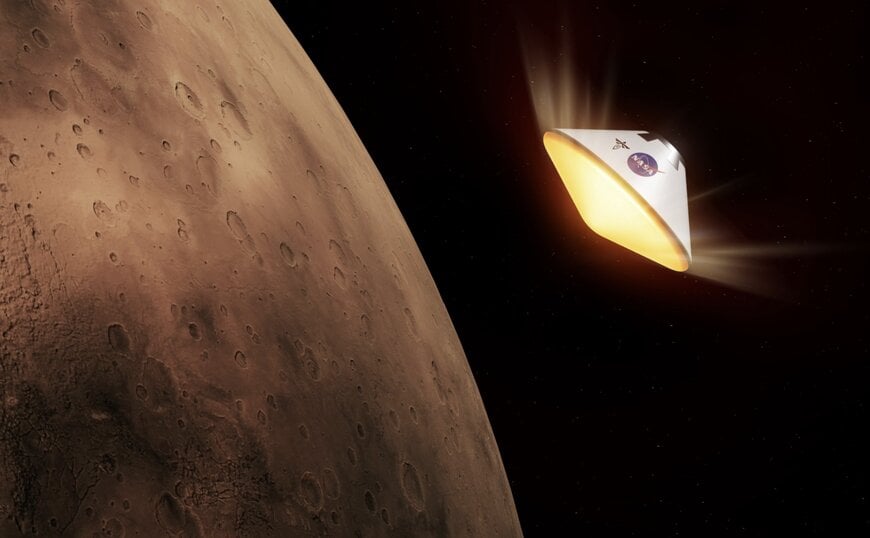
Firefly Aerospace and the NASA Jet Propulsion Laboratory (JPL) are collaborating to develop and implement a composite aeroshell system for the SkyFall Mars mission. This cooperation focuses on advanced spacecraft manufacturing to support the deployment of autonomous planetary rotorcraft for subsurface resource prospecting.
Collaborating Entities and Operational Context
NASA JPL manages the SkyFall mission, while Firefly Aerospace serves as the primary subcontractor under a 13 million USD agreement. The technical challenge involves delivering a protective entry vehicle capable of shielding three rotorcraft during atmospheric entry, descent, and landing operations. Cooperation is required to integrate JPL’s deployment systems with Firefly’s carbon composite manufacturing expertise, ensuring the structural integrity necessary for interplanetary transit.
Technical Solution and Responsibilities
The technical solution consists of an aeroshell architecture combining a backshell and a heatshield. Firefly Aerospace is responsible for utilizing carbon composite materials to produce high-strength, low-mass structures capable of withstanding the extreme thermal and kinetic stresses of Martian atmospheric entry. The aeroshell system is engineered to execute a mid-air release sequence, allowing the capsule to deploy the rotorcraft during descent and eliminating the need for a traditional surface landing platform. NASA JPL retains responsibility for the final integration of the helicopters and the internal deployment mechanisms.
Deployment and Implementation
Development and manufacturing occur at Firefly’s Gloworks laboratory and the Rocket Ranch facility in Briggs, Texas. The implementation phase includes structural qualification and flight acceptance testing at the Texas facility to simulate launch and entry environments. Following initial validation, the aeroshell will be delivered to NASA JPL for secondary environmental testing and integration with the helicopter payload.
Applications and Use Cases
The target application is planetary exploration and airborne subsurface mapping. The primary technical use case involves the mid-air deployment of three Mars helicopters to capture high-resolution surface imagery and subsurface radar data. The operational benefit of the mid-air release mechanism is a reduction in overall payload mass by removing standard lander hardware, thereby increasing the mass fraction available for scientific instrumentation to scout for water ice and analyze terrain formation.
Measurable Impact and Operational Results
The 13 million USD subcontract leverages existing carbon composite manufacturing processes derived from established lunar lander and orbital vehicle production lines. By isolating development within a dedicated innovation laboratory, Firefly Aerospace maintains continuous production of its primary spacecraft while providing NASA JPL with customized entry structures engineered to strict planetary protection and aerospace qualification standards.
Edited by Aishwarya Mambet, Induportals Editor, with AI assistance.
www.fireflyspace.com
