
www.aero-defence.tech
03
'26
Written on Modified on
Rheinmetall Secures Skynex Air Defense Contract
The company will supply four complete Skynex systems to an international customer over a 39-month execution period.
www.rheinmetall.com
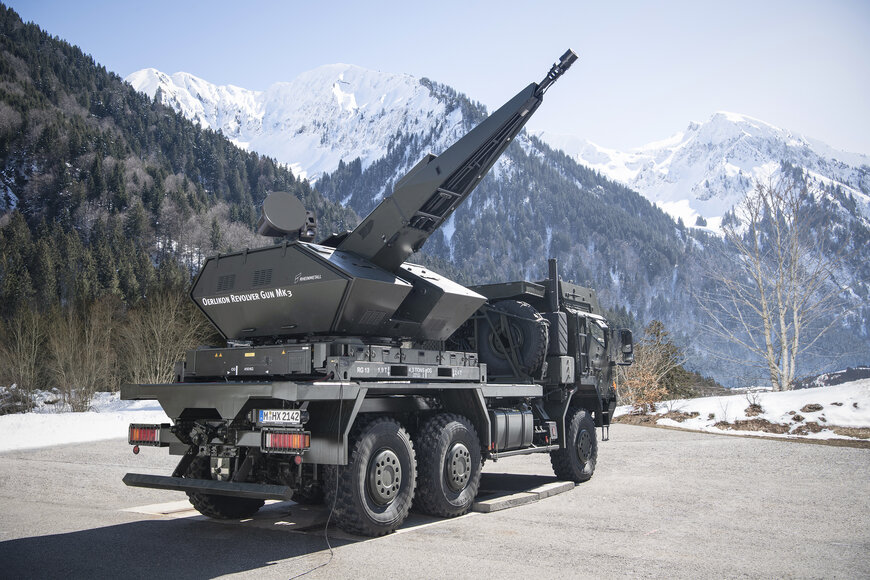
Rheinmetall has been awarded a contract for the delivery of four Skynex air defense systems. The order, booked in the second quarter of 2026, marks the first procurement of this gun-based system by this specific international client. The project will be led by Rheinmetall Italia, with support from subsidiaries including Rheinmetall Air Defence, Rheinmetall MAN Military Vehicles, and Rheinmetall Weapon and Munitions.
Contract Scope and Delivery Schedule
The agreement covers the supply of the complete weapon systems, including the integration platform and logistical support. The execution timeline spans 39 months, with a sequential delivery strategy:
- Initial Delivery: The first battery is scheduled for delivery 21 months after contract signature.
- Subsequent Deliveries: Remaining systems will be delivered at six-month intervals following the initial unit.
- Logistical Support: A comprehensive Integrated Logistic Support (ILS) package is included, covering spare parts, specialized tooling, training, and operational consumables.
Technical Capabilities of Skynex
The Skynex system is a gun-based solution engineered for very short-range air defense (VSHORAD). Its architecture is designed to address current and evolving aerial threats, specifically focusing on two primary operational domains:
The Skynex system is a gun-based solution engineered for very short-range air defense (VSHORAD). Its architecture is designed to address current and evolving aerial threats, specifically focusing on two primary operational domains:
- Counter-Unmanned Aerial Systems (C-UAS): Providing defense against small-to-medium drone swarms.
- C-RAM (Counter-Rocket, Artillery, and Mortar): Capable of intercepting incoming indirect fire projectiles, a critical requirement for modern ground-based protection.
Additional Context: Engineering challenges in gun-based VSHORAD
The primary technical challenge in gun-based air defense systems like Skynex lies in the "hit-to-kill" probability at very high engagement rates. Unlike missile-based systems that rely on proximity fuzing and large blast fragmentation, Skynex utilizes programmable air-burst ammunition. This requires an ultra-high-speed fire control system capable of calculating the interception point in real-time, accounting for the target’s ballistic trajectory and atmospheric variables. The Skynex architecture integrates a 35mm Oerlikon Revolver Gun, which features a high rate of fire and sophisticated sensor fusion. The fire control unit (Oerlikon Skymaster) must process data from multiple 3D search sensors to identify small radar cross-section targets (such as drones) amidst clutter. The mechanical reliability of the weapon system is maintained through specialized logistical support, ensuring that the high-velocity firing components do not suffer from thermal fatigue during prolonged defensive operations.
Edited by Lekshman Ramdas, Induportals editor – adapted by AI.
www.rheinmetall.com
The primary technical challenge in gun-based air defense systems like Skynex lies in the "hit-to-kill" probability at very high engagement rates. Unlike missile-based systems that rely on proximity fuzing and large blast fragmentation, Skynex utilizes programmable air-burst ammunition. This requires an ultra-high-speed fire control system capable of calculating the interception point in real-time, accounting for the target’s ballistic trajectory and atmospheric variables. The Skynex architecture integrates a 35mm Oerlikon Revolver Gun, which features a high rate of fire and sophisticated sensor fusion. The fire control unit (Oerlikon Skymaster) must process data from multiple 3D search sensors to identify small radar cross-section targets (such as drones) amidst clutter. The mechanical reliability of the weapon system is maintained through specialized logistical support, ensuring that the high-velocity firing components do not suffer from thermal fatigue during prolonged defensive operations.
Edited by Lekshman Ramdas, Induportals editor – adapted by AI.
www.rheinmetall.com
