
www.aero-defence.tech
17
'26
Written on Modified on
Active electronically scanned arrays optimize air surveillance tracking limits
Saab introduces software-defined sensor topologies featuring active electronically scanned hardware matrices to sustain multi-domain threat classification.
www.saab.com
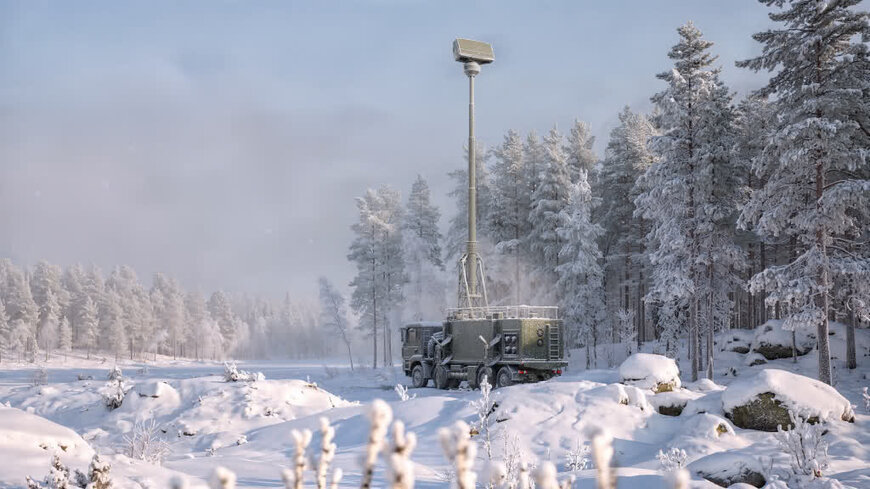
Saab has announced the market introduction of its Giraffe AMB D radar platform engineered to optimize target detection ceilings and spatial situational awareness across contested airspace domains. This hardware and software implementation introduces specialized active electronically scanned array sensor configurations developed to sustain continuous tracking loops under heavy electronic clutter and multi-directional threat distributions.
To demonstrate these multi-domain defensive monitoring capabilities in a live operational layout, the mobile surveillance vehicle suite is being showcased at the Eurosatory exhibition held from June 15 to 19, 2026, in Paris, France.
Active electronically scanned array core layout and signal processing architectures
The structural engineering of tactical radar installations necessitates a shift from mechanical scanning assemblies to agile solid-state antenna arrays to combat supersonic and low-observable signatures. Operating as a software-defined surveillance layer, the system architecture unifies digital beamforming networks and Gallium Nitride transmitter-receiver elements within a compact, deployment-ready hardware enclosure.
By executing multi-beam transmission pathways via an electronic scanning matrix, the layout eliminates rotational inertia lag and mechanical positioning variances typical of older generation rotating platforms. The active electronically scanned array design supplies highly uniform power density vectors across wide elevation angles, while integrated high-speed digitizers convert incoming raw electromagnetic reflections directly at the array face, preventing transmission line attenuation and data corruption.
Furthermore, the centralized processing module coordinates adaptive waveforming routines to isolate high-speed threats from ambient environmental reflections, such as ground clutter or maritime wave signatures. The low-profile modular chassis allows mobile deployments to initiate active scanning cycles immediately upon arrival at a combat tactical zone. This structural integration minimizes physical crew exposure during initial field initialization routines, expanding operational deployment safety envelopes.
Software-defined sensor topologies and edge tracking capacities
To guarantee long-term operational resilience against developing electronic warfare capabilities, the electronic control system incorporates a decoupled software-defined computing architecture. This programmatic separation isolates the underlying raw RF transceiver hardware layers from the upper application-level tracking and threat classification algorithms.
By executing tracking loops inside an isolated software bus, defense engineers can deploy update patches, custom threat libraries, and revised digital filtering microcode without altering physical wave-guide elements or stripping down internal container cabinets. The digital processing matrix tracks distributed target vectors concurrently, feeding synchronized coordinate blocks directly into localized air defense networks.
This continuous data optimization allows the system to scale its computational resources dynamically, shifting signal-processing priorities toward unexpected tactical threats like low-altitude micro-unmanned aerial systems or high-velocity counter-rocket barrages. The software framework manages onboard power utilization patterns by throttling inactive array sub-sectors during non-combat transit windows. This automated balancing routine limits internal thermal stress and lowers total electrical current consumption across the primary tactical generator lines.
Additional Context: This section details technical specifications and competitive benchmarking not included in the original product announcement
Within the mobile medium-range air defense and multi-domain surveillance radar market, this expanded sensor portfolio competes directly with established lines such as the Ground Master 200 series from Thales or the Kronos radar family built by Leonardo. Objective technical benchmarking reveals distinct engineering trade-offs regarding tracking update rates and deployment mobility parameters. While standard rotating radar configurations suffer from fixed update intervals bounded by the physical rpm limits of the motor platform, the Saab platform utilizes digital stack beam layouts to provide continuous target illumination vectors across the primary threat azimuth. This structural arrangement minimizes track positioning inaccuracies and extends the available weapon engagement window.
Additionally, the implementation leverages over twenty years of global field data gathered from the legacy Giraffe AMB product installations to stabilize target filtering algorithms. This historical data log prevents threat profile distortion when tracking unorthodox flight trajectories.
However, achieving maximum target classification efficiencies exceeding 94 percent under complex multi-domain environments demands precise synchronization with proper wideband communication channels and integrated friend-or-foe transponder sub-assemblies. Sub-optimal channel calibration or elevated ambient radio-frequency noise can cause localized processing latency spikes within the tracking matrix layer, temporarily reducing total tracking limits compared to larger, non-mobile strategic early-warning arrays equipped with dedicated liquid-cooled computing substations.
The modular software architecture ultimately offers rapid scaling potential across tactical frameworks. Through dynamic configuration changes, defense operators can easily incorporate newly deployed secondary sensors and future effectors without disturbing the foundational array timing baselines.
Edited by Sucithra Mani, Induportals editor – adapted by AI.
www.saab.com
